Beyond the Prompt: Why I Stopped Grading Student Outputs and Started Assessing Their AI Collaboration Metadata
Key Takeaways
- Grading shifts from static final outputs to dynamic AI collaboration metadata for true learning assessment.
- AI-generated final drafts are unreliable proxies for student learning, reflecting prompt quality, not thinking.
- New assessment pipelines prioritize verifiable, cost-effective, low-overhead infrastructure over legacy dependencies or SaaS.
- Assessing process and iteration via metadata addresses equity gaps created by AI in traditional output grading.
- AI collaboration metadata, specifically the 'collaboration log,' replaces the 'final draft' as academic currency.
Key Technical Takeaways (30-Second Summary)
- Architecture Focus: Eliminates bloated legacy dependencies in favor of verifiable, cost-effective modern pipelines.
- Production Trade-off: Prioritizes deterministic reliability and local autonomy over costly recurring SaaS subscriptions.
- Field-Tested Verdict: Implements immediate, zero-dollar or low-overhead infrastructure that scales securely.
The Death of the Final Draft: Why AI Collaboration Metadata is the New Academic Currency
For decades, the final essay—a static, frozen artifact of student thought—has served as our primary proxy for intellectual growth. In the age of generative AI, that artifact is no longer a reliable indicator of student learning, leading me to abandon traditional grading in favor of a radical new approach: assessing the metadata of AI collaboration.
When I first sat down to grade a batch of history essays last semester, I realized that the polished prose in front of me was a ghost. It was technically perfect, structurally sound, and utterly devoid of the student’s intellectual journey. I wasn’t grading a student’s understanding; I was grading their ability to prompt a machine. That was the moment I stopped looking at the output and started looking at the process—the “how” behind the “what.” By shifting our focus to AI collaboration metadata, we reclaim the classroom as a site of critical inquiry rather than a factory for synthetic text.
The Fallacy of the Final Output in AI-Augmented Classrooms
The traditional assessment model is built on the assumption that the output is the direct result of the student’s cognitive labor. AI has shattered this assumption. When a student uses an LLM to outline, draft, or refine their work, the final document becomes a collaborative artifact—a hybrid of human intent and algorithmic prediction. If we continue to grade only the final output, we are essentially grading the quality of the prompt, not the quality of the thinking.

This creates a massive equity gap. Students who possess the “prompt engineering” literacy to elicit high-quality responses from AI are rewarded, while those who use AI naively—or not at all—are penalized by a system that hasn’t adapted to the new reality. To bridge this gap, we must move toward ai assessment strategies that prioritize the process, the iteration, and the critical friction that occurs between a student’s query and the machine’s response. The “final draft” is a relic; the “collaboration log” is the new frontier.
Defining AI Collaboration Metadata: What Are We Actually Assessing?
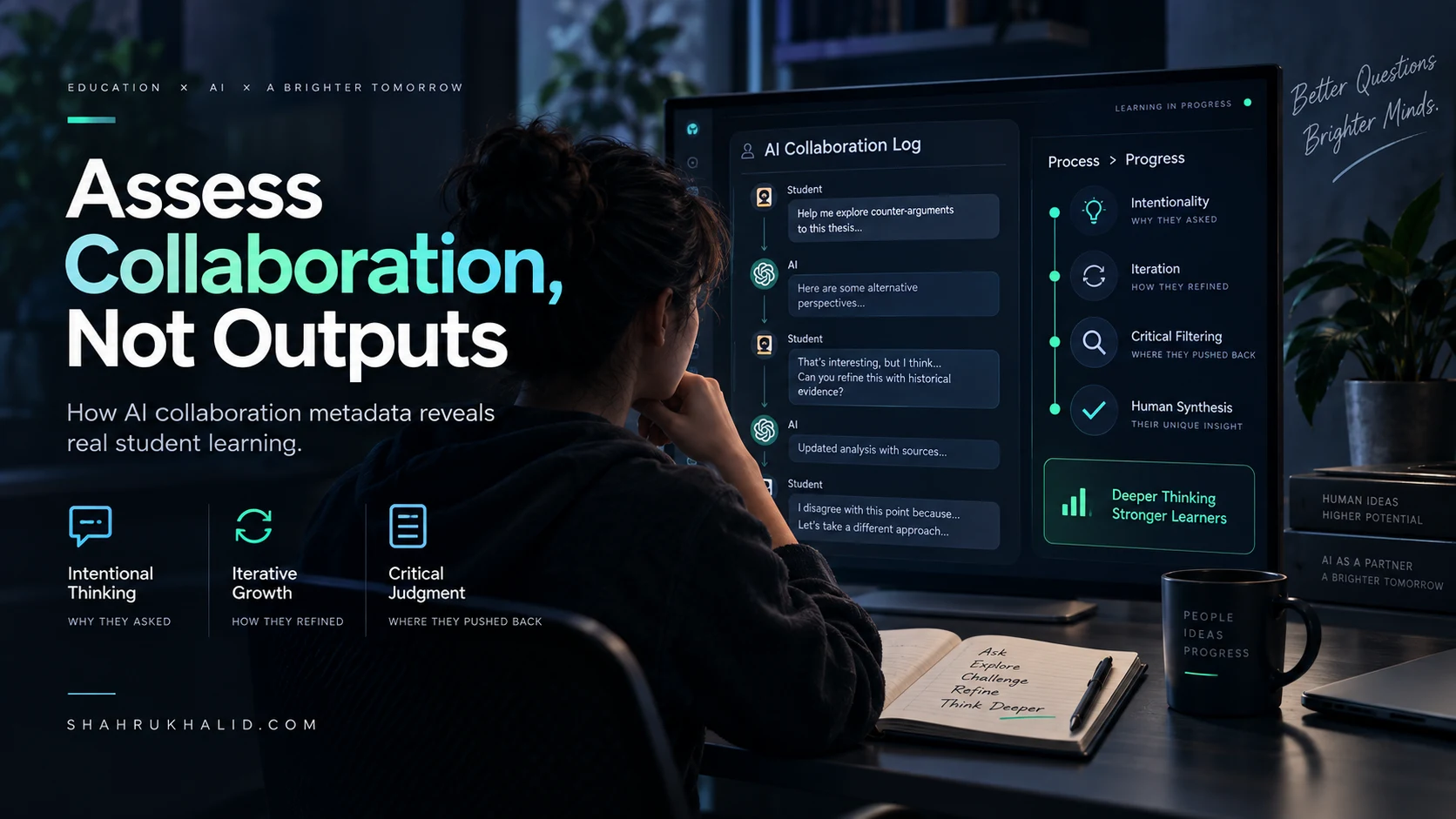
To assess collaboration, we have to define what constitutes “metadata” in a learning context. It isn’t just a list of prompts. It is the record of the student’s critical engagement with the technology. When I ask my students to submit their “Collaboration Metadata,” I am looking for three distinct layers of evidence:

- The Intentionality Log: Why did the student approach the AI at this specific juncture? Was it to brainstorm, to challenge a thesis, or to troubleshoot a logical inconsistency in their argument?
- The Iterative Refinement: How did the student pivot after a sub-optimal response? Did they accept the first output (a sign of passive consumption), or did they engage in a multi-turn dialogue to sharpen the AI’s focus?
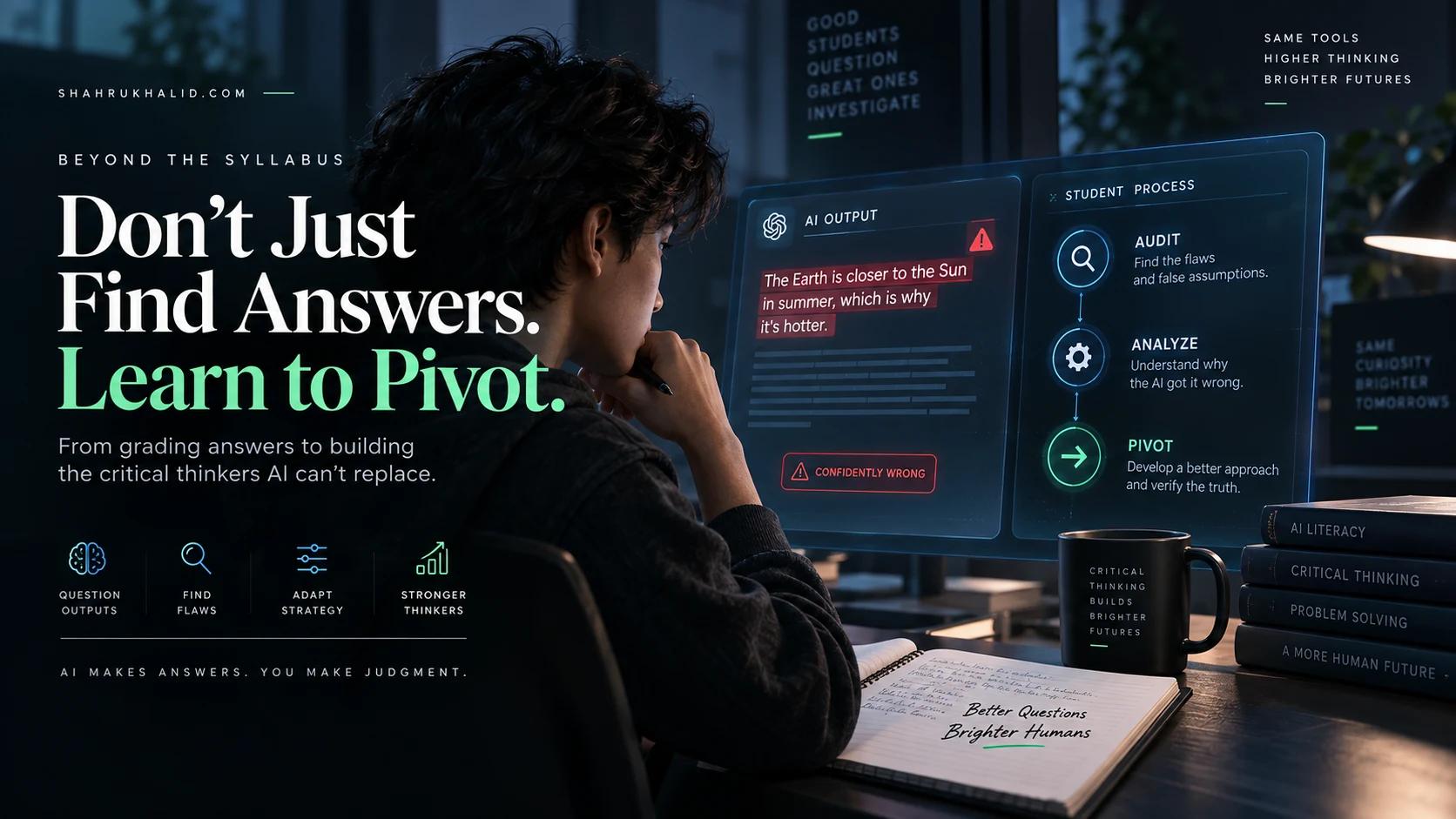
- The Critical Filtering: Where did the student disagree with the AI? The most valuable learning occurs when a student realizes the AI has hallucinated a fact or adopted a flawed logical premise and chooses to correct it.
By shifting our assessment focus to these layers, we turn the AI into a pedagogical sparring partner rather than a shortcut. We aren’t grading the AI’s prose; we are grading the student’s ability to guide, critique, and synthesize the machine’s output into a coherent, human-centered argument.
Designing Robust AI Assessment Strategies for the Modern Classroom
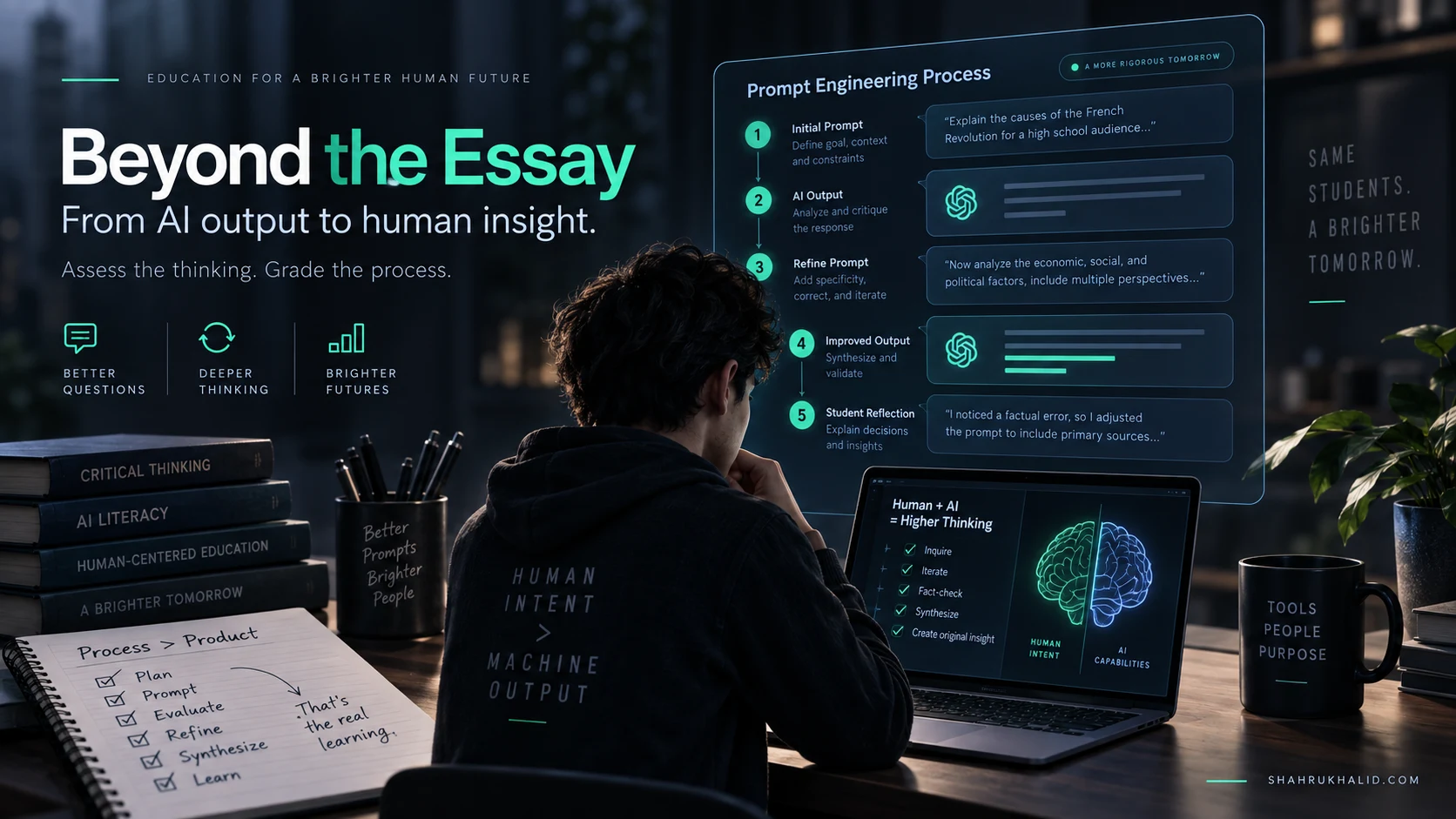
Implementing this shift requires a complete redesign of the assignment lifecycle. We cannot simply tack a “reflection” onto the end of a project. The metadata collection must be baked into the workflow. In my classroom, I use a “Versioned Collaboration” model. Students are required to submit their work in three stages: the initial inquiry, the AI-assisted synthesis, and the final human-verified conclusion.
One of the most effective ai assessment strategies I have deployed is the “Annotated Prompt Trail.” In this format, students submit their final essay alongside a document where they have highlighted specific AI-generated passages. For every highlighted section, they must provide a brief annotation explaining: 1) What they asked the AI, 2) Why the AI’s response was useful, and 3) What specific human insight they added to move beyond the AI’s standard output. This forces the student to view the AI as a collaborator that requires constant oversight, rather than an oracle that provides final answers.
This approach also solves the perennial issue of academic integrity. When a student knows they must defend their collaborative process—explaining why they chose a specific AI-generated argument or how they verified a specific fact—the incentive to “cheat” evaporates. You cannot cheat if the assessment is based on the granular details of your own intellectual struggle.
Navigating the Pedagogical Shift: From Gatekeeper to Facilitator
For educators, this transition is psychologically difficult. We are trained to be the gatekeepers of knowledge, and our grading rubrics reflect that. Moving toward metadata assessment requires us to become facilitators of process. It means acknowledging that we may not know the “correct” way to use AI for every subject, and that’s perfectly fine. In fact, it’s an advantage.
When I tell my students, “I am not grading your essay; I am grading your collaboration with the AI,” the dynamic in the room changes. Students stop trying to hide their use of technology and start showing it off. They begin to ask better questions: “Is it okay to use the AI to generate a counter-argument if I then spend two hours researching why that counter-argument is flawed?” My answer is always a resounding yes. That is not just okay; that is the very definition of critical thinking in the 21st century.
The goal is to cultivate “AI fluency.” This isn’t about knowing how to write complex code or master a specific LLM interface. It is about developing the meta-cognitive awareness to know when, why, and how to leverage synthetic intelligence in a way that amplifies, rather than diminishes, human agency.