Cracking the IB Code: Your 2026 Student Guide to InThinkings Exam Prep Power in International Schools

This isn’t just another study guide. This is your masterclass. Over the next two years, you’re going to embark on one of the most challenging and rewarding academic journeys of your life: the International Baccalaureate Diploma Programme. It’s a marathon, not a sprint, and success isn’t just about being smart; it’s about being strategic. It’s about understanding the “code” of the IB—its language, its expectations, and its structure. And that’s exactly what we’re going to do together. We’re going to crack that code, using the incredible power of InThinking as our key. So, grab a coffee, get comfortable, and let’s begin your journey to acing the IB.
Comprehensive Foundations & Concept Primer for Your IB Exam Prep Journey

Before we dive into the deep end of digital tools and study workflows, let’s take a moment to zoom out. You’ve probably heard a dozen different descriptions of the IB Diploma Programme, from “the hardest thing you’ll ever do” to “your golden ticket to university.” The truth, as it often is, lies somewhere in the middle. I want to give you a clear, jargon-free foundation, a mental map you can refer back to throughout your journey.
What is the IB Diploma Programme? An Analogy
So, what is the IB Diploma Programme? At its core, the IB DP is an intensive two-year program for students aged 16 to 19. The official definition from the IBO (the International Baccalaureate Organization, whose site at `ibo.org` is the ultimate source of truth) talks about developing students who have excellent breadth and depth of knowledge. But let’s cut through the official language.
I like to think of the IB Diploma Programme as an intellectual triathlon.
- The Swim (Your Six Subjects): This is the foundation. You have to choose six subjects from different groups—your languages, social sciences, experimental sciences, and mathematics. Three are at Higher Level (HL), and three are at Standard Level (SL). This is the breadth and depth the IBO talks about. The swim is long and requires endurance. You can’t just be good at one stroke; you need versatility. You have to be a scientist, a historian, a mathematician, and a literary critic, all at the same time.
- The Bike (The DP Core: EE, TOK, CAS): This is the grueling, long-distance middle section that truly separates the dedicated from the casual participants. It consists of three mandatory components:
- The Extended Essay (EE): A 4,000-word independent research paper on a topic of your choice. It’s your first taste of university-level academic work.
- Theory of Knowledge (TOK): A course that asks you to reflect on the nature of knowledge itself. It’s not about what you know, but how you know it. It’s the philosophical glue that binds your six subjects together.
- Creativity, Activity, Service (CAS): A range of experiences you undertake alongside your academic work. It’s about becoming a well-rounded, engaged person, not just a grade-generating machine.
- The Run (The Final Exams): This is the final sprint to the finish line. In May of your second year (so, for you, the IB 2026 exams will take place in May 2026, though you should always confirm the final schedule on `ibo.org`), you’ll sit for a series of high-stakes written examinations that count for the majority of your final score. This is where all your training pays off.
Why is this analogy important? Because it shows that you can’t just focus on one part. You can’t be a brilliant swimmer but fail to get on the bike. You need a holistic training plan. And that’s where effective IB exam prep becomes more than just last-minute cramming; it becomes a two-year lifestyle.
Why InThinking is Your Secret Weapon for 2026
Now, where does InThinking fit into this? In my role, I analyze how schools integrate various educational platforms into their campus technology stack. I’ve seen schools use everything from sprawling Student Information Systems like Rediker’s AdminPlus to manage student data, to bespoke learning platforms. As Shahrukh Khalid often emphasizes on his platform (`shahrukhalid.com`), the key isn’t just having the technology, but integrating it into a coherent pedagogical strategy.
InThinking is, in my professional opinion, one of the most powerful and well-integrated resources designed by IB teachers and examiners, for IB students. It’s not a generic study tool; it’s a platform that speaks the IB’s language fluently.
Think of it this way: If the IB is a complex piece of code, then your textbook is like a user manual—useful, but dry and sometimes hard to follow. InThinking, on the other hand, is like having the source code itself, fully commented by the original developers. It shows you not just what to learn, but how the IB wants you to think, write, and problem-solve. It decodes the assessment objectives, command terms, and markschemes that are the hidden syntax of every IB exam.
For the 2026 cohort, this is more critical than ever. The educational landscape is still settling from the shifts of the early 2020s. Digital literacy is no longer a bonus; it’s a prerequisite. The ability to navigate high-quality digital resources, self-direct your learning, and synthesize information from multiple online sources is precisely what the IB aims to foster. Mastering InThinking isn’t just about IB score improvement; it’s about building the skills you’ll need for university and beyond. It’s your training ground for becoming an independent, digitally-native scholar.
In the following modules, we’re going to move from the ‘what’ and ‘why’ to the ‘how’. We’ll set up your digital environment, build a workflow, and walk through practical examples. But for now, just let this sink in: The IB is a challenge, but it’s a solvable one. You have the race to run, and with InThinking, you have a world-class coach and a detailed race plan right at your fingertips.
Prerequisites & Complete Environment Setup
Alright, let’s get our hands dirty. A brilliant strategy is useless without the right setup. An athlete wouldn’t show up to the triathlon with a flat tire, and you shouldn’t start your IB journey with a disorganized digital life. This module is all about building your “base camp”—the physical, digital, and mental environment that will support your climb up the IB mountain. This is a step-by-step guide, so follow along and do it now, not later. Trust me, your future self will thank you.
Your Digital Cockpit: Accessing and Configuring InThinking
First things first: you need to get access to InThinking. This isn’t a public website you can just sign up for. It’s a premium resource that your school subscribes to. Here’s how the process typically works and how you can ensure you’re set up correctly.
Step 1: Understand Your School's Tech Ecosystem
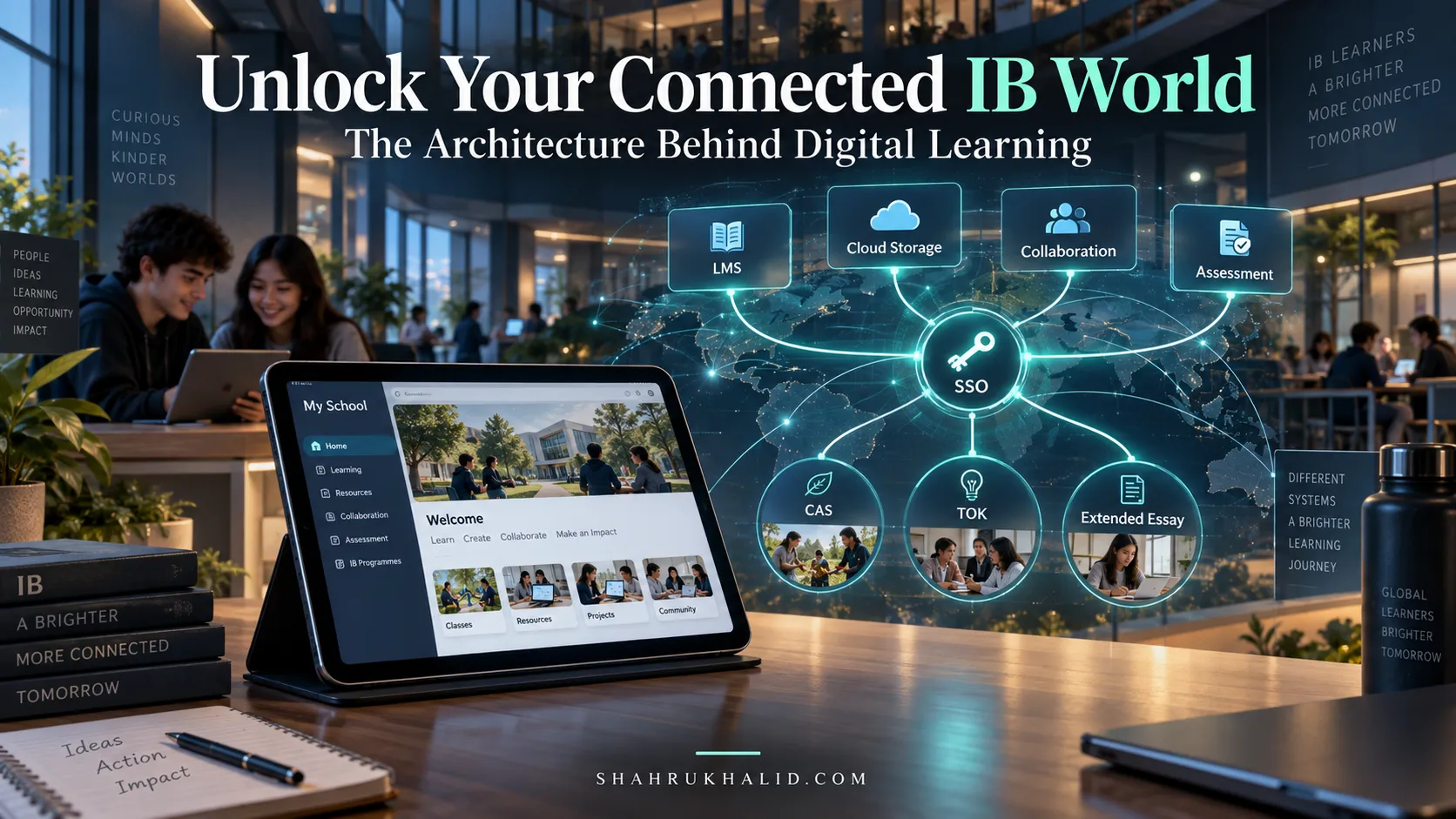
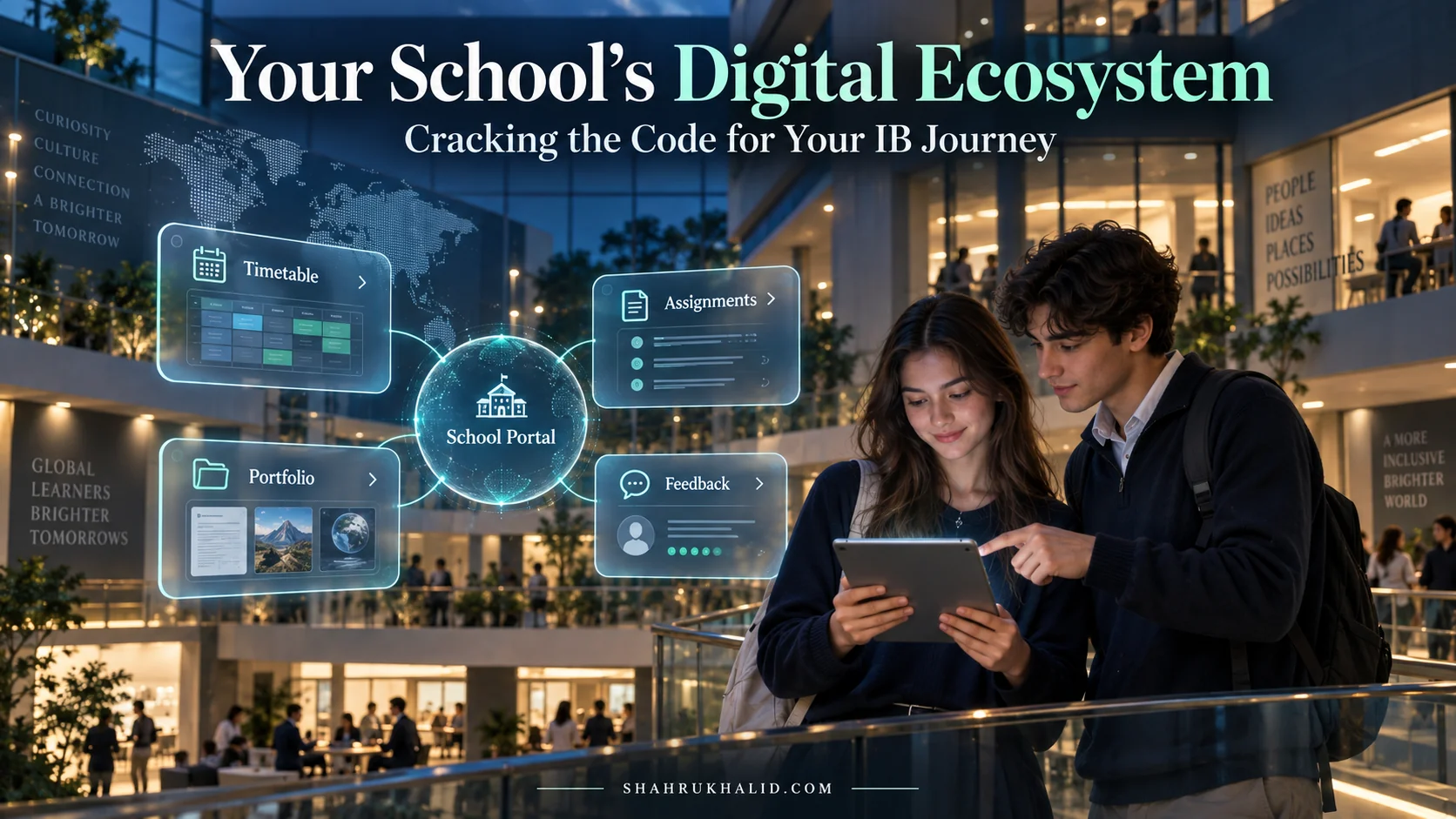
Your school has a system for managing everything. My work often involves mapping these systems, and they usually revolve around a central Student Information System (SIS). Many international schools use platforms like Rediker’s AdminPlus, which you might know as the portal where you check your grades or attendance. As noted on `rediker.com`, these systems are the central hub for student data and communication.
Why does this matter to you? Because your school’s IT department or your IB Coordinator likely uses this system to manage access to other educational tools, including InThinking. The link and your login details might be waiting for you in that very portal.
Action Item
- Log into your school’s main student portal (whatever you use to check grades or announcements).
- Look for a section named “IB Resources,” “Class Links,” “Digital Textbooks,” or something similar.
- Find the link for InThinking. If you can’t find it, don’t panic.
Step 2: The IB Coordinator is Your Best Friend
If you can’t find the link, your next stop is your school’s IB Diploma Programme Coordinator. This person is the master of all things IB at your school. They are your guide, your advocate, and the keeper of the keys to resources like InThinking.
Action Item (if needed)
- Send a polite email to your IB Coordinator. Here’s a template:
Subject: Inquiry about InThinking Access – [Your Name], Grade 11
Dear [Coordinator’s Name],
I hope you’re well.
As I begin my Diploma Programme journey, I’m eager to set up my study resources. I understand our school provides access to InThinking, which I believe will be a key part of my IB exam prep.
Could you please let me know the best way to access the platform and if there are any specific login credentials I need?
Thank you for your support.
Best regards,
[Your Name]
2026 IB Cohort
Step 3: First Login and Dashboard Familiarization
Once you have your login details, it’s time to enter the cockpit.
- Go to the InThinking subject site you need (e.g., `thinkib.net/chemistry`, `thinkib.net/englishalangandlit`, etc.). Note: The exact URL will be provided by your school.
- Enter your username and password.
- Verification: You’re in! You should see a dashboard that looks something like a textbook’s table of contents, but interactive. You’ll see sections for the SL/HL Core, AHL (Additional Higher Level) topics, Options, and crucially, sections on the Internal Assessment (IA) and Extended Essay (EE).
- Take 15 minutes. Don’t try to learn anything yet. Just click around. Get a feel for the layout. Where are the study guides? Where is the question bank? Where are the exam-style papers? This initial exploration is about reducing the “cognitive load” later, so the platform feels familiar when you’re under pressure.
Structuring Your Digital Filing Cabinet
This is one of the most impactful, five-minute changes you can make to your student life. Do not, I repeat, do not just dump everything into your “Downloads” or “Documents” folder. We’re going to create a directory structure that mirrors the IB and InThinking. This makes finding anything instantaneous.
Action Item: Create This Folder Structure NOW
On your computer’s hard drive or your preferred cloud service (Google Drive, OneDrive, Dropbox), create the following top-level folder:
`IB_DP_2026`
Inside this folder, create folders for the core and your six subjects:
- `00_DP_CORE`
- `01_Group1_Studies_in_Language_and_Literature`
- `02_Group2_Language_Acquisition`
- `03_Group3_Individuals_and_Societies`
- `04_Group4_Sciences`
- `05_Group5_Mathematics`
- `06_Group6_The_Arts`
Now, go into each folder and customize it. For example, inside `04_Group4_Sciences`, you’d create a folder for your specific science subject:
`IB_DP_2026` -> `04_Group4_Sciences` -> `Physics_HL`
Finally, within each subject folder, create sub-folders that mirror the InThinking/IB syllabus topics. For example, inside `Physics_HL`:
- `Topic_1_Measurements_and_Uncertainties`
- `Topic_2_Mechanics`
- `Topic_3_Thermal_Physics`
- `…and so on.`
- `IA_Internal_Assessment`
- `Exam_Prep_and_Past_Papers`
Why does this work? Because now, when you download a worksheet on Mechanics from InThinking or save your notes from class, you know exactly where it goes. You’ve created a digital library that is logical, searchable, and scalable for the next two years. You’ve just eliminated a massive future source of stress.
The Mental and Physical Environment
Your digital setup is clean. Now let’s talk about the analog world.
Physical Setup: You need a designated study space. It doesn’t have to be a huge, fancy desk. It can be a corner of your room. But it needs to be your space.
- The Rule of One: When it’s time for deep work on a subject, have only what you need for that one subject on your desk: your laptop (open only to InThinking and a document), your notebook, your textbook, and a pen. Everything else is a distraction.
- Ergonomics: You’re going to spend a lot of time here. Sit properly. Get a comfortable chair if you can. Your back will thank you in April 2026.
Mental Setup: The IB Learner Profile as Your Guide
The IBO publishes the “IB Learner Profile,” which lists ten attributes like Inquirers, Knowledgeable, Thinkers, Communicators, Principled, etc. Most students glance at this poster in their classroom and forget it. I want you to see it as your mental checklist for success.
Before a study session, ask yourself:
- “How can I be an Inquirer today?” (Maybe I’ll explore a ‘Going Further’ link on InThinking).
- “How can I be a Thinker?” (Instead of just reading the InThinking notes, I’ll try to connect this concept in Physics to something I learned in TOK).
- “How can I be Reflective?” (After I finish this practice quiz on InThinking, I’ll spend 5 minutes writing down what I got wrong and why).
By setting up your digital, physical, and mental environments with intention, you’re not just preparing to study. You are building the very infrastructure of your success in the IB Diploma Programme. You’ve laid the foundation. Now, let’s build the house.
Core Implementation Architecture & Workflow Blueprint

Welcome to Module 3. We’ve laid our foundation and set up our environment. Now, we start building the engine. This is where we move from “what is it?” to “how do I use it systematically?” Many students fail not because they lack intelligence, but because they lack a system. They treat studying as a series of random, frantic bursts. We’re not going to do that. We are going to build a repeatable, reliable workflow—an architecture for your learning—centered around the InThinking platform. This is the core of effective IB diploma program support.
The InThinking Ecosystem: A Visual Card Structure
First, let’s understand the architecture of InThinking itself. It’s not just a website with notes. It’s a multi-layered ecosystem. I want you to visualize each topic on InThinking (like “Topic 2: Cells” in Biology or “Topic 5: Trigonometry” in Maths) as a stack of interactive “Visual Cards.”
Here’s what that stack looks like, from top to bottom:
—
[Visual Card 1: The Dashboard]
- Purpose: High-level orientation.
- Content: A quick summary of the topic, key learning objectives from the official IB guide (`ibo.org` standards are baked right in), and links to the main sub-sections.
- Your Action: Read this first. It’s your 30-second briefing before you dive in. What is this topic about?
—
[Visual Card 2: The Study Notes]
- Purpose: Core knowledge delivery.
- Content: Detailed, well-written explanations of the concepts. This is your digital textbook, but better. It’s often interspersed with diagrams, short video clips, and links to relevant simulations. It’s written by experienced IB examiners, so the emphasis is always on what’s examinable.
- Your Action: This is your primary reading. But don’t just read passively. Take notes, highlight, and question what you’re reading.
—
[Visual Card 3: Worked Examples & Case Studies]
- Purpose: Bridging theory and application.
- Content: Step-by-step solutions to common problem types (in Maths/Sciences) or detailed analyses of texts/sources (in Humanities/Languages). This is pure gold.
- Your Action: Don’t just read the solution. Cover it up! Try the problem yourself first. Then, compare your process to theirs. Where did you differ? Why is their method more efficient?
—
[Visual card 4: The Practice Arena]
- Purpose: Active recall and self-assessment.
- Content: A mix of interactive quizzes, short-answer questions, and a full-blown Question Bank of past IB exam questions, sortable by topic. Each question is tied to the official markscheme.
- Your Action: This is where the real learning happens. Do the quizzes. Attempt the exam questions under timed conditions. This is non-negotiable.
—
[Visual Card 5: The “Going Further” & TOK Links]
- Purpose: Extension and interdisciplinary connection.
- Content: Links to interesting articles, further reading, advanced concepts (for the high-flyers), and—crucially—explicit links to Theory of Knowledge. For example, in a History topic, it might ask, “How does the perspective of the historian shape this narrative?”
- Your Action: You won’t use this card every time. But when you’re writing an essay, preparing for a TOK presentation, or working on your EE, this is your secret weapon for adding depth and sophistication to your work.
—
Understanding this “Visual Card” structure is key. It transforms InThinking from a wall of text into a dynamic, multi-layered tool you can navigate with purpose.
The Weekly Workflow Blueprint: A Study Cycle Grid
Now, let’s put those cards into a weekly cycle. This is your blueprint for a sustainable, low-stress approach to the IB. Forget 8-hour cram sessions. We’re aiming for consistent, focused, 60-90 minute blocks of work for each subject, integrated into your week.
I’ll lay this out as a grid, representing a typical workflow for a single subject topic that you’re covering in class that week.
| Phase | When to Do It | InThinking Tool to Use | Time | The “Why” (Pedagogy) |
| :— | :— | :— | :— | :— |
| 1. PRIMING | Night Before the Class | Visual Card 1: Dashboard | 10 mins | Flipped Learning: You’re pre-loading your brain. The concepts won’t be completely alien in class, so you can focus on your teacher’s deeper insights instead of just trying to keep up. |
| 2. ENGAGING | During Class | Visual Card 2: Study Notes | N/A | Active Listening: Have the relevant InThinking page open. As your teacher explains a concept, you can cross-reference, see a different diagram, or jot down questions in your own notebook based on what you see. |
| 3. CEMENTING | Day of the Class (Evening) | Visual Card 3: Worked Examples | 30 mins | Consolidation: This is the most critical phase. You’re closing the “forgetting curve.” You connect the theory from class to a practical application while it’s still fresh in your mind. |
| 4. TESTING | 2-3 Days After the Class | Visual Card 4: Practice Arena | 45 mins | Spaced Repetition & Active Recall: You’re forcing your brain to retrieve the information, not just recognize it. This is scientifically proven to build long-term memory. Use the quizzes and short-answer questions. |
| 5. REVIEWING | End of the Week (e.g., Sunday) | Your Own Notes + InThinking Summary | 15 mins | Synthesis: Quickly read through your own notes from the week and the InThinking topic summary. This helps your brain file the information away in your long-term memory as a coherent block. |
How this looks in practice
Let’s say on Monday in your IB Chemistry HL class, you’re starting Topic 10: Organic Chemistry.
- Sunday Night (Priming): You spend 10 minutes on InThinking Chemistry. You read the Topic 10 dashboard. You learn it’s about functional groups and reaction types. You’re now primed.
- Monday (Engaging): In class, your teacher talks about alkanes. You have the InThinking page on alkanes open. You see a 3D model of ethane that helps you visualize it.
- Monday Evening (Cementing): You spend 30 minutes going through the InThinking worked example on naming a complex branched alkane. You follow the IUPAC rules step-by-step.
- Wednesday Evening (Testing): You log back into InThinking and do the 10-question interactive quiz on “Alkanes and Alkenes.” You get 7/10. You review the 3 you got wrong, reading the markscheme explanations carefully.
- Sunday Afternoon (Reviewing): As part of your weekly review, you spend 5 minutes re-reading your notes on alkanes and the InThinking summary. You feel confident.
This isn’t a huge time commitment. We’re talking about maybe 90 minutes of focused, out-of-class work spread across the week for that one subject. But by following this blueprint, you are engaging with the material five times in five different ways. You’re not cramming; you’re learning. This is the architecture of success. This is how to improve IB exam scores 2026—not by magic, but by process.
Hands-on Practical Implementation & Real-World Configuration
Theory is great, but it’s in the application that we forge real understanding. In this module, we’re rolling up our sleeves and getting our hands dirty. We’re going to move beyond the blueprint and into the workshop. I’ll walk you through, step-by-step, how to apply the workflow from Module 3 to three