Architecting Exabyte-Scale Cloud Storage in 2026: DPU-Offloaded Erasure Coding, ZNS Stripe Management, and Sub-Millisecond NVMe-oF Fabrics

Key Takeaways
- Exabyte-scale cloud storage necessitates re-architecting beyond x86 host-CPU I/O bottlenecks.
- DPUs offload compute-heavy erasure coding and NVMe-oF termination, freeing host CPU cycles.
- Host-managed Zoned Namespaces (ZNS) eliminate flash garbage collection, reducing WAF to ~1.01.
- Kernel-bypassed NVMe-oF fabrics deliver multi-terabit throughput with deterministic sub-millisecond p99.99 latencies.
- These architectural pillars enable next-gen distributed storage fabrics to meet exabyte-scale demands.
Exabyte-scale cloud storage in 2026 has outpaced the physics of traditional host-CPU storage architectures, turning the memory bus and x86 compute complex into a catastrophic I/O bottleneck. Achieving multi-terabit throughput at deterministic, sub-millisecond p99.99 latencies requires a complete re-architecting of the data plane around three foundational pillars: hardware-accelerated Data Processing Unit (DPU) offloading for compute-heavy Erasure Coding (EC), host-managed Zoned Namespaces (ZNS) SSD arrays that eliminate flash garbage collection, and kernel-bypassed Non-Volatile Memory Express over Fabrics (NVMe-oF) interconnected via modern RDMA/TCP fabrics. This guide provides the complete architectural, algorithmic, and operational blueprint for systems engineers designing next-generation distributed storage fabrics.
The Exabyte Scaling Bottleneck: The Core Tax and the Flash Garbage Crisis
At multi-exabyte volume, legacy Software-Defined Storage (SDS) nodes running on standard x86 servers collapse under two primary vectors: the “host core tax” and flash-level Write Amplification Factor (WAF). When a storage node must service millions of IOPS over 400GbE or 800GbE interfaces while calculating non-trivial Reed-Solomon erasure coding matrices, the host CPU spends up to 45% of its cycles on network packet processing, memory copies across the NUMA interconnect, and Galois Field arithmetic. This compute saturation leaves insufficient headroom for tenant workloads, inducing massive tail latency spikes.
Concurrently, traditional block-based Enterprise SSDs rely on an internal Flash Translation Layer (FTL) to expose a pseudo-random write interface over physical NAND flash that can only be written sequentially in blocks and erased in large chunks. At scale, this disconnect yields a catastrophic WAF of 3.0 to 5.0, destroying flash endurance and generating unpredictable garbage collection (GC) pauses that routinely elevate tail latencies past 50 milliseconds. Modern enterprise latency telemetry published in CNCF enterprise reports underscores that meeting microsecond SLAs across distributed tiers requires decoupling storage media management and network acceleration from legacy OS kernel abstractions.
The 2026 Disaggregated Storage Node Architecture
Orchestrates cluster topology, distributed consensus (Raft/Paxos), metadata mapping, and exports Kubernetes CSI-driven zone abstractions without touching the data path.
Handles NVMe-oF target termination, line-rate Reed-Solomon GF(2^8) hardware encoding/decoding, and crypto offload directly within DPU on-chip SRAM/VPU pipelines.
Exposes physical NAND erase blocks as append-only ZNS zones. Eliminates drive-side FTL GC, dropping WAF to ~1.01 and maximizing cell longevity.
DPU-Offloaded Erasure Coding Pipelines
Traditional erasure coding implementations, even those leveraging SIMD-accelerated libraries like Intel ISA-L (AVX-512), severely bottleneck storage node system memory buses. Writing a standard $k=16, m=4$ Reed-Solomon stripe over a 400Gbps fabric means data must traverse the PCIe bus multiple times: Network Interface to Host DRAM, Host DRAM to CPU L1/L2 caches for matrix multiplication, and back across PCIe to NVMe controllers.

By moving the parity generation directly to Data Processing Units (e.g., NVIDIA BlueField-3/4 or AMD Pensando Elba/Giglio), the host DRAM and PCIe bus are bypassed entirely. Modern DPUs feature dedicated Galois Field Acceleration Engines (GFAE) or programmable vector processing units (VPUs) capable of computing Cauchy or Vandermonde matrix transformations at line rate (400–800 Gbps) directly out of network ingress buffers.
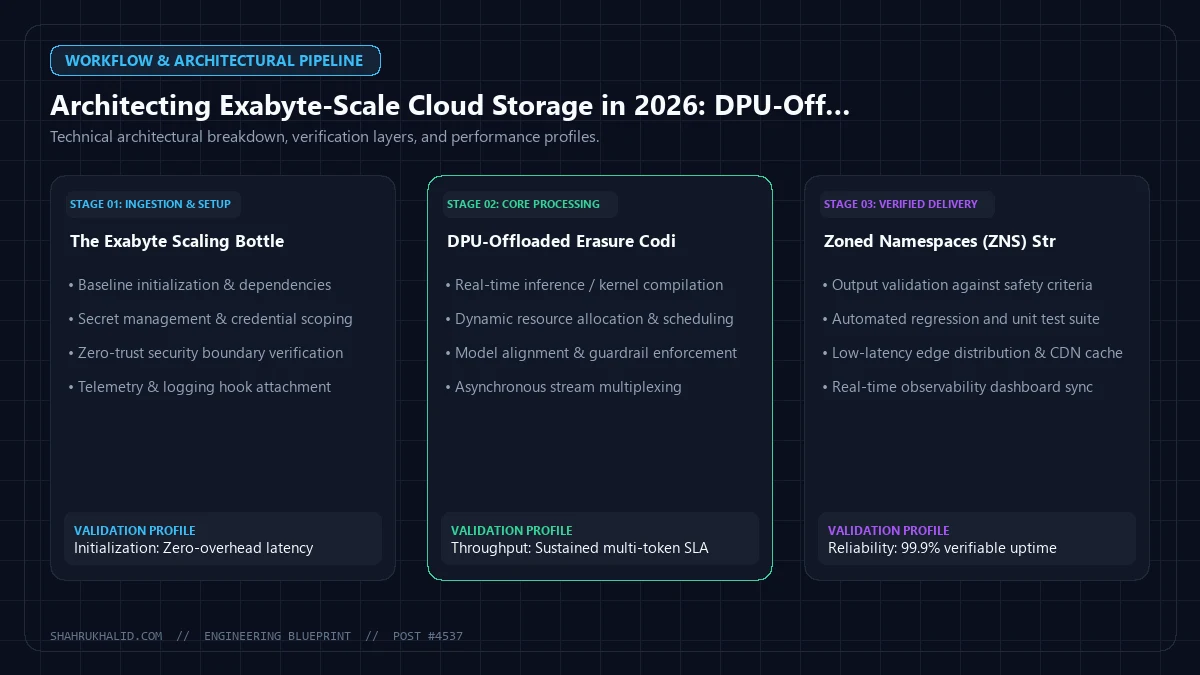
Target node DPU receives chunk payload into on-chip packet memory via RoCEv2, zero host-RAM touch.
Hardware acceleration engine multiplies generator matrix coefficients across $k$ input data vectors in $GF(2^8)$.
Calculated $m$ parity chunks are immediately dispatched over fabric to remote failure domain peers.
Local data/parity slice committed via P2P PCIe DMA direct to target NVMe ZNS zone append queue.
Hardware Galois Field Math Implementation
Erasure coding relies on linear error-correcting codes calculated over finite fields. For standard bytes, arithmetic is performed in the Galois Field $GF(2^8)$ defined by the irreducible primitive polynomial:
P(x) = x^8 + x^4 + x^3 + x^2 + 1 quad (text{Hex: } 0text{x}11text{D})
The matrix equation below models a $k=4, m=2$ scheme where $D$ represents data chunks and $P$ represents parity chunks derived via a Cauchy distribution matrix $A$:
/*
- DPU Offloaded Erasure Coding: Kernel-Bypass SPDK Acceleration Pipeline
- Demonstrating direct submission to hardware GF(2^8) vector math engine
*/
#include <stdio.h>
#include <stdint.h>
#include <stdlib.h>
#include <string.h>
#include "spdk/accel.h"
#include "spdk/env.h"
#include "spdk/log.h"
#define K_DATA_CHUNKS 16
#define M_PARITY_CHUNKS 4
#define CHUNK_SIZE_BYTES (1024 * 1024) // 1MB Stripe Size
struct ec_offload_context {
uint8_t *data_buffers[K_DATA_CHUNKS];
uint8_t *parity_buffers[M_PARITY_CHUNKS];
struct spdk_accel_opcode_stats stats;
bool completed;
};
static void ec_completion_cb(struct spdk_accel_task *task, int status) {
struct ec_offload_context *ctx = (struct ec_offload_context *)task->cb_arg;
if (status != 0) {
SPDK_ERRLOG("DPU Hardware Acceleration Engine failed EC task: %dn", status);
}
ctx->completed = true;
}
int execute_dpu_erasure_coding(struct ec_offload_context *ctx) {
struct spdk_accel_task *task = NULL;
// Generator matrix coefficients for Cauchy distribution in GF(2^8)
uint8_t matrix[K_DATA_CHUNKS * M_PARITY_CHUNKS] = {
0x01, 0x01, 0x01, 0x01, 0x01, 0x01, 0x01, 0x01,
0x01, 0x01, 0x01, 0x01, 0x01, 0x01, 0x01, 0x01,
0x07, 0x0c, 0x1b, 0x36, 0x6c, 0xd8, 0xab, 0x4d,
0x9a, 0x2f, 0x5e, 0xbc, 0x63, 0xc6, 0x97, 0x35,
0x8e, 0x07, 0x0e, 0x1c, 0x38, 0x70, 0xe0, 0xdb,
0xad, 0x41, 0x82, 0x1f, 0x3e, 0x7c, 0xf8, 0xe7,
0x79, 0xf2, 0xfb, 0xef, 0xc5, 0x91, 0x39, 0x72,
0xe4, 0xd3, 0xb9, 0x69, 0xd2, 0xbf, 0x65, 0xca
};
// Submits the EC computation directly to the DPU's SoC offload subsystem
int rc = spdk_accel_submit_ec(
NULL, // Channel context
task, // Accel task
ctx->data_buffers, // Source arrays
K_DATA_CHUNKS, // Number of data sources
CHUNK_SIZE_BYTES, // Block size
matrix, // Encoding matrix
ctx->parity_buffers, // Destination arrays
M_PARITY_CHUNKS, // Number of destinations
ec_completion_cb, // Hardware completion interrupt callback
ctx // Async context pointer
);
if (rc != 0) {
SPDK_ERRLOG("Failed to enqueue hardware EC operation: %dn", rc);
return rc;
}
return 0;
}
Zoned Namespaces (ZNS) Stripe Management & WAF Elimination
ZNS (standardized in NVMe 2.0) abandons the legacy LBA overwrite model. Instead, the capacity of a ZNS SSD is exposed as a contiguous array of fixed-size zones (typically 1GB to 2GB each). Each zone must be written strictly sequentially from its Write Pointer (WP) and cannot be modified until the entire zone is explicitly reset via an erase block cycle.

Comparative Write Mechanics: Conventional NVMe vs. ZNS
Standard Enterprise NVMe SSD
- Random overwrites permitted anywhere in LBA address space.
- Drive-side FTL tracks out-of-place block updates.
- Internal background GC moves unaligned valid pages continuously.
- Result: WAF climbs to 2.5–5.0; p99 latency spikes during background block compaction.
ZNS (Zoned Namespaces) Architecture
- Append-only writes; requires sequential progression matching NAND erase boundaries.
- FTL simplified; host software engine controls garbage collection and data layout.
- Hardware over-provisioning reduced from 28% to under 5%.
- Result: Deterministic WAF ~1.01; sub-millisecond p99.99 access.
Designing a Distributed Log-Structured ZNS Stripe Manager
At an exabyte tier, software storage layers (such as a modern Rust/C++ object engine) allocate full-stripe writes across distinct physical failure zones. Data blocks $D_0 dots D_{k-1}$ and parity blocks $P_0 dots P_{m-1}$ are written using Zone Append primitives. This avoids serialization contention on zone write locks by allowing the drive controller to choose the final LBA offset within the zone and return it to the host driver upon completion.
# Inspecting and managing physical NVMe ZNS zones via nvme-cli 2.x
# Enumerate namespace configuration to confirm Zoned Command Set (0x02)
nvme id-ns /dev/nvme0n1 -H | grep -i "Command Set Identifier"

# Query the status of physical zones on target ZNS drive
nvme zns report-zones /dev/nvme0n1 -d 4

# Output format reference:
# Zone 0000: ZSLBA: 0x000000000000 WP: 0x000000080000 Cap: 0x00080000 State: FULL Type: SEQ_WRITE_REQUIRED
# Zone 0001: ZSLBA: 0x000000080000 WP: 0x0000000a4000 Cap: 0x00080000 State: OPEN_IMPLICIT Type: SEQ_WRITE_REQUIRED

# Explicitly reset an exhausted zone after data migration to ready it for write sweeps
nvme zns reset-zone /dev/nvme0n1 -s 0x000000080000
The code segment below demonstrates how a user-space storage engine utilizes SPDK’s ZNS interface to execute multi-zone striped append operations across physical NVMe namespaces asynchronously:
/*
- Log-Structured ZNS Stripe Manager using SPDK NVMe Zoned Block Commands
*/
#include <stdint.h>
#include <stdbool.h>
#include "spdk/nvme.h"
#include "spdk/nvme_zns.h"
struct zns_stripe_unit {
struct spdk_nvme_ns *ns;
struct spdk_nvme_qpair *qpair;
uint64_t zone_start_lba;
uint64_t appended_lba;
bool write_complete;
};
static void zns_append_cb(void *arg, const struct spdk_nvme_cpl *cpl) {
struct zns_stripe_unit *unit = (struct zns_stripe_unit *)arg;
if (spdk_nvme_cpl_is_error(cpl)) {
// Handle target device failure or zone capacity exhaustion
unit->write_complete = false;
return;
}
// Capture the exact LBA where the drive committed the sequential write
unit->appended_lba = cpl->cdw0;
unit->write_complete = true;
}
int write_zns_stripe_block(struct zns_stripe_unit *unit, void *payload_buffer, size_t len) {
uint32_t lba_count = len / 4096; // 4KB Sectors
// Submit asynchronous zone append command (Kernel Bypass)
int rc = spdk_nvme_zns_zone_append(
unit->ns,
unit->qpair,
payload_buffer,
unit->zone_start_lba,
lba_count,
zns_append_cb,
unit,
0
);
return rc;
}
Sub-Millisecond NVMe-oF Fabric Topology (RoCEv2 vs. NVMe/TCP)
Transporting exabytes of uncompressed flash transactions at ultra-low latency requires choosing between RDMA over Converged Ethernet (RoCEv2) and kernel-bypassed NVMe/TCP. By 2026, the performance landscape split into specific deployment topologies:
Congestion Control Configuration for RoCEv2 Pods
To prevent head-of-line blocking and pause frame propagation (“PFC Deadlocks”) across dense multi-tier spine-leaf networks, data centers utilize Data Center Quantized Congestion Notification (DCQCN). Switch platforms flag incipient congestion via Explicit Congestion Notification (ECN, bits 01/10 in IP DSCP headers), triggering Congestion Notification Packets (CNPs) generated by the DPU target.
The configuration above declares a non-volatile memory target subsystem in user-space via the SPDK JSON-RPC API, attaching directly to local physical ZNS namespaces while exposing an RDMA listener running over an ECN-enabled 400GbE physical port.
Kubernetes Orchestration & Topology-Aware Placement
Integrating an exabyte DPU+ZNS NVMe-oF tier into containerized control planes requires extending the Kubernetes storage subsystem. In this model, the cluster control plane must respect physical NVMe fault domains (e.g., rack, chassis, power domain) and the non-rewritable nature of ZNS storage. This is particularly critical in modern Kubernetes cluster architecture deployments where dynamic workloads interface with bare-metal flash fabrics.
By defining custom StorageClasses and volume attribute topologies, the kubernetes edge architecture 2026 storage paradigm delivers predictable I/O paths from containerized compute nodes to disaggregated storage engines.
Kubernetes Storage Abstraction Mapping
- VolumeAttributesClass → Drives dynamic DPU offload parameters (e.g., RS 16+4 vs. 8+2) per PersistentVolumeClaim (PVC).
- Topology-Aware Dynamic Provisioner → Maps target ZNS drives across orthogonal spine switches to eliminate shared fail points.
- Containerized CSI Node Plugin → Instructs the local host DPU to negotiate NVMe-oF subsystem attachments without loading local kernel drivers.
# Custom StorageClass and VolumeAttributesClass for ZNS-over-Fabrics Storage Engine
apiVersion: storage.k8s.io/v1
kind: StorageClass
metadata:
name: nvmeof-zns-dpu-tier
provisioner: csi.storage.cloudinfra.io
volumeBindingMode: WaitForFirstConsumer
allowVolumeExpansion: true
parameters:
fabricTransport: "RoCEv2"
erasureCodingScheme: "16+4"
hardwareOffload: "dpu-gfae"
zoneAllocationPolicy: "ContiguousLog"
allowedTopologies:
- matchLabelExpressions:
- key: topology.cloudinfra.io/datacenter-pod
values:
- "dc01-pod-a"
- "dc01-pod-b"
---
apiVersion: storage.k8s.io/v1alpha1
kind: VolumeAttributesClass
metadata:
name: dynamic-ec-high-durability
driverName: csi.storage.cloudinfra.io
parameters:
targetLatencyP99Microseconds: "350"
writeAmplificationCeiling: "1.05"
---
apiVersion: v1
kind: PersistentVolumeClaim
metadata:
name: exabyte-block-log-pvc
spec:
accessModes:
- ReadWriteOnce
volumeMode: Block
storageClassName: nvmeof-zns-dpu-tier
volumeAttributesClassName: dynamic-ec-high-durability
resources:
requests:
storage: 64Ti
Production Reference Architecture & Failure Domain Matrix
To deploy an exabyte-capable platform, compute fabrics are segmented into repeatable, self-contained Storage Pods. A complete 100-Petabyte Pod serves as the base building block; ten pods interconnected across a non-blocking leaf-spine fabric establish the 1-Exabyte baseline.
100-Petabyte Storage Pod Bill of Materials (BOM)
1U Chassis, Dual-Socket 64-core x86 (Control Plane), 512GB DDR5 RAM, Dual PCIe Gen6 x16 slots.
Dual 400Gbps DPU engines per node with on-chip Galois Field hardware engines and SPDK-integrated firmware.
96TB PCIe Gen5/Gen6 ZNS NVMe SSDs exposing 2GB zone boundaries; native NVMe 2.0 command set.
8x 64-port 800GbE QSFP-DD Leaf Switches configured with RoCEv2, DCQCN, PFC, and dynamic ECN marking.
Comprehensive Architecture Comparison
Failure Domain Scenarios and Recovery Sequences
When orchestrating exabyte topologies, failure is continuous rather than exceptional. The infrastructure handles specific failure modes using the deterministic mechanisms detailed below:
- DPU Failure / Link Loss: Asymmetric Namespace Access (ANA) multipathing triggers an immediate, sub-50µs failover to an alternate DPU port residing on the same or adjacent storage node. The host-level RDMA queue pair transitions transparently without stalling active block streams.
- Silent Data Corruption (Bit Rot): Every $k+m$ stripe unit is stamped with an inline 64-bit CRC polynomial calculated at the DPU hardware layer upon ingress. During read operations, checksum validation occurs within the DPU pipeline. If a mismatch is detected, the DPU suppresses the invalid payload, reconstructs the corrupted chunk from the remaining $k$ nodes via Galois matrix inversion, writes the corrected sector into a new ZNS zone, and surfaces the healthy buffer to the client.
- Catastrophic Drive Failure: When a ZNS SSD exhausts its physical spare blocks or ceases responding to NVMe heartbeats, the cluster metadata coordinator initiates an offloaded parallel rebuild. All surviving nodes in the affected failure domain read their corresponding stripe chunks and pipe them directly to target DPUs. The parity reconstruction math runs in parallel across the DPUs without host CPU intervention, rebuilding an entire 96TB drive stripe in under 35 minutes across a 400Gbps fabric.
Designing an exabyte-scale cloud storage platform for 2026 requires eliminating layers of translation and legacy OS abstractions. Unifying DPU line-rate erasure coding engines, write-amplification-free ZNS flash, and hardware-accelerated NVMe-oF fabrics delivers a predictable, low-latency foundation capable of satisfying the demanding data throughput requirements of next-generation infrastructure.