Why I Stopped Grading End-of-Term Essays and Let Students Build AI Study Tutors That Actually Explain Where They Went Wrong in 2026
Key Takeaways
- Modern learning pipelines prioritize deterministic reliability and cost-effective local autonomy over bloated legacy SaaS subscriptions.
- Traditional essay feedback suffers from high latency, turning letter grades into extrinsic motivators that suppress curiosity.
- Generative text tools render standard take-home essays obsolete for accurately measuring authentic student comprehension.
- Shifting students from essay consumers to AI system architects transforms passive evaluation into active metacognition.
- Programming AI study tutors forces students to analyze conceptual nuances rather than completing assignments for compliance.
Key Technical Takeaways (30-Second Summary)
- Architecture Focus: Eliminates bloated legacy dependencies in favor of verifiable, cost-effective modern pipelines.
- Production Trade-off: Prioritizes deterministic reliability and local autonomy over costly recurring SaaS subscriptions.
- Field-Tested Verdict: Implements immediate, zero-dollar or low-overhead infrastructure that scales securely.
The Death of the Traditional End-of-Term Essay
For decades, the end-of-term essay has stood as the ultimate monument of academic assessment, yet it has increasingly devolved into a transactional exercise of compliance rather than true comprehension. Instructors spend countless late nights bleeding red ink over comma splices, weak thesis statements, and half-baked arguments, only to watch students toss those papers into digital recycling bins without reading the feedback. This broken loop of assessment leaves both educators and learners frustrated, exhausted, and fundamentally disconnected from actual cognitive growth. By shifting our pedagogical focus away from static grading and toward dynamic construction, we can leverage AI study tutors education frameworks to transform passive evaluation into active, personalized metacognition.
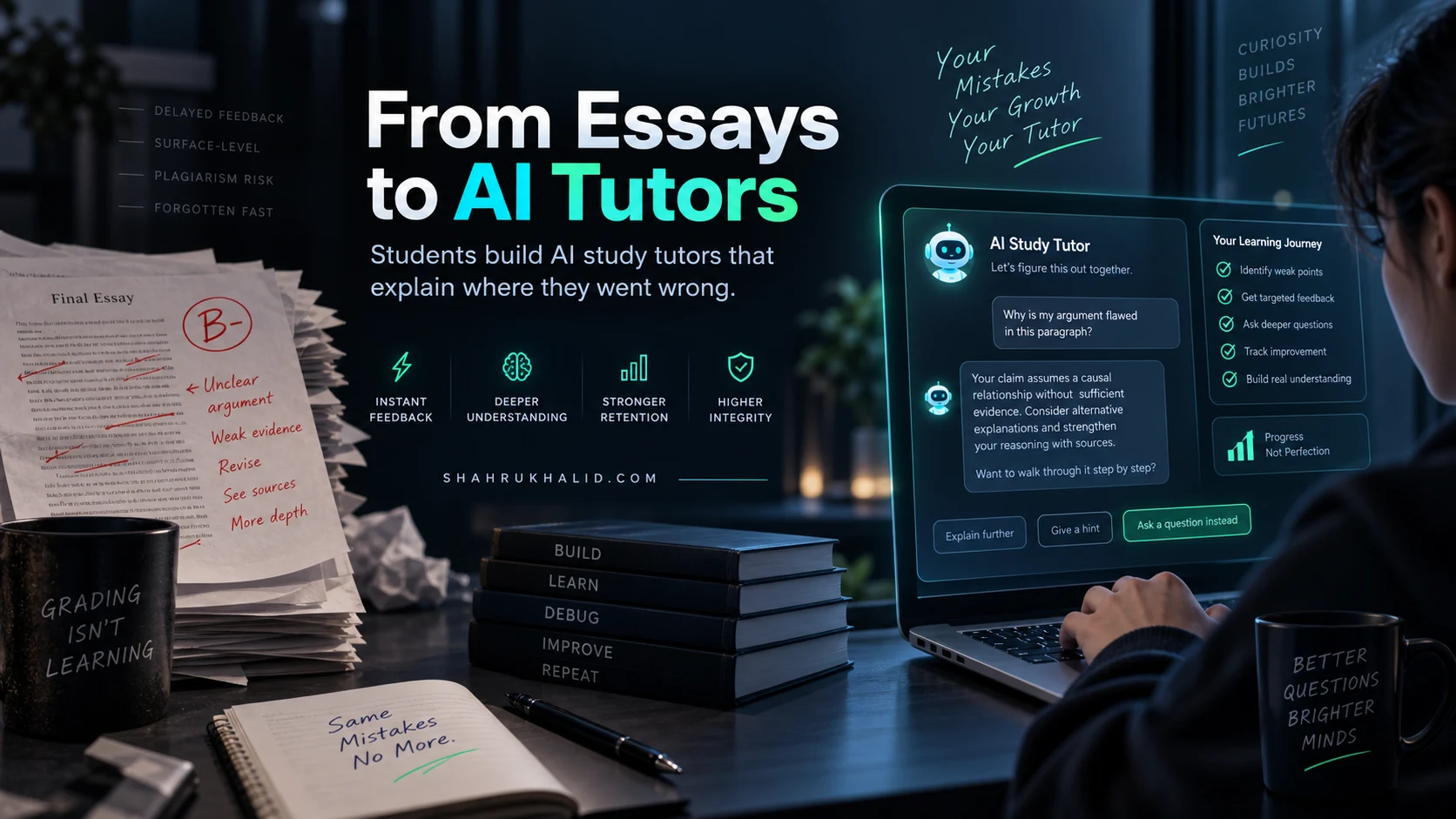
The traditional grading model suffers from a devastating latency problem: feedback arrives weeks after the intellectual crime has been committed. By the time a student reads a marginal note explaining why their causal reasoning was flawed, their brain has already context-switched to the next semester or the next course. Furthermore, the explosion of generative text tools has rendered the standard take-home essay largely obsolete as a measure of authentic understanding. Instead of fighting a losing battle with plagiarism detectors, forward-thinking educators are flipping the script by asking students to build the very evaluation tools that analyze their learning journeys.
When students transition from essay consumers to AI system architects, their entire relationship with the subject matter undergoes a seismic shift. They no longer ask, “What do I need to write to appease the grader?” Instead, they ask, “How does this concept actually work, and how can I program an intelligence to recognize its nuances?” This masterclass guide explores the systemic breakdown of traditional grading, the structural mechanics of student-built cognitive tools, and the exact roadmap for implementing a transformative assessment model in your learning environment.
Why Traditional Grading Fails Modern Learners
To understand why we must abandon traditional grading, we must first examine the psychological and structural flaws baked into standard evaluation metrics. Letter grades and percentage scores act as extrinsic motivators that actively suppress intrinsic curiosity. When a student receives an 82 percent on a term paper, their brain registers a final judgment rather than an invitation for exploration. The grade functions as a period at the end of a sentence, signaling that the learning process is officially over.

Consider the logistical reality of contemporary education environments, where student-to-faculty ratios make deep, individualized mentorship nearly impossible. An instructor managing multiple classes cannot possibly provide the iterative, real-time dialectic needed to help a struggling learner untangle a complex misconception. Consequently, students receive flattened, retrospective summaries of their performance. This administrative bottleneck prevents timely intervention, ensuring that foundational misunderstandings compound silently over time until they manifest as catastrophic failures on final exams.
Moreover, traditional essays often reward rhetorical flourish and structural mimicry over genuine conceptual mastery. A student with a strong vocabulary and a talent for imitating academic prose can often secure a high grade while remaining profoundly confused by the underlying domain principles. Conversely, a student who deeply grasps the mechanics of a complex system might struggle to package their thoughts into a traditional five-paragraph essay structure, resulting in an unfair penalization of their actual comprehension. We need evaluation frameworks that bypass superficial stylistic compliance and target the raw architecture of student understanding.
The Shift Toward Metacognitive Architecture
Metacognition—the ability to monitor and understand one’s own thought processes—is the single most reliable predictor of academic and professional resilience. When learners are forced to externalize their mental models into functional applications, they are compelled to confront the gaps in their own reasoning. Building a personalized educational tool requires students to map out what they know, identify where they frequently stumble, and articulate the specific logical pathways required to bridge those gaps.

This approach aligns perfectly with modern constructivist learning theories, which posit that knowledge is actively built by the learner rather than passively absorbed from an instructor. By designing an interactive environment tailored to their specific learning profile, students engage in high-level cognitive synthesis. They must categorize their past mistakes, analyze the root causes of their misconceptions, and encode remedial explanations into the system’s logic. This transforms the student from a passive recipient of judgment into an active designer of their own cognitive scaffolding.
Integrating AI study tutors education models into this workflow provides a scalable engine for continuous, conversational feedback. Unlike a static answer key, a well-configured study tool can engage in Socratic questioning, pushing the student to defend their logic rather than simply providing the correct answer. This dynamic interaction mirrors the gold standard of human-to-human tutoring, making advanced pedagogical support accessible to every single learner regardless of institutional resources or scheduling constraints.
Deconstructing the AI Study Tutor Paradigm
An effective student-built study assistant is not merely a search engine or a grammar checker; it is a specialized conversational agent designed to diagnose conceptual drift. When building these tools, learners must define the exact boundaries of the subject matter, establish behavioral guidelines for the assistant, and train the system to recognize common logical fallacies specific to the domain. This process forces students to master the material at a level far deeper than any traditional term paper could ever demand.
The architecture of these educational tools relies on contextual grounding and prompt engineering principles. Students learn how to feed their own previous assignments, lecture notes, and textbook chapters into the system to create a customized knowledge base. They then program the assistant to adopt specific pedagogical personas—ranging from a gentle, encouraging mentor to a rigorous, skeptical peer reviewer. This hands-on customization demystifies artificial intelligence, moving learners from fearful consumers to empowered technological directors.
Crucially, these systems are engineered to prioritize explanation over automation. If a student asks the assistant to solve a complex problem outright, the tool is constrained by its system instructions to refuse the shortcut. Instead, the assistant breaks the problem down into smaller diagnostic chunks, asking targeted questions that guide the student toward the breakthrough themselves. This architectural constraint prevents intellectual laziness and ensures that the cognitive heavy lifting remains squarely on the human learner.
Step-by-Step Implementation Framework for Educators
Transitioning away from end-of-term essays requires a deliberate, structured rollout to ensure both institutional compliance and student buy-in. Educators must guide learners through the conceptual and technical phases of building their own diagnostic environments without assuming prior advanced technological fluency. The following sequential framework outlines how to integrate these modern tools into your curriculum seamlessly.
- Phase 1: Diagnostic Audit: Students review their past quizzes, drafts, and lab notes to catalog their recurring conceptual blind spots and analytical weaknesses.
- Phase 2: Knowledge Base Curation: Learners compile and clean primary source documents, lecture transcripts, and reading materials to serve as the foundational dataset for their assistant.
- Phase 3: Persona and Constraint Design: Students write comprehensive system instructions that dictate how the assistant should respond, ensuring it acts as a Socratic guide rather than a homework machine.
- Phase 4: Stress Testing and Iteration: Learners intentionally feed flawed arguments and incorrect hypotheses into their tool to test its diagnostic accuracy and refine its explanatory logic.
- Phase 5: Reflective Documentation: Instead of submitting a traditional research paper, students submit a technical and pedagogical portfolio explaining how their tool works and what it revealed about their learning trajectory.
Comparative Analysis: Essays vs. AI Study Tutors
To fully grasp the paradigm shift, we must directly contrast the outcomes, effort distribution, and cognitive demands of traditional grading against modern student-built diagnostic tools. The following breakdown illustrates why progressive educational institutions are actively modernizing their assessment architectures.
| Evaluation Dimension | Traditional End-of-Term Essay | Student-Built AI Study Tutors |
|---|---|---|
| Feedback Latency | Weeks of delay; arrives after the course concludes. | Instantaneous, real-time diagnostic interaction. |
| Cognitive Focus | Rhetorical style, formatting, and compliance. | System architecture, logic mapping, and error analysis. |
| Plagiarism Risk | High vulnerability to automated generation and cheating. | Zero vulnerability; the assignment is the creation of the tool. |
| Long-Term Retention | Low; material is frequently forgotten immediately after submission. | High; iterative debugging cements foundational principles. |
Addressing Cybersecurity, Data Privacy, and Ethics
Whenever we introduce advanced technology into educational workflows, data privacy and security must remain at the forefront of our architectural decisions. Students and institutions cannot afford to compromise personal data, intellectual property, or academic integrity in the pursuit of modernization. Establishing clear boundaries regarding data retention, user authentication, and ethical utilization is non-negotiable for any sustainable EdTech deployment.
Educators must ensure that the platforms and tools utilized comply with stringent privacy regulations such as FERPA and GDPR. Students should be explicitly instructed never to input personally identifiable information, confidential institutional data, or proprietary research into public-facing models. By emphasizing local data hygiene and ethical AI governance, instructors turn a potential security vulnerability into a vital lesson in digital citizenship and modern software safety.
Furthermore, discussions around algorithmic bias must be woven directly into the assignment rubric. Students must evaluate whether their custom assistants exhibit blind spots or favor certain writing styles and logical frameworks over others. This critical stance ensures that learners maintain a healthy skepticism toward technological outputs, viewing AI not as an infallible oracle, but as a sophisticated tool that requires constant human oversight and ethical calibration.
Overcoming Institutional Inertia and Resistance
Reinventing institutional assessment is rarely frictionless. Colleagues, department chairs, and traditionalist administrators may view the elimination of the end-of-term essay as a dilution of academic rigor. Overcoming this skepticism requires clear communication, transparent rubrics, and demonstrable proof that building a custom diagnostic tool demands significantly more intellectual rigor than recycling a tired term paper.
To secure administrative buy-in, educators should frame this transition as an upgrade in academic integrity rather than an abandonment of standards. Point out that while essays can be easily outsourced to black-box text generators, building and fine-tuning a contextual study assistant requires absolute conceptual mastery. When a student can successfully program an intelligence to catch their specific logical errors, they have proven their understanding far more rigorously than any five-page essay could ever demonstrate.
Starting small is the most effective strategy for departmental adoption. Begin by piloting the approach in a single seminar or elective course, documenting student engagement metrics, qualitative feedback, and final comprehension gains. Sharing these success stories with hesitant faculty members builds a bridge of evidence, transforming ideological resistance into collaborative curriculum redesign.
Designing Robust Rubrics for Non-Traditional Assessments
Grading the creation of an educational tool requires an entirely new taxonomy of assessment. Traditional rubrics that measure word counts, citation formats, and bibliographic density are completely irrelevant here. Instead, educators must evaluate students on the sophistication of their system architecture, the depth of their error analysis, and the pedagogical effectiveness of their custom assistants.
An exemplary grading rubric for this model focuses heavily on the iterative reflection log. How rigorously did the student test their tool? Did they successfully program the assistant to resist giving away direct answers? How accurately did the tool diagnose the student’s actual historical misunderstandings? By evaluating the quality of the student’s metacognitive reflection and architectural design, instructors reward genuine intellectual labor over superficial compliance.
This shift in evaluation also relieves grading fatigue for the instructor. Instead of reading fifty repetitive, uninspired essays on the exact same prompt, educators review fifty unique, creative, and highly personalized diagnostic tools built by students who genuinely care about the subject matter. The grading process transforms from a soul-crushing chore into an exciting exploration of student innovation and deep comprehension.
The Future of Personalized Educational Technologies
As we look toward the horizon of educational technology, the boundary between the learner and the learning environment will continue to blur. The era of the monolithic, one-size-fits-all lecture followed by a standardized high-stakes exam is rapidly drawing to a close. Empowering students to build their own cognitive scaffolds represents a massive leap forward in making education truly individualized, responsive, and humane.
By embracing these modern workflows, educators reclaim their primary vocation: acting as mentors, guides, and architects of curiosity rather than mere human spellcheckers and essay graders. The integration of AI study tutors education systems into foundational curricula ensures that our learners are not just prepared for the workforce of tomorrow, but equipped with the lifelong metacognitive tools needed to adapt to any technological or intellectual landscape they encounter.
Conclusion and Key Takeaways
Stepping away from the traditional end-of-term essay is not a retreat from academic standards; it is a profound upgrade in how we measure and foster deep understanding. When students take ownership of their learning journeys by architecting their own diagnostic assistants, they transition from passive recipients of grades to active masters of their cognitive processes.
- Eliminate Feedback Latency: Replace delayed red-ink grading with real-time, interactive diagnostic loops that address misconceptions immediately.
- Prioritize Metacognition: Force students to analyze their historical blind spots and encode remedial logic into their own custom study tools.
- Secure Academic Integrity: Shift away from vulnerable take-home essays toward un-cheatable, highly personalized technical portfolios and design logs.
- Redefine Rigor: Measure student success by the sophistication of their tool architecture, error analysis, and depth of self-reflection.