Kafka vs RabbitMQ: Complete Comparison
Key Takeaways
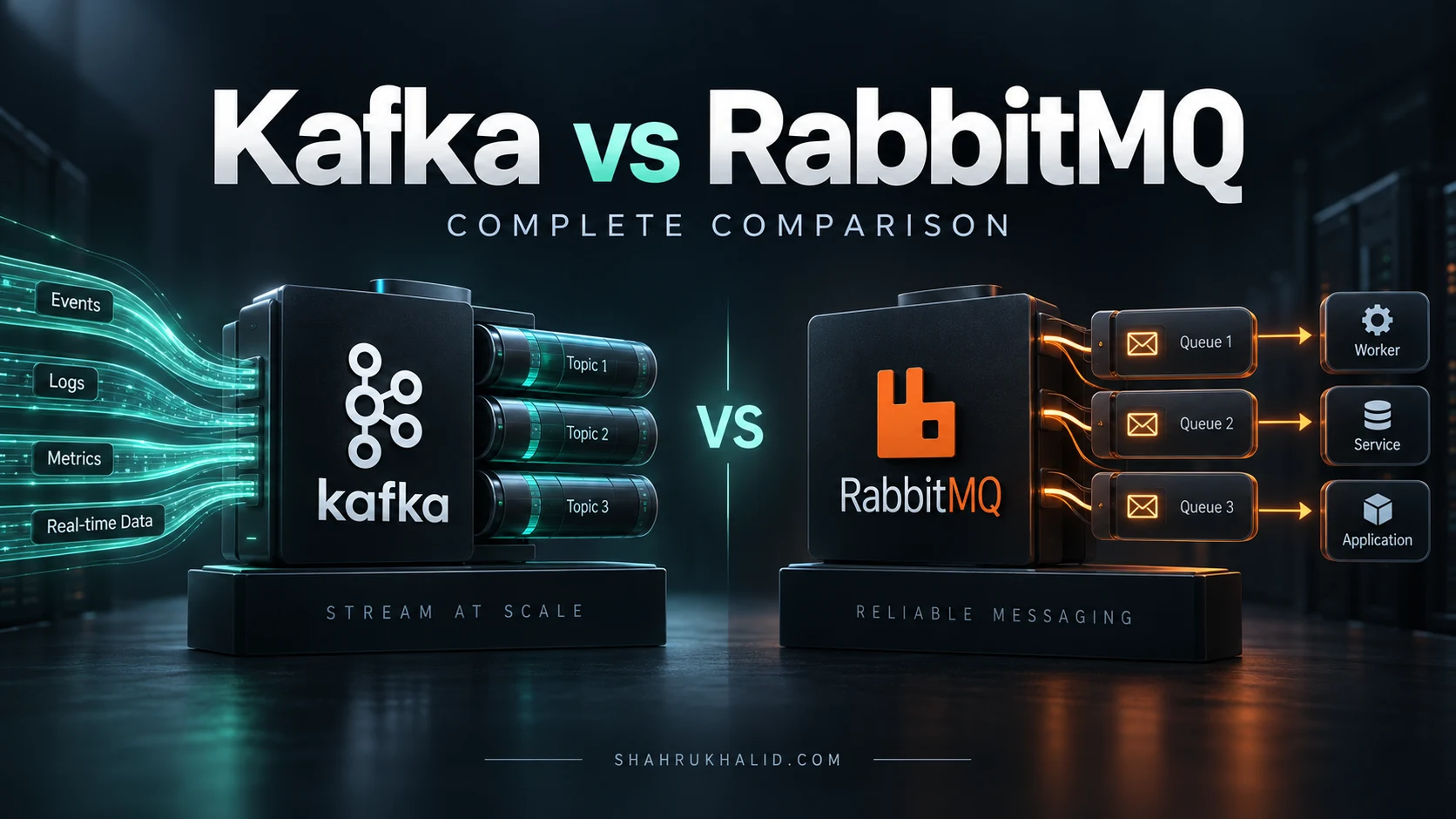
- Kafka is a distributed streaming platform for high-throughput data pipelines and event logs.
- RabbitMQ functions as a general-purpose message broker, optimized for traditional queue-based messaging.
- Kafka offers extremely high throughput and long-term message retention for replayability.
- RabbitMQ provides high throughput for moderate loads with short-term, transient message retention.
- Kafka has a steeper learning curve due to its distributed nature and complex concepts.
Kafka vs RabbitMQ: Complete Comparison
In the rapidly evolving landscape of distributed systems and microservice architectures, efficient and reliable communication between components is paramount. Message brokers and streaming platforms serve as the backbone for such communication, enabling asynchronous processing, decoupling services, and ensuring data flow. Among the myriad options available, Apache Kafka and RabbitMQ stand out as two of the most popular and powerful solutions, each with distinct philosophies and strengths.
This comprehensive article aims to provide a detailed, authoritative comparison between Kafka and RabbitMQ. We will delve into their core architectures, operational paradigms, and ideal use cases, helping software engineers, architects, and system designers make informed decisions. By the end of this read, you will have a clear understanding of the fundamental differences between Kafka vs RabbitMQ, enabling you to select the best tool for your specific project requirements, whether you’re building high-throughput data pipelines or robust enterprise messaging systems.
Quick Comparison Overview
Before we dive deep, here’s a quick side-by-side comparison of key features:
| Feature | Kafka | RabbitMQ |
|---|---|---|
| Primary Purpose | Distributed Streaming Platform, Event Log, Data Pipeline | General-purpose Message Broker, Traditional Message Queue |
| Messaging Model | Publish-Subscribe (Log-based) | Publish-Subscribe, Point-to-Point (Queue-based) |
| Performance | Extremely high throughput, low latency for large data streams. Optimized for sequential reads/writes. | High throughput for moderate loads, optimized for message delivery. Can handle millions of messages/sec. |
| Scalability | Horizontal scaling by adding more brokers and partitions. Consumer groups enable parallel processing. | Horizontal scaling via clustering. Queue sharding and federation for distributed queues. |
| Learning Curve | Steeper due to distributed nature, concepts like partitions, offsets, consumer groups, and strong consistency models. | Moderate. Concepts like exchanges, queues, bindings are straightforward. AMQP protocol can be complex. |
| Community & Ecosystem | Very large, active community. Rich ecosystem (Kafka Streams, KSQL, Connect, numerous client libraries). | Mature, active community. Extensive plugin ecosystem, supports multiple protocols (AMQP, MQTT, STOMP). |
| Cost (Self-hosted) | Free (Apache 2.0 license). Operational costs can be high due to resource intensity and complexity. | Free (Mozilla Public License). Generally lower resource footprint for typical messaging loads. |
| Message Retention | Configurable, typically long-term (days, weeks, or indefinitely) for replayability and historical analysis. | Short-term, messages are deleted after consumption. Designed for transient messages. |
| Use Cases | Event sourcing, log aggregation, real-time analytics, data pipelines, stream processing, microservice event bus. | Task queues, inter-service communication, request/reply patterns, fanout messaging, background job processing. |
What is Kafka?
Apache Kafka, originally developed by LinkedIn and later open-sourced, is a distributed streaming platform designed for building real-time data pipelines and streaming applications. At its core, Kafka functions as a distributed commit log. It stores streams of records in categories called topics, which are partitioned and replicated across multiple servers (brokers). Producers write records to topics, and consumers read from them, maintaining their own offset to track their position in the stream.
Kafka’s architecture prioritizes high throughput, fault tolerance, and durability. It achieves this by appending events to immutable logs on disk, allowing for efficient sequential I/O operations. This design enables multiple consumers to read the same stream of data independently, without affecting each other’s progress. Its ability to retain data for configurable periods makes it suitable for event sourcing, replayable data streams, and building complex stream processing applications using tools like Kafka Streams or KSQL. While historically reliant on Apache ZooKeeper for cluster coordination, newer versions are moving towards a self-managed quorum, simplifying its operational footprint.
What is RabbitMQ?
RabbitMQ is a widely adopted open-source message broker that implements the Advanced Message Queuing Protocol (AMQP). It acts as a middleman, facilitating communication between disparate applications and services. Unlike Kafka’s log-centric model, RabbitMQ operates on a traditional message queue paradigm, where producers send messages to exchanges, which then route them to queues based on predefined rules (bindings). Consumers retrieve messages from these queues.
RabbitMQ is known for its robustness, flexibility, and mature feature set. It supports various messaging patterns, including point-to-point, publish-subscribe, request-reply, and RPC. Key features include message acknowledgments, dead-letter queues, message prioritization, and support for multiple protocols beyond AMQP, such as MQTT and STOMP, making it versatile for diverse integration scenarios. Its design emphasizes reliable message delivery and complex routing capabilities, making it an excellent choice for enterprise messaging, task queues, and general inter-service communication where message transience and guaranteed delivery are crucial.
Kafka — Pros and Cons
Pros of Kafka:
- High Throughput and Low Latency: Designed to handle millions of messages per second with minimal latency, making it ideal for high-volume data streams.
- Scalability: Horizontally scalable by adding more brokers and partitions, allowing it to grow with data volume.
- Durability and Fault Tolerance: Data is replicated across multiple brokers, ensuring high availability and preventing data loss even if some nodes fail.
- Data Retention and Replayability: Messages are retained for a configurable period, allowing consumers to re-read historical data or for disaster recovery.
- Stream Processing Capabilities: Provides powerful APIs (Kafka Streams, KSQL) for real-time data processing and analytics directly within the platform.
- Ecosystem: A vast and active community, with extensive tooling, connectors (Kafka Connect), and client libraries in various languages.
- Event Sourcing: Its immutable log nature makes it a perfect fit for event sourcing patterns in microservices architectures.
Cons of Kafka:
- Operational Complexity: Setting up, configuring, and managing a Kafka cluster, especially for high availability and performance, can be complex and resource-intensive.
- Steeper Learning Curve: Concepts like partitions, offsets, consumer groups, and strong consistency models require a deeper understanding.
- Resource Intensive: Can consume significant CPU, memory, and disk I/O, particularly with high data retention policies.
- Not a Traditional Message Queue: Lacks features like message prioritization, selective message consumption, or direct message deletion from the queue.
- Zookeeper Dependency (Historical): Traditionally required ZooKeeper for cluster coordination, adding another component to manage (though this is changing).
- No Built-in Complex Routing: Routing is primarily based on topic and partition keys; complex message routing logic needs to be implemented by producers or consumers.
RabbitMQ — Pros and Cons
Pros of RabbitMQ:
- Mature and Robust: A battle-tested message broker with a long history of stability and reliability in production environments.
- Flexible Routing: Offers powerful and flexible routing capabilities through exchanges, queues, and bindings (e.g., direct, topic, fanout, headers exchanges).
- Guaranteed Message Delivery: Supports various acknowledgment mechanisms (publisher confirms, consumer acknowledgments) to ensure messages are processed reliably.
- Multi-Protocol Support: While AMQP is native, it also supports MQTT, STOMP, and other protocols via plugins, making it versatile for different client types.
- Ease of Use: Generally easier to set up, configure, and manage for typical messaging workloads compared to Kafka.
- Message Prioritization & Dead-Letter Queues: Built-in features for prioritizing messages and handling undeliverable messages gracefully.
- Rich Ecosystem of Plugins: A wide array of plugins extends its functionality for various use cases, from monitoring to message persistence.
Cons of RabbitMQ:
- Lower Throughput for Streaming: While capable of high throughput, it generally cannot match Kafka’s performance for extremely high-volume, continuous data streams.
- Scalability Complexity for Extreme Loads: Scaling to extreme levels (millions of messages per second continuously) can be more challenging and resource-intensive than Kafka.
- Transient Messages: Designed for messages that are consumed and then removed from the queue; not ideal for long-term data retention or event sourcing.
- Less Suited for Stream Processing: Lacks native stream processing capabilities; real-time analytics requires external processing engines.
- Resource Usage: Can consume significant memory and CPU, especially with many queues, bindings, and persistent messages.
- Limited Replayability: Once a message is consumed and acknowledged, it’s typically gone, limiting the ability to reprocess historical data.
When to Choose Kafka
Choosing Kafka is often the right decision when your primary requirements revolve around high-volume, real-time data streams and event-driven architectures. Consider Kafka for the following scenarios:
- High-Throughput Data Ingestion: If you need to ingest and process millions of events per second from various sources, such as IoT devices, web clicks, or sensor data.
- Event Sourcing and Log Aggregation: When you need an immutable, ordered log of all system events for auditing, debugging, or rebuilding application state.
- Real-time Analytics and Monitoring: For building real-time dashboards, fraud detection systems, anomaly detection, or monitoring application performance metrics.
- Data Pipelines: As the central nervous system for moving data between different systems (databases, data warehouses, search engines) in real-time.
- Microservices Communication (Event Bus): When services need to communicate asynchronously through a shared event log, enabling loose coupling and scalability.
- Stream Processing: If your application logic involves complex transformations, aggregations, or joins on continuous streams of data.
- Long-Term Data Retention: When you need to store messages for extended periods for historical analysis, replayability, or compliance.
Kafka excels in scenarios where data is treated as a continuous stream, and the ability to process, store, and re-process this stream is critical. It’s built for scale and resilience, making it a cornerstone of modern data platforms.
When to Choose RabbitMQ
RabbitMQ shines in scenarios requiring reliable, flexible, and traditional message queuing capabilities. It’s often preferred for enterprise messaging patterns and task distribution. Opt for RabbitMQ if your needs align with these use cases:
- Traditional Message Queuing: For reliable asynchronous communication between applications where messages are transient and processed once.
- Task Queues and Background Jobs: When you need to offload time-consuming tasks (e.g., image processing, email sending, report generation) to background workers.
- Complex Message Routing: If your application requires sophisticated routing logic based on message content, headers, or multiple criteria.
- Guaranteed Message Delivery: When message loss is unacceptable, and you need robust mechanisms for acknowledgments, retries, and dead-lettering.
- Inter-Service Communication (Request/Reply): For microservices that need to exchange messages in a more traditional request-response or RPC-like fashion.
- Legacy System Integration: Its support for various protocols and mature features makes it suitable for integrating with older systems or diverse technology stacks.
- Moderate Scale Enterprise Messaging: For applications that require high reliability and flexibility but don’t necessarily handle the extreme throughput of a streaming platform.
RabbitMQ provides a robust and feature-rich environment for managing messages with precision, ensuring that they reach their intended destination reliably and efficiently, even in complex distributed environments.
Real-World Use Cases for Each
Kafka Real-World Use Cases:
- Netflix: Uses Kafka extensively for real-time monitoring, activity tracking, recommendations, and processing billions of events daily. It forms the backbone of their data pipeline.
- LinkedIn: The birthplace of Kafka, it’s used for tracking user activity, operational metrics, and as an event bus for various internal services.
- Uber: Leverages Kafka for real-time ride data processing, predictive analytics, and managing billions of messages related to trips, drivers, and passengers.
- Financial Institutions: Employ Kafka for real-time fraud detection, trading system updates, and compliance auditing due to its immutable log and high throughput.
- Gaming Companies: Use Kafka to ingest and process player activity, in-game events, and telemetry data for analytics and personalized experiences.
RabbitMQ Real-World Use Cases:
- E-commerce Platforms: For processing orders, managing inventory updates, handling payment notifications, and sending customer confirmations asynchronously.
- Background Job Processing: Companies like Instagram (historically) and many web applications use RabbitMQ to queue tasks such as image resizing, video encoding, or sending notifications.
- IoT Device Communication: For collecting data from numerous IoT devices, routing commands, and managing device state changes, often via MQTT protocol.
- Microservices Communication: As a central message bus for orchestrating complex workflows between loosely coupled microservices, particularly for request/reply patterns.
- Content Delivery Networks (CDNs): For distributing configuration updates, cache invalidation messages, and managing edge server states.
- Healthcare Systems: For securely exchanging patient data, lab results, and administrative messages between different hospital systems.
Verdict: Kafka vs RabbitMQ
The choice between Kafka vs RabbitMQ is not about which one is inherently “better,” but rather which one is better suited for your specific problem domain. They address different fundamental requirements, though there can be overlap in certain generalized use cases.
Choose Kafka if: Your primary need is to build a high-throughput, fault-tolerant, and scalable streaming platform for handling continuous streams of data. You require long-term data retention, the ability to reprocess historical events, and robust stream processing capabilities. Kafka excels as an event backbone for complex data pipelines, real-time analytics, and event-sourced microservices architectures.
Choose RabbitMQ if: Your focus is on reliable message delivery, flexible routing, and managing transient messages in a traditional message queuing fashion. You need a mature, easy-to-operate broker for task distribution, inter-service communication with guaranteed delivery, or integrating diverse systems using various messaging protocols. RabbitMQ is a superb choice for enterprise messaging patterns and background job processing where individual message integrity and routing flexibility are paramount.
It’s also worth noting that Kafka and RabbitMQ are not mutually exclusive. Many organizations choose to use both, leveraging Kafka for their high-volume streaming data and RabbitMQ for specific task queues or RPC-style communications where its features are more appropriate. Understanding their core design philosophies is key to making the optimal architectural decision for your distributed system.