Architecting Sidecarless Service Meshes in 2026: eBPF Sockops Kernel-Bypass, Hardware-Offloaded TLS 1.3, and Shared-Memory In-Pod IPC
Key Takeaways
- Sidecar proxies impose excessive memory consumption, duplicate TCP stack traversals, and complex operational entanglement.
- Modern sidecarless architectures utilize eBPF sockops for kernel-bypass, eliminating multiple TCP stack traversals.
- Hardware-offloaded kTLS and shared-memory IPC are crucial for efficient sidecarless data plane performance.
- Sidecarless models drastically reduce memory footprint to a fixed node-level agent, saving significant RAM.
- Sidecarless upgrades are out-of-band, avoiding application pod restarts and operational complexity.
The traditional sidecar proxy model—which inserts an Envoy container alongside every application pod—has reached its architectural limit due to excessive memory consumption, duplicate TCP stack traversals, and complex lifecycle management. Modern cloud-native engineering in 2026 has transitioned decisively to sidecarless architectures, leveraging extended Berkeley Packet Filter (eBPF) sockops kernel bypass, kernel-space TLS (kTLS) with SmartNIC offloading, and shared-memory inter-process communication (IPC). This deep-dive masterclass examines how to design, deploy, and benchmark high-throughput, sub-millisecond service mesh fabrics across high-density enterprise nodes and modern Kubernetes cluster architectures.
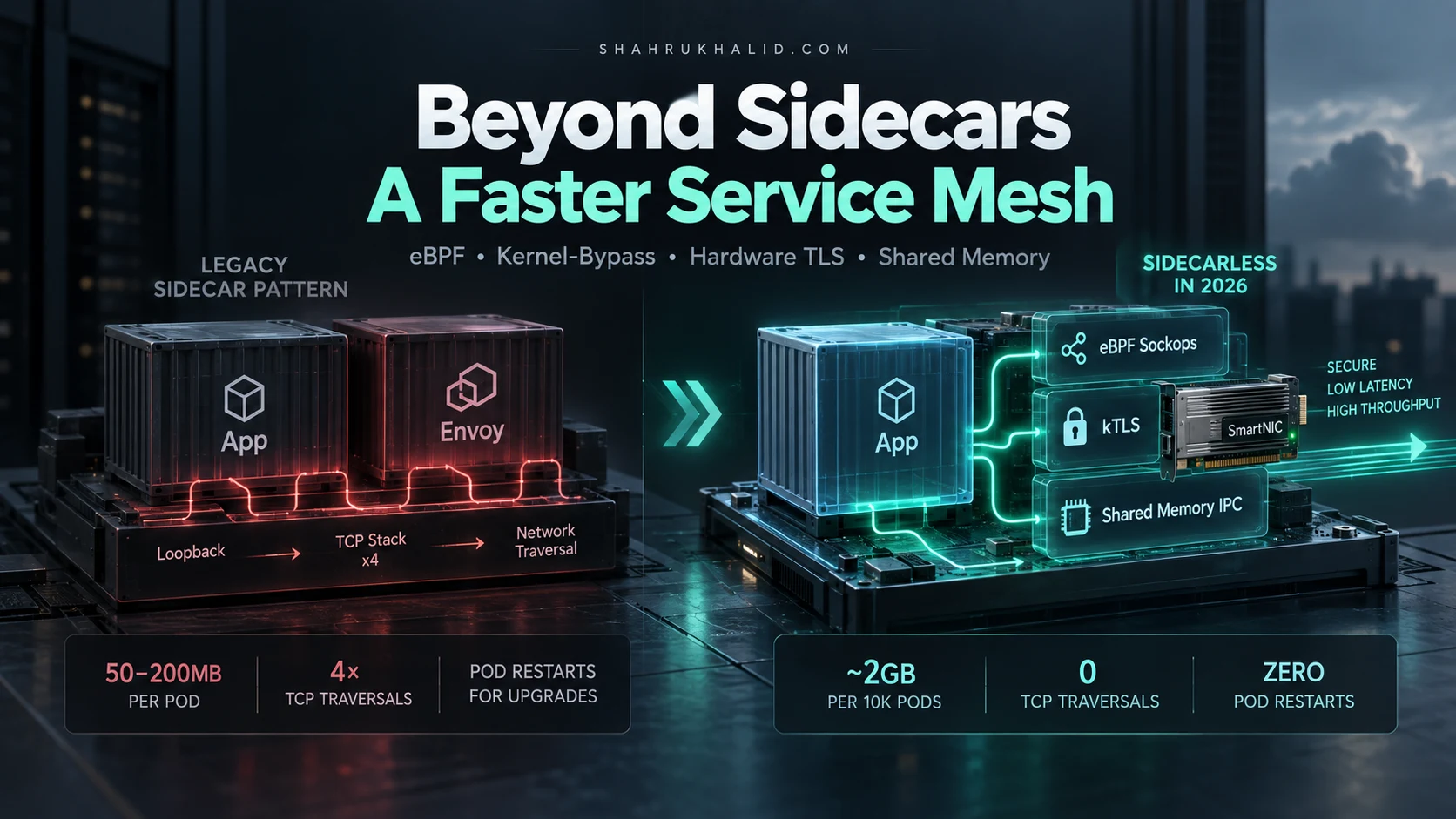
2026 Sidecarless Data Plane vs. Legacy Sidecar Pattern
Legacy Sidecar Architecture
- Data Path: App Pod → Loopback → Sidecar Envoy → Host veth → Bridge → Host veth → Remote Envoy → App Pod
- Kernel Traversal: 4 full TCP/IP network stack traversals (L2-L4 IP routing, netfilter, iptables/nftables)
- Memory Tax: 50MB–200MB baseline per pod; 10,000 pods = 0.5TB–2.0TB RAM wasted on proxy binaries
- Upgrade Blast Radius: Upgrading proxy requires pod re-injection and application container restarts
Sidecarless Ambient / eBPF Architecture
- Data Path (Co-located): App Pod → eBPF
sockops(Socket-to-Socket redirect) → App Pod (0 TCP traversals) - Data Path (Cross-Node L4): App Pod → eBPF / Node Ztunnel → Hardware kTLS Engine → Wire → Remote Node
- Memory Tax: Node-level agent (Ztunnel or Cilium agent); 10,000 pods = fixed ~2GB–4GB RAM footprint
- Upgrade Blast Radius: Proxies and eBPF maps patch out-of-band with zero pod restarts
The Structural Collapse of the Sidecar Proxy Pattern
For nearly a decade, the service mesh paradigm relied on injecting a dedicated Layer 7 proxy (typically Envoy) into the network namespace of every application pod. While this pattern abstracted mutual TLS (mTLS), traffic routing, and telemetry collection away from application logic, empirical data from enterprise deployments highlighted severe operational penalties at scale.
According to field data published across recent CNCF Telemetry Reports, the sidecar model imposes three non-negotiable performance bottlenecks:
- Memory and Core Allocations: In microservice deployments with hundreds of services scaling to thousands of replicas, the memory allocation for sidecars often dwarfs the resource consumption of the applications they govern. A cluster running 5,000 pods with a conservative 70MB memory footprint per Envoy proxy burns 350GB of RAM purely on proxy infrastructure before handling a single request.
- Context Switching and Path Overhead: A single inter-pod RPC traverses the Linux kernel network stack four times. Each hop triggers network scheduler interrupts, sk_buff allocations, netfilter rule checks, and context switches between the application runtime and the Envoy user-space process.
- Operational Entanglement: Upgrades to the proxy runtime necessitate rolling restarts of the entire microservice fleet. Furthermore, startup ordering races between the application container and the sidecar container continue to introduce race conditions in distributed systems.
eBPF Sockops and Socket-Level Kernel-Bypass Mechanics
The foundational breakthrough of sidecarless networking lies in eBPF socket operations (sockops). In a standard Linux network transaction between two containers residing on the same node, a packet generated by an application must travel down the user-space socket interface, through the TCP/IP stack (building IP headers, calculating checksums), across a virtual Ethernet pair (veth) into the root network namespace, through bridge or routing tables, down into the target container’s veth pair, and back up the target’s TCP stack to the destination user space.

eBPF short-circuits this pipeline entirely. By attaching eBPF programs to the socket infrastructure using BPF_PROG_TYPE_SOCK_OPS and BPF_PROG_TYPE_SK_MSG, we intercept network traffic at the socket layer (struct sock) and transfer payloads directly between the transmit socket buffer (sk_sndbuf) of the client and the receive socket buffer (sk_rcvbuf) of the server.

eBPF Socket-Level Kernel Bypass Pipeline
Application triggers
connect() or listen(). The bpf_sockops_handler intercepts BPF_SOCK_OPS_ACTIVE_ESTABLISHED_CB and BPF_SOCK_OPS_PASSIVE_ESTABLISHED_CB events, extracting the 4-tuple key: {src_ip, src_port, dst_ip, dst_port}.
The socket pointer is committed to a kernel-level
BPF_MAP_TYPE_SOCKHASH map via bpf_sock_hash_update(), establishing an authoritative mapping between network tuples and established kernel socket structs.
When the client issues a
write() or sendmsg() syscall, the attached sk_msg program executes. It queries the sockhash map using the destination key and executes bpf_msg_redirect_hash(), streaming memory directly to the destination socket’s ingress queue, completely bypassing IP routing, iptables, and veth serialization.
Implementing Socket Bypass via eBPF C
The following C implementation demonstrates the eBPF kernel logic required to construct a functional socket bypass datapath for co-located pods:
#include <linux/bpf.h>
#include <linux/in.h>
#include <bpf/bpf_helpers.h>
#include <bpf/bpf_endian.h>

struct sock_key {
    __u32 sip;
    __u32 dip;
    __u32 sport;
    __u32 dport;
    __u32 family;
};

struct {
    __uint(type, BPF_MAP_TYPE_SOCKHASH);
    __uint(max_entries, 65535);
    __type(key, struct sock_key);
    __type(value, __u64);
} sock_map SEC(".maps");

static inline void extract_key(struct bpf_sock_ops *skops, struct sock_key *key) {
    key->dip = skops->remote_ip4;
    key->sip = skops->local_ip4;
    key->family = skops->family;
    key->dport = bpf_ntohl(skops->remote_port);
    key->sport = skops->local_port;
}

SEC("sockops")
int bpf_sockops_intercept(struct bpf_sock_ops *skops) {
    if (skops->family != AF_INET)
        return BPF_OK;

    switch (skops->op) {
    case BPF_SOCK_OPS_PASSIVE_ESTABLISHED_CB:
    case BPF_SOCK_OPS_ACTIVE_ESTABLISHED_CB: {
        struct sock_key key = {};
        extract_key(skops, &key);

        // Register socket inside BPF SOCKHASH
        bpf_sock_hash_update(skops, &sock_map, &key, BPF_NOEXIST);
        break;
    }
    default:
        break;
    }
    return BPF_OK;
}

SEC("sk_msg")
int bpf_sk_msg_redirect(struct sk_msg_md *msg) {
    struct sock_key key = {};
    key.sip = msg->remote_ip4;
    key.dip = msg->local_ip4;
    key.family = msg->family;
    key.sport = bpf_ntohl(msg->remote_port);
    key.dport = msg->local_port;

    // Fast-path bypass: Stream socket memory buffer directly to target socket
    int ret = bpf_msg_redirect_hash(msg, &sock_map, &key, BPF_F_INGRESS);
    if (ret != SK_PASS) {
        return SK_PASS;
    }
    return SK_PASS;
}

char _license[] SEC("license") = "GPL";
kTLS, Hardware-Offloaded mTLS 1.3, and NIC Cryptographic Engines
While intra-node communications are accelerated via eBPF socket memory bypass, zero-trust cloud architectures demand full mutual TLS (mTLS 1.3) with cryptographic identity proofs across node boundaries. Historically, carrying out TLS termination inside user-space proxies induced heavy CPU context-switch churn and cache invalidation.

In modern high-performance cloud networks, two techniques resolve this penalty: Kernel TLS (kTLS) and SmartNIC / DPU Cryptographic Hardware Offload.
kTLS Offload Architecture with Hardware SmartNIC Cryptographic Acceleration
1. Control Plane & Handshake (User Space)
The service mesh node agent (e.g., Istio Ztunnel or Cilium agent) performs the asynchronous mTLS 1.3 cryptographic handshake, authenticating SPIFFE/SPIRE identity certificates, exchanging ephemeral Diffie-Hellman keys, and negotiating symmetric session keys (AES-128-GCM or CHACHA20-POLY1305).
2. Symmetric Cryptographic Offload (Kernel & DPU)
Once keys are derived, the agent invokes setsockopt(..., SOL_TLS, TLS_TX, &crypto_info). The symmetric encryption keys are programmed into the kernel’s kTLS subsystem or directly offloaded onto the hardware ASIC (e.g., NVIDIA BlueField-3 or Intel IPU) via the tls-hw-offload driver hook.
Once kTLS is active on an established socket, user-space applications (or intermediate L4 forwarders) write plaintext buffers directly to the socket via the standard write() or sendfile() system calls. Payload framing, AES-GCM record encryption, counter mode maintenance, and authentication tag validation occur entirely inside the kernel or at the network interface hardware boundary.
Enabling and Initializing kTLS via the Linux Socket API
The code below demonstrates how a modern service mesh control daemon sets up symmetric cryptographic offloading on a validated network connection:
#include <stdio.h>
#include <string.h>
#include <sys/socket.h>
#include <linux/tls.h>
#include <linux/tcp.h>
#include <unistd.h>

#define TLS_CIPHER_AES_GCM_128 51

int enable_ktls_rx_tx(int sock_fd, unsigned char *key, unsigned char *iv, unsigned char *salt, unsigned char *rec_seq) {
    // 1. Attach the TLS upper layer protocol (ULP) to the TCP socket
    if (setsockopt(sock_fd, SOL_TCP, TCP_ULP, "tls", sizeof("tls")) < 0) {
        perror("Failed to assign TCP_ULP 'tls'");
        return -1;
    }

    // 2. Configure the Transmit (TX) Symmetric Crypto Parameters
    struct tls12_crypto_info_aes_gcm_128 crypto_tx;
    memset(&crypto_tx, 0, sizeof(crypto_tx));
    crypto_tx.info.version = TLS_1_3_VERSION;
    crypto_tx.info.cipher_type = TLS_CIPHER_AES_GCM_128;

    memcpy(crypto_tx.key, key, TLS_CIPHER_AES_GCM_128_KEY_SIZE);
    memcpy(crypto_tx.iv, iv, TLS_CIPHER_AES_GCM_128_IV_SIZE);
    memcpy(crypto_tx.salt, salt, TLS_CIPHER_AES_GCM_128_SALT_SIZE);
    memcpy(crypto_tx.rec_seq, rec_seq, TLS_CIPHER_AES_GCM_128_REC_SEQ_SIZE);

    if (setsockopt(sock_fd, SOL_TLS, TLS_TX, &crypto_tx, sizeof(crypto_tx)) < 0) {
        perror("Failed to program TLS_TX cryptographic session info");
        return -1;
    }

    // 3. Configure the Receive (RX) Symmetric Crypto Parameters
    struct tls12_crypto_info_aes_gcm_128 crypto_rx;
    memcpy(&crypto_rx, &crypto_tx, sizeof(crypto_rx));

    if (setsockopt(sock_fd, SOL_TLS, TLS_RX, &crypto_rx, sizeof(crypto_rx)) < 0) {
        perror("Failed to program TLS_RX cryptographic session info");
        return -1;
    }

    return 0; // The socket now performs hardware/in-kernel crypto transparently
}
When pairing this subsystem with SmartNIC hardware offload, the host CPU is entirely freed from the cryptographic math required by AES-GCM and ChaCha20-Poly1305. The SmartNIC’s inline encryption engines process cryptographic frames at line rate (100Gbps–400Gbps), maintaining sub-microsecond framing latency.
Shared-Memory In-Pod and Colocated IPC via POSIX and Memfd
For ultra-dense computing deployments, such as high-frequency trading pipelines, distributed database engines, or edge AI inferences running across clustered workloads, even socket redirection introduces memory-copy bottlenecks. When microservices reside on the same physical host, Zero-Copy Shared-Memory IPC eliminates the network stack entirely.
Under this architectural pattern, pods communicate across isolated Linux namespaces via anonymous, file-descriptor-backed memory pages created using memfd_create(), which are mapped concurrently into the address spaces of both client and server containers. Coordination across these memory zones is managed through non-blocking single-producer single-consumer (SPSC) ring buffers paired with Linux eventfd primitives for low-overhead signaling.
Shared-Memory Ring-Buffer Inter-Process Communication (IPC)
Shared Memory Region (memfd / tmpfs)
Pod B (Consumer / Receiver)
Step 1: Pod A allocates memory: fd = memfd_create("shm_mesh", MFD_CLOEXEC), resizes via ftruncate(), and maps it using mmap().
Step 2: Pod A passes the file descriptor to Pod B via a UNIX Domain Socket using SCM_RIGHTS ancillary control messages.
Step 3: Both workloads write and read messages directly from circular cache-line aligned ring buffers (std::atomic<uint64_t> head, std::atomic<uint64_t> tail), completely bypassing the Linux network subsystem.
Step 4: Signals are sent using lightweight eventfd interrupts only when the consumer thread transitions to an idle wait state.
High-Performance Lock-Free Shared-Memory Data Exchange
The code segment below demonstrates the synchronization layout used to build an in-memory transport ring between co-located workloads:
#define _GNU_SOURCE
#include <sys/mman.h>
#include <sys/syscall.h>
#include <unistd.h>
#include <stdint.h>
#include <stdatomic.h>
#include <string.h>
#include <stdio.h>

#define RING_CAPACITY 1024
#define SLOT_SIZE 4096

struct ipc_slot {
    uint32_t length;
    uint8_t payload[SLOT_SIZE - sizeof(uint32_t)];
} __attribute__((aligned(64)));

struct shared_ring_buffer {
    _Atomic uint64_t head __attribute__((aligned(64)));
    _Atomic uint64_t tail __attribute__((aligned(64)));
    struct ipc_slot slots[RING_CAPACITY];
};

// Producer push routine
int ring_push(struct shared_ring_buffer *ring, const uint8_t *data, uint32_t len) {
    uint64_t current_tail = atomic_load_explicit(&ring->tail, memory_order_relaxed);
    uint64_t current_head = atomic_load_explicit(&ring->head, memory_order_acquire);

    if ((current_tail - current_head) >= RING_CAPACITY) {
        return -1; // Ring buffer full, backpressure triggered
    }

    struct ipc_slot *slot = &ring->slots[current_tail % RING_CAPACITY];
    slot->length = len;
    memcpy(slot->payload, data, len);

    // Commit write memory barrier before tail pointer advance
    atomic_store_explicit(&ring->tail, current_tail + 1, memory_order_release);
    return 0;
}

// Consumer pop routine
int ring_pop(struct shared_ring_buffer *ring, uint8_t *out_data, uint32_t *out_len) {
    uint64_t current_head = atomic_load_explicit(&ring->head, memory_order_relaxed);
    uint64_t current_tail = atomic_load_explicit(&ring->tail, memory_order_acquire);

    if (current_head == current_tail) {
        return -1; // Ring buffer empty
    }

    struct ipc_slot *slot = &ring->slots[current_head % RING_CAPACITY];
    *out_len = slot->length;
    memcpy(out_data, slot->payload, slot->length);

    // Advance head to free slot
    atomic_store_explicit(&ring->head, current_head + 1, memory_order_release);
    return 0;
}
Enterprise Control Plane Architecture: Ambient Istio (Ztunnel) vs. Cilium Service Mesh
The transition toward sidecarless infrastructures has crystallized into two primary architectural models: Istio’s Ambient Mesh and Cilium’s eBPF Service Mesh. While both eliminate the sidecar container, their underlying datapath separation, transport encodings, and Layer 7 processing models differ fundamentally.
Istio Ambient vs. Cilium eBPF Datapath Layering
Istio Ambient Architecture (Layered L4/L7)
Layer 4 Fabric (Ztunnel): A dedicated Rust-based node-level daemon (Ztunnel) manages L4 identity, mTLS encapsulation (HBONE / HTTP/2 Connect over port 15008), and SPIFFE certificate rotations.
Layer 7 Processing (Waypoint Proxies): Advanced routing (header manipulation, canary shifts, fault injection) runs on dynamically instantiated Envoy-based Waypoint Proxies deployed per namespace or service identity, completely decoupled from compute nodes.
Cilium eBPF Mesh Architecture (Integrated Engine)
Layer 4 Fabric (eBPF Kernel): All L3/L4 load balancing, routing, and access control execute directly within the kernel via eBPF XDP, tc (traffic control), and socket tables. WireGuard or IPsec is used for wire encryption.
Layer 7 Processing (Node-Shared Envoy): If L7 rules are declared, Cilium redirects only matching flows out of eBPF and into an integrated node-level Envoy proxy instance using a shared host model.
Implementation Blueprint: Building a High-Performance Sidecarless Node Topology
To deploy a production-ready sidecarless service mesh capable of saturating 100GbE interconnects with minimal CPU overhead, you must apply low-latency Linux kernel optimizations, configure modern CNI datapath parameters, and deploy L4 secure tunneling.
1. Kernel and System Network Tuning
Apply these tuned parameters via /etc/sysctl.d/99-sidecarless-mesh.conf across all cluster nodes to maximize eBPF map sizing, socket memory limits, and connection concurrency:
# Increase socket listen backlog for ultra-dense microservices
net.core.somaxconn = 65535
net.core.netdev_max_backlog = 100000

# Optimize TCP buffer auto-tuning for high bandwidth-delay products
net.ipv4.tcp_rmem = 4096 87380 16777216
net.ipv4.tcp_wmem = 4096 65536 16777216

# Enable TCP BBR Congestion Control
net.core.default_qdisc = fq
net.ipv4.tcp_congestion_control = bbr

# Maximize eBPF JIT compiler performance and memory maps
net.core.bpf_jit_enable = 1
net.core.bpf_jit_harden = 0
net.core.bpf_jit_limit = 268435456
kernel.unprivileged_bpf_disabled = 1

# kTLS support prerequisites
net.ipv4.tcp_slow_start_after_idle = 0
2. Cilium Sidecarless CNI Helm Deployment
Deploy Cilium using socket-level load balancing, full kube-proxy replacement, and kernel-space WireGuard encryption to achieve an end-to-end zero-copy sidecarless substrate:
# values-cilium-sidecarless.yaml
kubeProxyReplacement: "true"
routingMode: "native"
autoDirectNodeRoutes: true
ipv4NativeRoutingCIDR: "10.244.0.0/16"

bpf:
  masquerade: true
  sockops:
    enabled: true  # Enables BPF sockops socket bypass for co-located pods
  tproxy: true
  mapDynamicSizeRatio: 0.0055

loadBalancer:
  acceleration: "native"
  mode: "dsr"      # Direct Server Return for minimum ingress latency

encryption:
  enabled: true
  type: "wireguard"
  wireguard:
    userspaceFallback: false

serviceMonitor:
  enabled: true

cgroup:
  autoMount:
    enabled: true
3. Provisioning Istio Ambient Waypoint Proxies
For workloads requiring Layer 7 authorization policies (e.g., HTTP path matching, JWT parsing, and retry budgets), attach an on-demand Waypoint Proxy without reintroducing sidecars to the application pods:
apiVersion: gateway.networking.k8s.io/v1
kind: Gateway
metadata:
name: payment-service-waypoint
namespace: core-banking
labels:
istio.io/waypoint-for: service
spec:
gatewayClassName: istio-waypoint
listeners:
- name: mesh
port: 15008
protocol: HBONE
---
apiVersion: security.istio.io/v1beta1
kind: AuthorizationPolicy
metadata:
name: enforce-jwt-and-paths
namespace: core-banking
spec:
targetRef:
kind: Gateway
group: gateway.networking.k8s.io
name: payment-service-waypoint
action: ALLOW
rules:
- from:
- source:
principals: ["cluster.local/ns/checkout/sa/checkout-service-account"]
to:
- operation:
methods: ["POST"]
paths: ["/v2/transactions/process"]
Edge and Resource-Constrained Environments: Kubernetes Edge Architecture 2026
The constraints of modern kubernetes edge architecture 2026 deployments—ranging from single-node far-edge appliances in retail distributions to 5G User Plane Functions (UPF) and industrial automation gateways—render the sidecar model obsolete. Edge nodes typically operate with tight computational parameters: 2 to 8 CPU cores, 4GB to 16GB of LPDDR5 RAM, and variable upstream satellite or cellular backhauls.
Edge Topology: Resource Allocation Comparison
Legacy Sidecars on Edge (50 Pods)
RAM Consumption: 3.5GB – 5.0GB consumed purely by 50 Envoy instances.
CPU Overhead: 15%–25% of total node compute consumed by context switches and duplicate socket management.
Result: Node capacity is heavily degraded, triggering premature scale-out requirements on physical hardware.
2026 Sidecarless Edge Fabric (50 Pods)
RAM Consumption: ~120MB total footprint for the eBPF datapath and host agent.
CPU Overhead: < 2% node utilization via direct kernel-bypass socket routing.
Result: Up to 95% of hardware resources remain available for actual edge application logic.
In distributed edge architectures, the combination of eBPF socket routing and in-memory IPC delivers deterministic execution critical for real-time edge processing:
- Sub-Millisecond Control Loops: Eliminating the multi-hop veth/bridge network path allows edge sensor ingress streams and control-plane controllers to achieve deterministic P99.99 response times below 200 microseconds.
- Disconnected Resiliency: Node-level L4 data planes maintain local mTLS authentication states, crypto keys, and routing hash tables within the kernel, enabling continuous zero-trust operation during transient WAN backhaul disconnections.
- Zero-Disruption Firmware and Control-Plane Updates: Node-level eBPF programs can be swapped atomically using the
bpf_prog_load()andbpf_prog_attach()system calls withBPF_F_REPLACE, allowing operators to update networking and security logic on edge appliances without interrupting running containers.
Verification, Observability, and Telemetry Extraction
A frequent challenge when adopting sidecarless networking is validating that the socket-level fast path is active and measuring the resulting performance gains. Because traffic bypasses the traditional veth virtual devices, legacy packet sniffers (e.g., standard tcpdump invocations) will capture no frames on the virtual interfaces.
To inspect active bypass connections and confirm that eBPF maps are properly handling payloads, use the kernel’s native tracing facilities:
# 1. Verify that the BPF sockops and sk_msg programs are attached
bpftool prog show --tag sockops
bpftool cgroup show /sys/fs/cgroup/unified/

# 2. Inspect active entries within the BPF SOCKHASH map
bpftool map dump name sock_map

# 3. Stream real-time kernel-space tracing messages from the BPF printk buffer
cat /sys/kernel/debug/tracing/trace_pipe | grep bpf_sk_msg

# 4. Measure end-to-end socket performance using modern socket statistics
ss -ti 'sport = :http or dport = :http'
For production telemetry, eBPF programs emit operational metrics directly to user-space collectors via high-speed BPF_MAP_TYPE_RINGBUF channels. This approach provides fine-grained observability into L4/L7 latency histograms, byte counters, and TCP state transitions without introducing user-space proxy overhead onto the critical network path.
Architectural Takeaways for 2026 Deployments
- Retire the Sidecar for L4: Decouple L4 connection routing and identity encryption from application containers. Leverage eBPF
sockopsfor local container IPC and node-level L4 fabrics (such as Ztunnel or Cilium CNI) for inter-node transport. - Target L7 Processing Selectively: Treat Layer 7 proxy capabilities (Envoy) as dedicated infrastructure resources (Waypoints) instantiated only where complex application routing or policy enforcement is required.
- Standardize on kTLS and Hardware Crypto Engines: Shift symmetric encryption workloads out of user space and onto the Linux kernel network stack or directly into SmartNIC ASICs to maximize throughput and free compute cores for business logic.