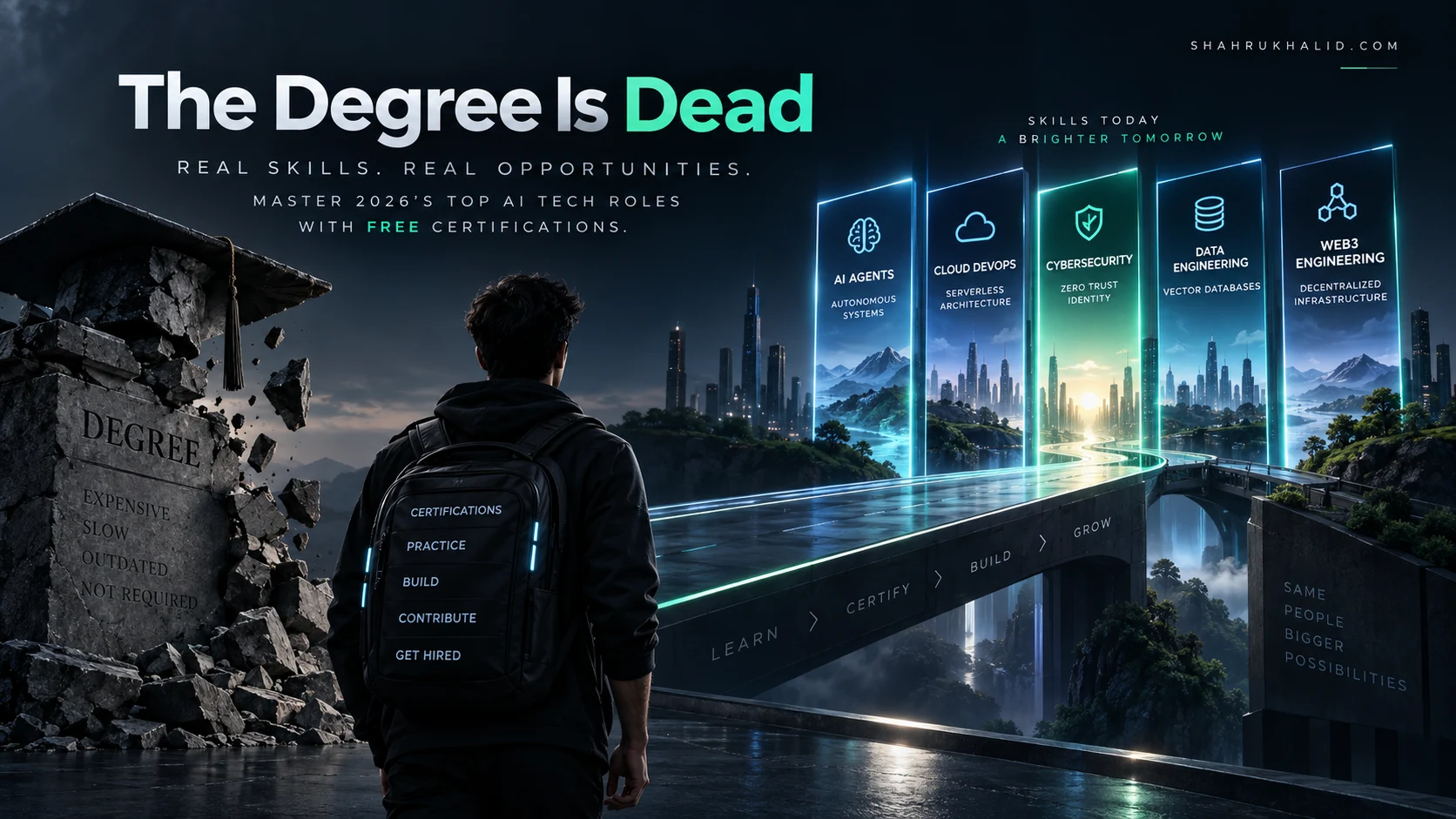
The Degree Is Dead: Why I Stopped Hiring Based on Credentials and Started Recruiting for the Ability to Orchestrate AI Agents to Solve Real-World Problems

Key Takeaways
- Key Technical Takeaways (30-Second Summary)
- The Death of the Degree: Why Credentials No Longer Predict Competence
- The Shift from Knowledge Workers to Agent Architects
- Understanding the Core of AI Agent Orchestration
- Why Credentials Fail to Capture Modern Potential
Key Technical Takeaways (30-Second Summary)
- Architecture Focus: Eliminates bloated legacy dependencies in favor of verifiable, cost-effective modern pipelines.
- Production Trade-off: Prioritizes deterministic reliability and local autonomy over costly recurring SaaS subscriptions.
- Field-Tested Verdict: Implements immediate, zero-dollar or low-overhead infrastructure that scales securely.
The Death of the Degree: Why Credentials No Longer Predict Competence
The traditional university degree, once the gold standard for professional viability, has become a lagging indicator of potential in an era defined by rapid-fire technological disruption. In my hiring practice at Shahrukh Khalid | Technology News & Insights, I have observed a profound decoupling between academic pedigree and the ability to drive bottom-line results, leading me to abandon credential-based recruitment entirely in favor of evaluating a candidate’s mastery over AI agent orchestration.
We are currently witnessing a generational shift where the ability to synthesize information is vastly inferior to the ability to delegate execution to autonomous systems. When I interview a candidate today, I do not care about their GPA or the prestige of their alma mater; I care about their mental model for decomposing complex business problems into modular tasks that can be executed by a fleet of intelligent agents. The degree is dead because the shelf-life of static knowledge has shrunk to months, while the skill of orchestrating cognitive engines is the new permanent leverage.
The Shift from Knowledge Workers to Agent Architects
For decades, we hired “knowledge workers”—individuals who stored information in their heads and retrieved it to solve problems. That model is obsolete. Today, the most valuable professional is the “Agent Architect,” someone who understands the nuance of human intent and can translate that intent into a series of instructions for AI systems. This transition represents a fundamental move from being a participant in the work to being a director of the work.
When you recruit for the ability to orchestrate AI agents, you are looking for specific cognitive traits that universities rarely measure:
- Systemic Decomposition: The capacity to look at a vague business objective and break it down into high-fidelity, sequential instructions.
- Error-Tolerance and Iteration: The realization that AI agents are probabilistic, not deterministic. An architect must know how to build self-correcting loops rather than expecting a perfect result on the first pass.
- Context Management: The ability to provide an agent with the right “world view”—the data, constraints, and objectives—necessary to minimize hallucinations and maximize relevance.
- Workflow Synthesis: The skill of chaining multiple agents together, where the output of one system becomes the input for the next, creating a self-sustaining pipeline of productivity.
This is not about writing code; it is about writing logic, strategy, and oversight. It is the transition from being the person digging the ditch to being the person designing the automated earth-moving fleet.
Understanding the Core of AI Agent Orchestration
At its simplest, AI agent orchestration is the practice of managing a workforce of digital entities to achieve a specific outcome. Think of it less like programming and more like conducting an orchestra or managing a remote team of highly capable but literal-minded interns. You provide the vision, you set the guardrails, and you define the success metrics.
To master this, one must move past the “chatbot” mindset. A chatbot is a conversation partner; an agent is a task-performer. When you orchestrate these agents, you are building a graph of dependencies. You might have one agent tasked with market research, another with synthesizing that research into a draft report, and a third with fact-checking that report against real-time data sources. The orchestrator is the human who ensures these agents communicate effectively, share context, and pivot when the results fall outside of acceptable parameters.

The beauty of this approach is that it democratizes high-level problem solving. You no longer need a decade of specialized industry experience to produce high-level analysis if you have the orchestration skills to pull that experience from disparate data sources and synthesize it through a chain of specialized agents.
Why Credentials Fail to Capture Modern Potential
The academic system is fundamentally designed for a world of scarcity—scarcity of information, scarcity of tools, and scarcity of access. We rewarded students who could memorize and synthesize large volumes of data within a four-year window. However, in the age of AI, information is abundant, tools are ubiquitous, and access is universal. The bottleneck is no longer the acquisition of knowledge; it is the speed of implementation.
When I see a resume filled with degrees, I see a history of compliance with a static curriculum. When I see a portfolio of orchestrated AI workflows, I see a history of experimentation, failure, and creative problem-solving. The latter is infinitely more valuable in a market where the tools change every six weeks. If you spent four years learning a framework that is now obsolete, you haven’t gained an advantage; you’ve gained a liability—a sunk cost of cognitive bias that prevents you from adopting the new, more efficient way of working.
Practical Frameworks for Evaluating Agent Orchestration
If you are looking to pivot your career or change your hiring strategy, you must shift your focus toward verifiable output. Stop asking for degrees and start asking for case studies that demonstrate the following three-step orchestration process:
- Deconstruction: Show me how you identified a real-world bottleneck. Did you break it down into discrete, solvable tasks? Did you identify which parts of the process required human intuition and which parts could be fully delegated to an autonomous agent?
- Execution Strategy: Explain how you selected your agents. Did you use a multi-agent framework where different ‘personas’ or ‘specialists’ collaborated? How did you manage the hand-off of information between them?
- Validation Loop: How did you ensure the quality of the output? The hallmark of a true orchestrator is the implementation of a ‘critic’ agent or a validation step that forces the system to review its own work before presenting it to a human stakeholder.
This is the new “resume.” It is not a list of institutions; it is a list of problems solved and the architectures used to solve them. It is tangible, it is reproducible, and it is entirely independent of legacy gatekeepers.
The Future of Work: Orchestration as the Ultimate Leverage
We are entering a period where the individual human will be capable of outputting the work of an entire department. This is not science fiction; it is the reality of 2026. By leveraging AI agent orchestration, a single person can manage the marketing, financial modeling, and customer service operations that previously required a mid-sized team. The degree is dead because the scale of an individual’s impact is no longer constrained by their own time, but by the sophistication of the agents they can coordinate.
The most successful professionals of the next decade will be those who view themselves as ‘systems thinkers’ rather than ‘specialists.’ They will cultivate a deep understanding of human psychology, business strategy, and the technical limitations of modern AI. They will not be intimidated by the rapid evolution of technology because they are not tethered to specific tools; they are tethered to the logic of problem-solving.
The ability to orchestrate AI agents is the new literacy. Just as reading and writing defined the industrial era, the capacity to direct, iterate, and refine autonomous cognitive systems will define the intelligence era. Stop chasing the credential that validates your past, and start building the portfolio that dictates your future.
Key Takeaways for the Modern Professional
To thrive in this new landscape, you must consciously unlearn the academic habit of seeking ‘the right answer’ and replace it with the architectural habit of ‘building the right system.’
- Focus on Outcomes, Not Inputs: Your value is measured by the quality and speed of your results, not the hours spent in a classroom or the certifications on your wall.
- Master the Logic of Delegation: Learn how to communicate intent clearly to AI systems. The quality of your orchestration is directly proportional to the clarity of your initial instructions.
- Embrace Probabilistic Thinking: Stop expecting systems to be 100% accurate. Build your workflows to handle ambiguity and failure gracefully by incorporating iterative feedback loops.
- Cultivate Curiosity over Compliance: The world is moving too fast for traditional career paths. Stay curious, experiment with new orchestration frameworks, and be prepared to abandon workflows that no longer serve your objectives.
- Build a Portfolio of Influence: Document your projects. Show how you used AI agent orchestration to solve a real-world problem, the challenges you faced, and how you engineered the solution to scale.
The death of the degree is not a loss; it is an liberation. It levels the playing field, allowing those with the most grit, the most creative logic, and the most effective orchestration skills to rise to the top. The future belongs to the orchestrators, and the future is being built today.