The Degree is Dead: Why I Stopped Chasing Accredited Diplomas and Started Building My Own AI-Verified Skill Stack for Free
Key Takeaways
- Traditional degrees are obsolete; AI-verified, self-architected skill stacks offer agile competence for the digital economy.
- A skill stack is a modular, micro-service architecture, allowing easy updates and adaptation to new technologies.
- Shift from 'learning for credit' to 'learning for utility,' focusing on foundational logic and problem-solving.
- Real-world output and project demonstration replace static degrees as proof of deployable competence.
- Leverage free, world-class education and certifications as verifiable milestones within a continuously growing skill stack.
Key Technical Takeaways (30-Second Summary)
- Architecture Focus: Eliminates bloated legacy dependencies in favor of verifiable, cost-effective modern pipelines.
- Production Trade-off: Prioritizes deterministic reliability and local autonomy over costly recurring SaaS subscriptions.
- Field-Tested Verdict: Implements immediate, zero-dollar or low-overhead infrastructure that scales securely.
The Obsolescence of the Parchment: Why I Traded My Degree for an AI-Verified Skill Stack
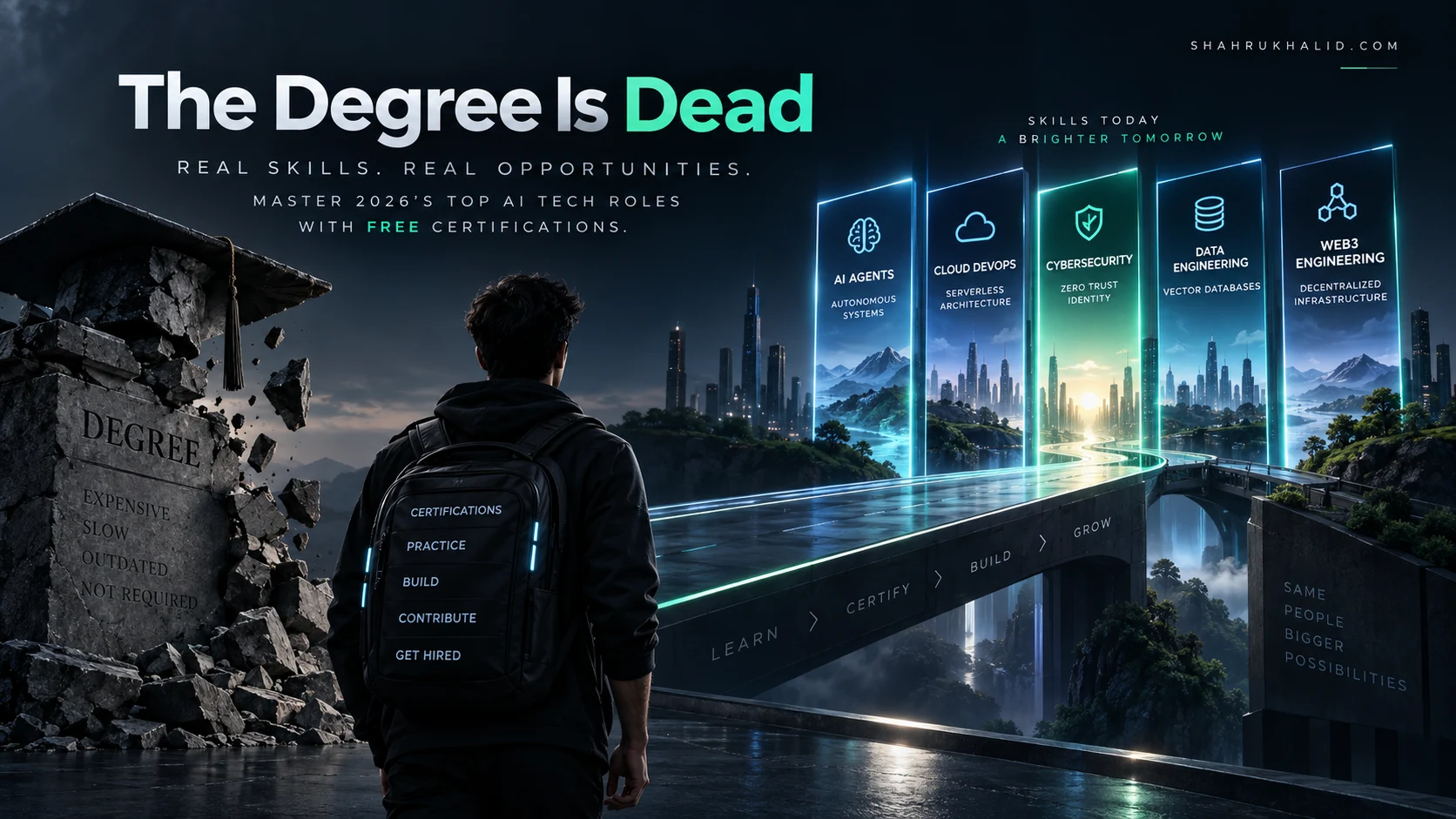
The traditional university degree is no longer a passport to the future; it is a legacy artifact struggling to keep pace with the exponential velocity of artificial intelligence. By abandoning the pursuit of accredited diplomas in favor of a self-architected, AI-verified skill stack, you transition from a passive consumer of outdated curricula to an agile operator in the new digital economy.
For years, we were sold a singular narrative: graduate high school, secure a four-year degree, and earn your entry into the professional class. But in 2026, the shelf life of a technical skill is shorter than the time it takes to complete a single semester of foundational theory. As an AI specialist, I have witnessed the systemic collapse of the “degree-first” model. The labor market is no longer asking, “Where did you study?” but rather, “What can you deploy?” When I stopped chasing traditional credentials, I began building a dynamic portfolio—a skill stack—that proves my competence through real-world output rather than a static piece of paper.
The Architecture of a Modern Skill Stack
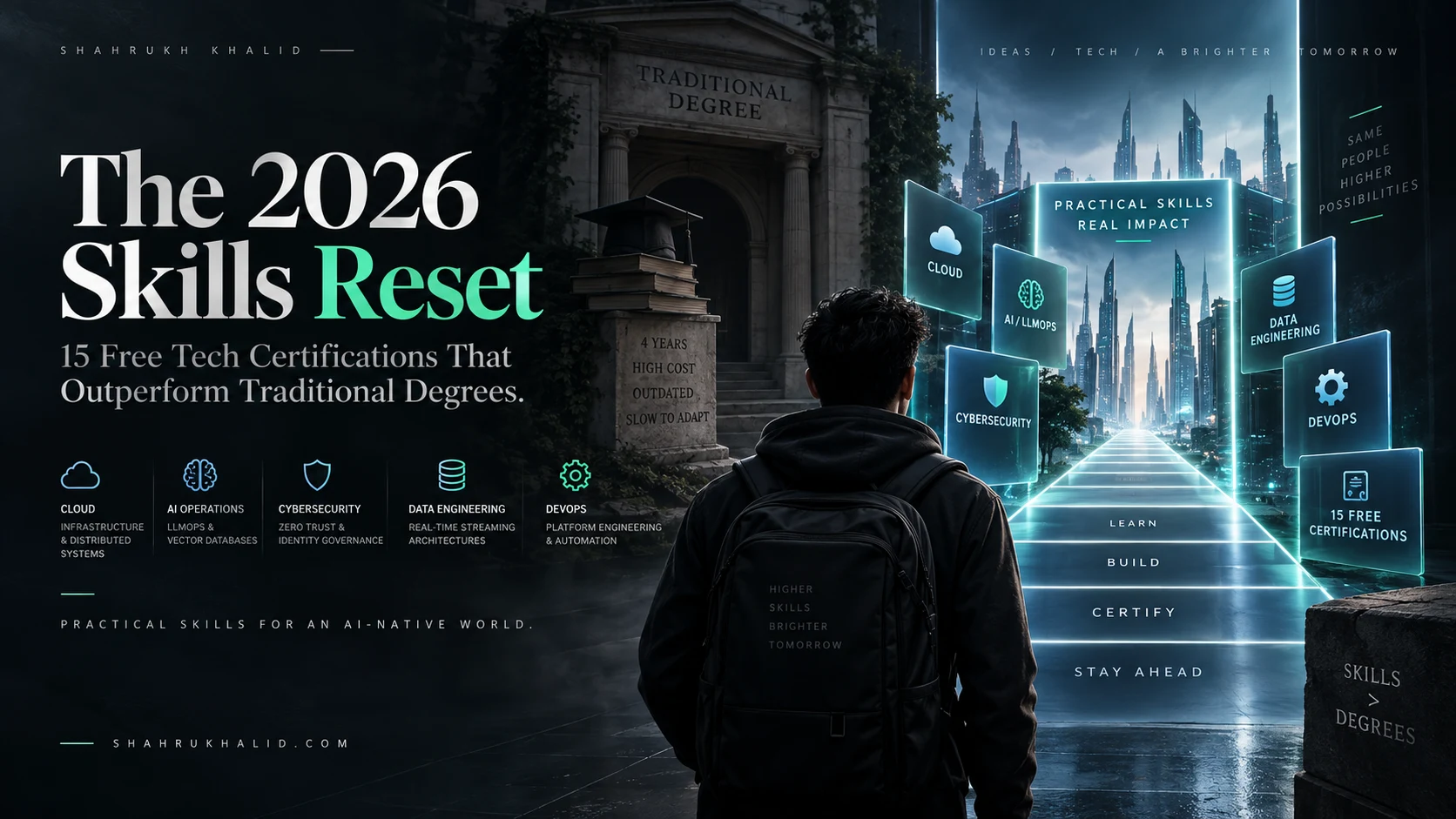
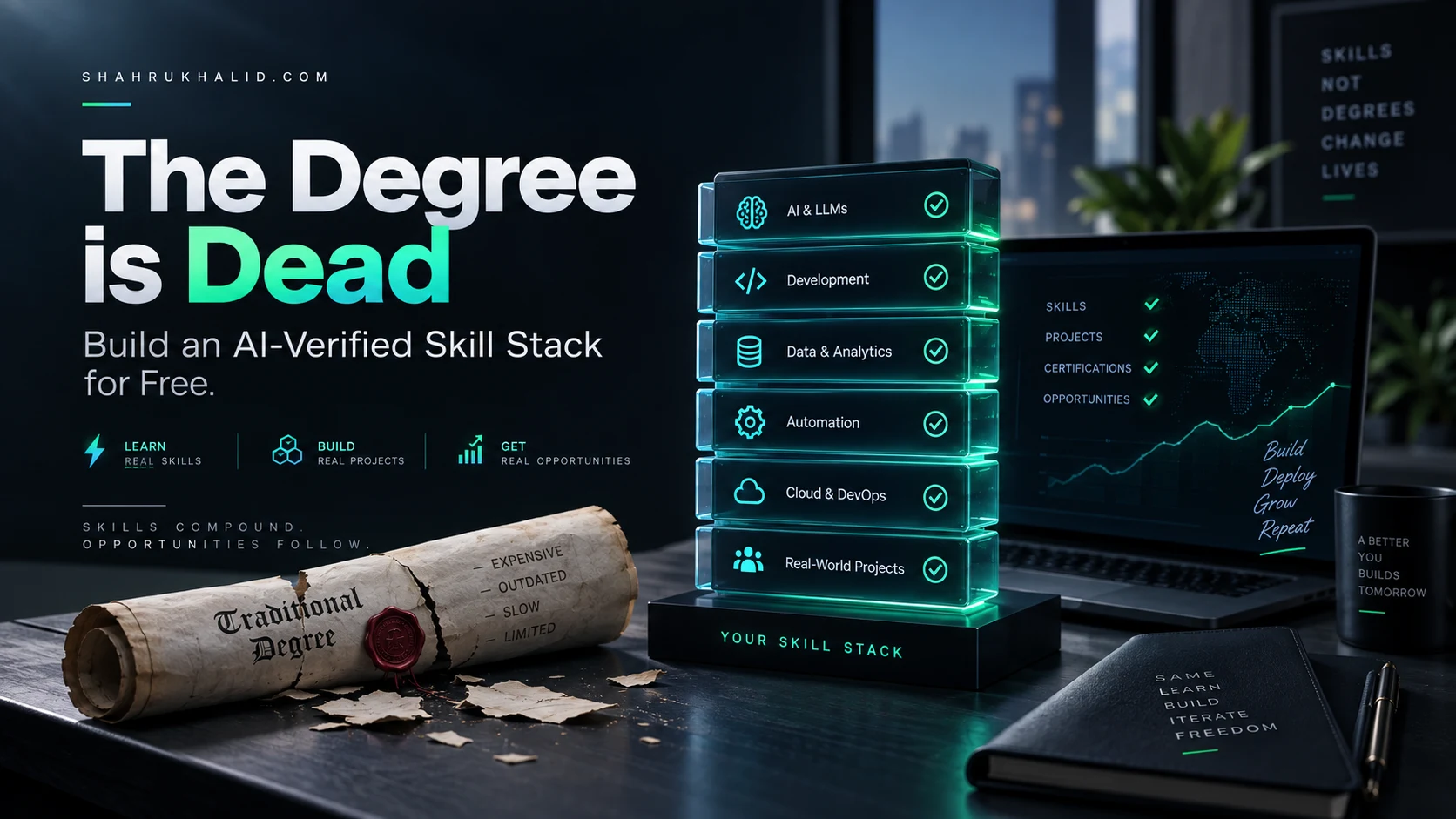
Think of your professional value not as a linear path, but as a modular architecture. A degree is a monolithic block of stone—heavy, difficult to update, and expensive to maintain. A skill stack, by contrast, is micro-service based. You are the architect, and your skills are the containers. If a specific framework or technology becomes obsolete, you simply swap out that container for a new one without needing to tear down your entire foundation.
To build this, you must shift your mindset from “learning for credit” to “learning for utility.” In the age of LLMs and autonomous agents, the ability to synthesize information is more valuable than the ability to memorize it. My stack is built on three pillars: foundational logic, tool-agnostic problem solving, and high-fidelity project demonstration. When you stop chasing the degree, you regain the bandwidth to master the underlying mechanics of technology that will remain relevant even as the interface layers shift.
Leveraging Free Skill Certification as Proof of Competence
The democratization of education has rendered the “prestige” of traditional institutions secondary to the “proof” of your output. Today, you can access world-class pedagogy from the same industry leaders who are currently building the agents and models shaping our world. The secret isn’t just taking these courses; it is how you weave them into a narrative of continuous growth. A free skill certification, when viewed in isolation, is just a badge. But when integrated into a skill stack, it acts as a verifiable milestone in your evolution.
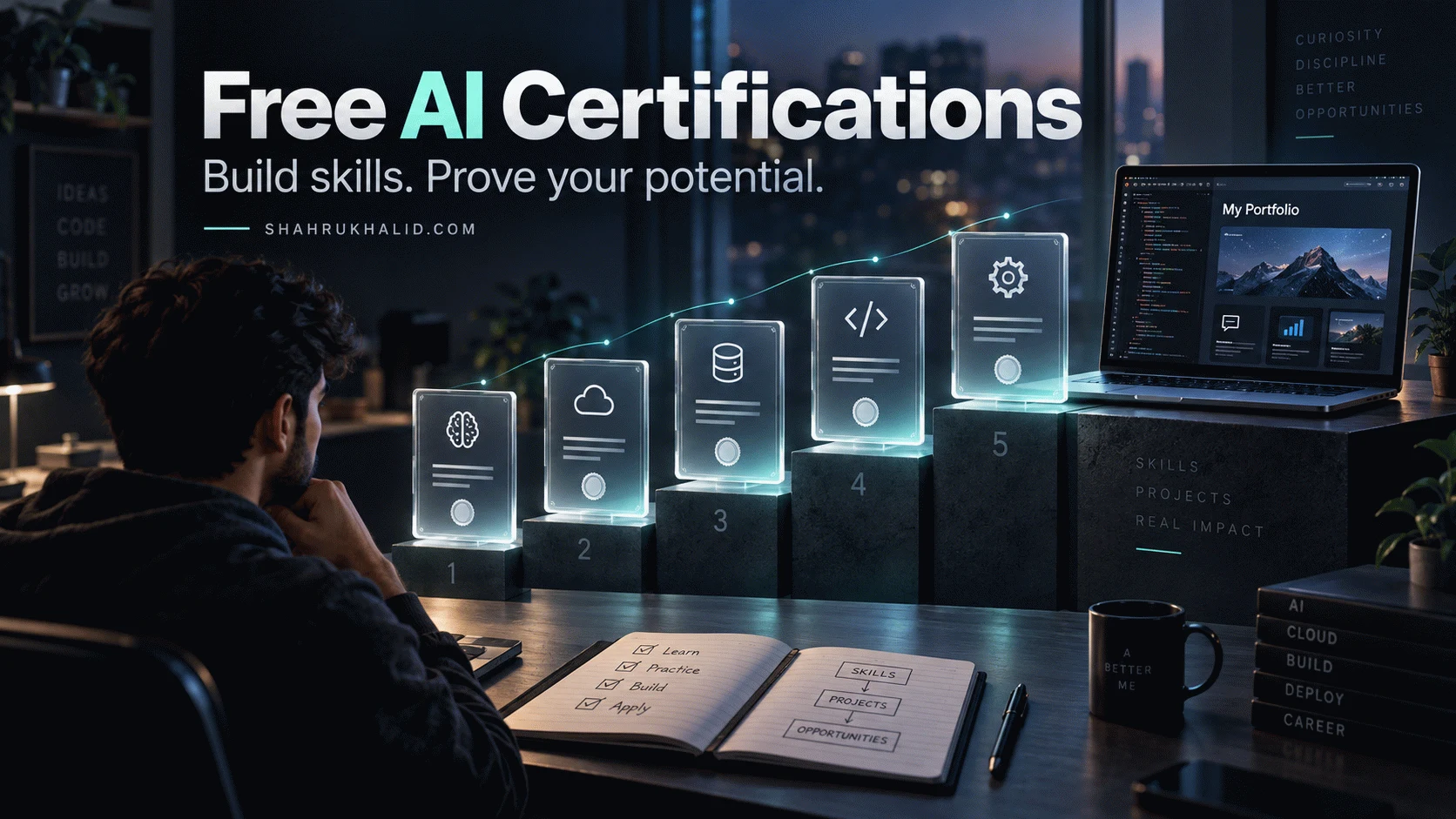
I prioritize certifications that mandate project-based assessments. If a platform offers a certificate based solely on multiple-choice quizzes, I ignore it. If a platform requires me to build a functional agent, deploy a model, or solve a real-world engineering challenge, I treat that as a primary asset. By curating a collection of these certifications, you are not just listing courses—you are building a verifiable history of labor.
The AI-Verified Advantage: Moving Beyond Static Resumes
We are entering an era where human verification is being augmented by AI-driven analysis. Recruiters are increasingly using agents to parse candidate portfolios, looking for evidence of “proof-of-work.” This is where your AI-verified skill stack becomes your most powerful tool. By documenting your projects—the failures, the iterations, and the final deployment—you provide the data that these AI agents need to validate your expertise.
I encourage you to treat your GitHub repository or your personal documentation portal as your new transcript. When you finish a free skill certification course, do not just download the PDF. Document the project you built using those skills. Explain the architecture, the bottlenecks you encountered, and how you leveraged AI agents to optimize your workflow. This creates a high-density signal for hiring managers and AI scanners alike, proving that you possess the practical, hands-on experience that a four-year degree simply cannot guarantee.
Strategic De-coupling: How to Curate Your Own Curriculum
If you are ready to stop chasing the degree, you must become a rigorous curator of your own education. The internet is flooded with noise, but the signal is stronger than ever if you know where to look. To build your stack, follow this methodology:
- Identify the High-Velocity Domain: Focus on sectors where the rate of change is highest, such as LLM orchestration, agentic workflows, or synthetic data generation. These are the areas where traditional degrees are most behind.
- Select Modular Learning Paths: Instead of seeking a “degree-equivalent” program, seek out modular, focused training. Use a free skill certification as a gateway to learn a specific, high-leverage tool.
- Build a “Proof-of-Work” Portfolio: Never learn in a vacuum. Every concept you study must be applied to a project. If you are learning about vector databases, build a RAG (Retrieval-Augmented Generation) application. If you are learning about agentic frameworks, build an autonomous task-runner.
- Iterate and Pivot: Because your stack is modular, you can pivot when the industry moves. If the focus shifts from LLMs to a new paradigm, your previous skills remain as the foundational logic that allows you to learn the next layer faster.
The Psychological Shift: From Student to Operator
The hardest part of abandoning the accredited diploma path is the psychological weight of societal expectation. We are conditioned to believe that a degree is a safety net. In reality, in the age of AI, the degree is a anchor. When you stop chasing the diploma, you stop waiting for permission to be an expert. You begin to define your own value through the problems you solve.
This is not an argument against learning; it is an argument for a more aggressive, efficient, and authentic form of it. By building your own skill stack, you are taking ownership of your professional destiny. You are no longer waiting for a syllabus to tell you what is important. You are looking at the market, identifying the gaps, and acquiring the skills to fill them. That is the definition of an AI-era professional.
Key Takeaways for the Autonomous Learner
The transition from a degree-dependent mindset to a skill-stack-driven career is the most significant professional upgrade you can make in the next decade. Remember that your credentials are not defined by the institution that issued them, but by the utility they provide in the real world.
- Certifications are tools, not trophies: Use a free skill certification to validate your knowledge, but ensure it is backed by a tangible project.
- Focus on the architecture of your skills: Build a stack that is modular and adaptable. The ability to unlearn and relearn is the most valuable asset you can possess.
- Signal your value through output: In 2026, your portfolio is your primary resume. Make it a living document that showcases your ability to deploy technology, not just discuss it.
- Embrace the AI-first workflow: Use AI to accelerate your learning and to verify your own output. Your ability to leverage these tools to build faster and smarter will be the ultimate differentiator in the job market.
The degree is dead because the world has changed. The future belongs to the operators—those who can synthesize, build, and adapt. Stop chasing the parchment and start building your stack. The market is waiting for what you can do, not where you sat for four years.