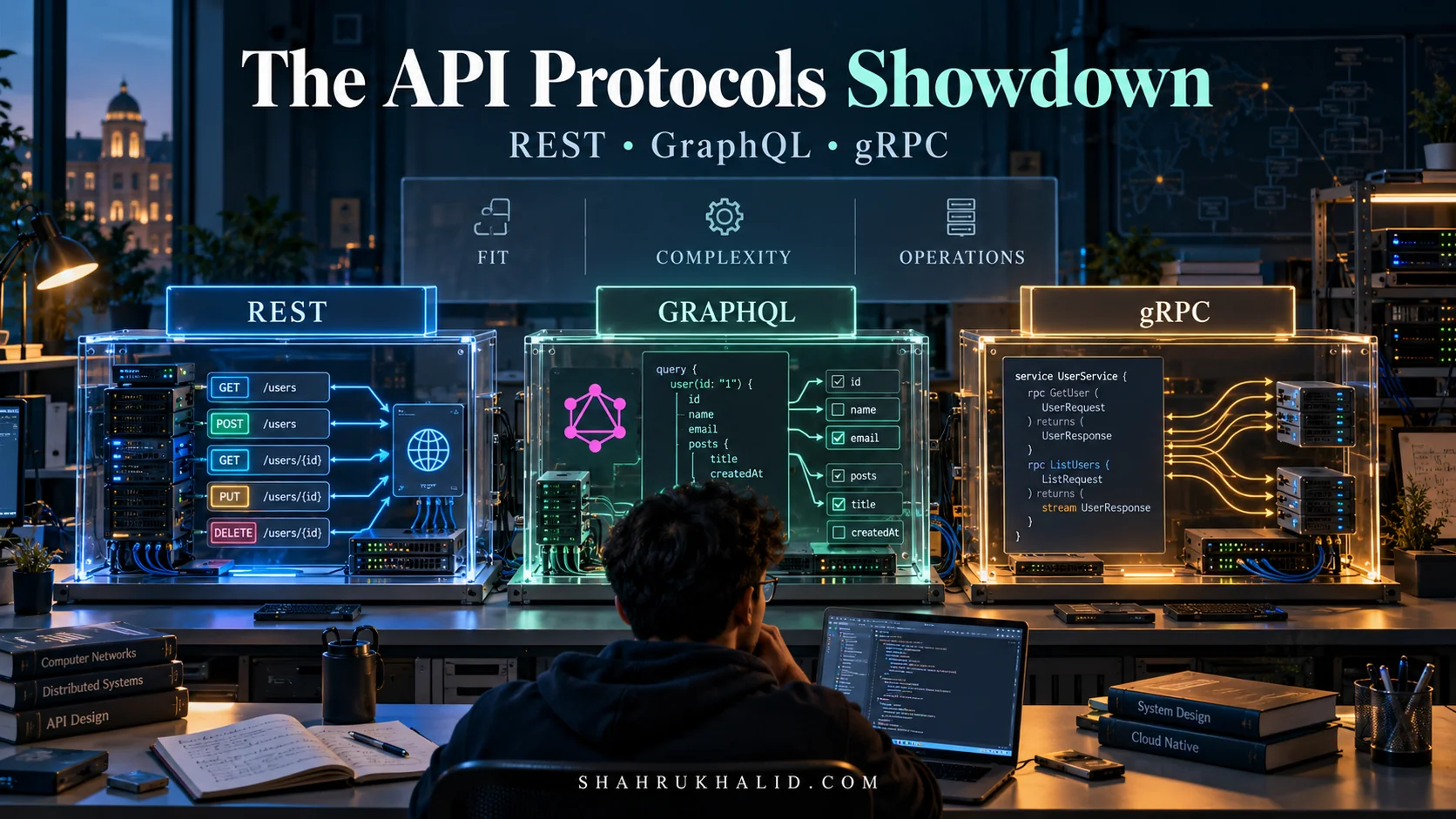
The 2026 API Battle: REST, GraphQL, gRPC — Your Production Playbook for Choosing the Right Protocol
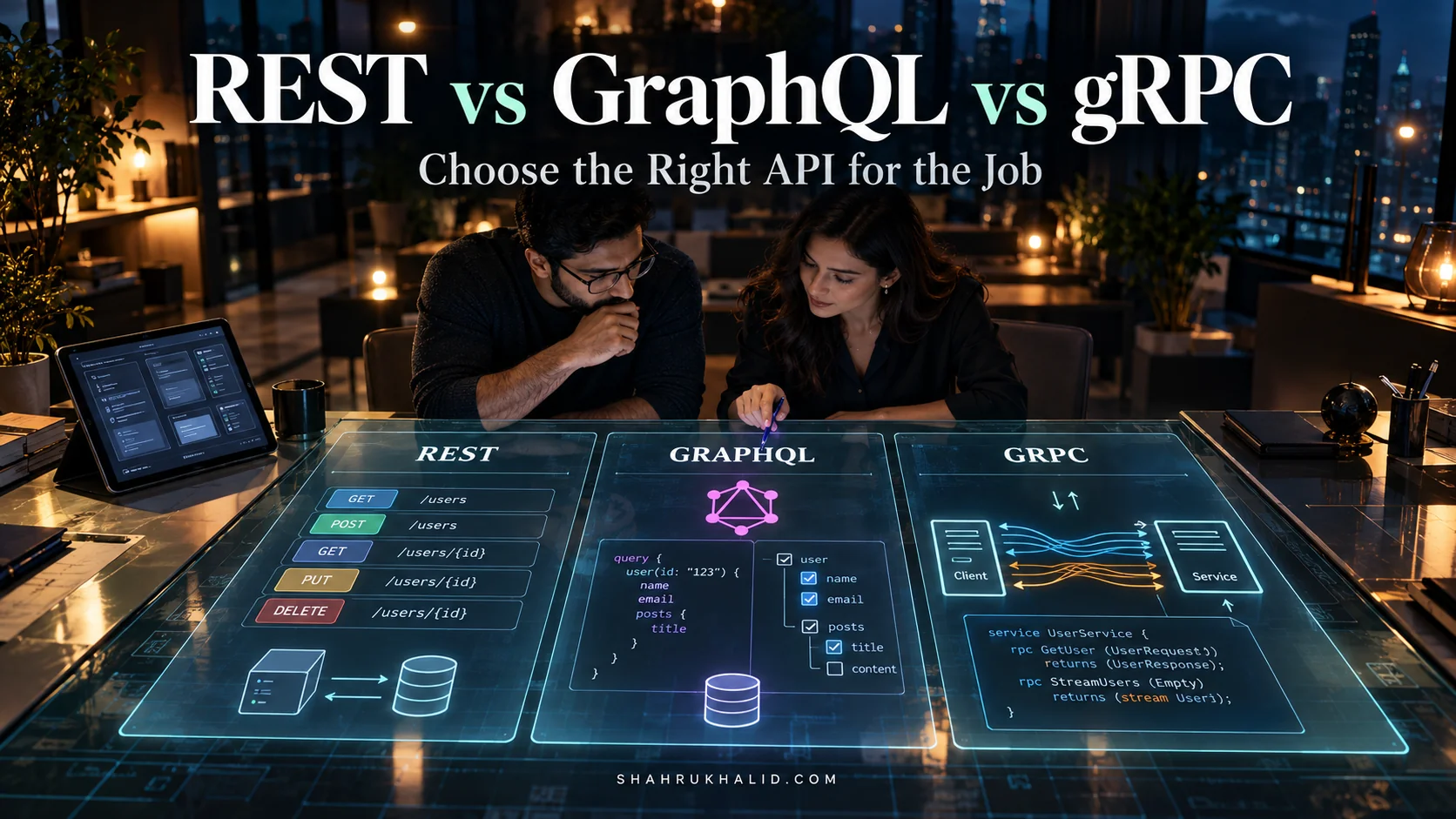
When designing modern distributed applications, choosing the right API protocol is a foundational decision that impacts latency, throughput, and developer velocity. This guide examines REST, GraphQL, and gRPC to help you establish a production-ready API strategy tailored to your system architecture.
Executive Architecture Summary and Design Objectives
Modern distributed systems require clear design objectives to ensure performance and reliability under heavy loads. Whether you are building a greenfield application or scaling an existing <a href="https://shahrukhalid.com/microservices-vs-monolith-complete-comparison/">Microservices vs Monolith: Complete Comparison</a>, your communication layer must align with specific performance targets.
Key design objectives include:
- Low Latency: Minimizing the round-trip time required for a client to receive a response, which directly affects user experience and conversion rates.
- High Throughput: Ensuring the system can process thousands of concurrent requests per second without degrading performance.
- Data Efficiency: Reducing payload size over the network to conserve bandwidth and accelerate data parsing, especially for mobile clients.
- Developer Experience (DX): Providing intuitive tooling, clear documentation, and straightforward integration patterns for engineering teams.
- Maintainability and Scalability: Allowing APIs to evolve over time without breaking existing client integrations.
To evaluate these objectives objectively, teams rely on Service Level Objectives (SLOs) and Service Level Agreements (SLAs). An SLO defines an internal target, such as ensuring ninety-nine percent of API requests complete under two hundred milliseconds. An SLA establishes a formal contractual commitment to users regarding uptime and response thresholds.
The Core Contenders: REST, GraphQL, and gRPC
Understanding the architectural foundations of each protocol helps clarify when to apply them in a production environment.
REST (Representational State Transfer)
REST remains the ubiquitous standard for web APIs. Operating primarily over HTTP/1.1 or HTTP/2, it leverages standard methods such as GET, POST, PUT, and DELETE with resources represented in JSON or XML.
- Strengths: Universal compatibility, mature tooling, straightforward caching semantics, and ease of debugging.
- Weaknesses: Prone to over-fetching (receiving unneeded fields) and under-fetching (requiring multiple round trips to assemble related data).
GraphQL
Developed to solve the rigidity of REST endpoints, GraphQL provides a declarative query language and runtime. Clients specify the exact shape of the data they require in a single request against a single endpoint.
- Strengths: Eliminates over-fetching and under-fetching, highly flexible for complex client applications, and strongly typed via a schema.
- Weaknesses: Increases server-side query complexity, introduces challenges for traditional HTTP caching, and can suffer from nested query performance issues if not properly guarded.
gRPC
Developed by Google, gRPC is a high-performance RPC framework built on HTTP/2 and Protocol Buffers (Protobuf). Instead of sending human-readable JSON text, data is serialized into compact binary payloads.
- Strengths: Exceptional speed and low resource consumption, bi-directional streaming out of the box, and strict schema contracts generated directly from Protobuf definitions.
- Weaknesses: Not human-readable without specialized tools, requires an explicit code-generation build step, and cannot be consumed natively by web browsers without a proxy layer like gRPC-Web.
| Metric / Feature | REST | GraphQL | gRPC |
|---|---|---|---|
| Primary Transport | HTTP/1.1 or HTTP/2 | HTTP/1.1 or HTTP/2 | HTTP/2 |
| Data Format | JSON, XML | JSON | Protocol Buffers (Binary) |
| Caching | Native HTTP Caching | Complex (Requires Application-Level) | None (Transport Level Only) |
| Streaming Support | Server-Sent Events / WebSockets | Subscriptions (via WebSockets) | Native Bi-directional Streaming |
| Best Suited For | Public APIs, CRUD apps, Webhooks | Frontend-heavy SPAs, Mobile Apps | Internal Microservices, High-Throughput IoT |
For deeper dives into specific comparisons, review the <a href="https://shahrukhalid.com/graphql-vs-rest-api-complete-comparison/">GraphQL vs REST API: Complete Comparison</a> and the <a href="https://shahrukhalid.com/grpc-vs-rest-complete-comparison/">gRPC vs REST: Complete Comparison</a>.
Component Topology and Microservice Boundaries
A robust API strategy rarely relies on a single protocol. Most enterprise systems adopt a hybrid architecture where different communication paths use the protocol best suited to their specific constraints.
“ [Web / Mobile Clients] │ ▼ (REST / GraphQL) [API Gateway] │ ▼ (gRPC) [Microservices Mesh: Auth, Catalog, Orders] “
External vs. Internal Traffic
- External Clients (Web, Mobile, Third-Party Partners): Expose REST and GraphQL via an API Gateway. REST serves public endpoints and webhook deliveries where third-party compatibility is essential. GraphQL serves client-facing web and mobile applications that require aggregated data structures.
- Internal Microservices: Use gRPC for backend-to-backend communication. Services such as inventory management, authentication, and payment processing benefit from the binary serialization, speed, and strict typing of gRPC over HTTP/2.
To accelerate your journey toward building production-grade distributed backends, refer to <a href="https://shahrukhalid.com/the-2026-dev-story-your-hands-on-journey-to-shipping-your-first-production-app-beginners-guide/">The 2026 Dev Story: Your Hands-On Journey to Shipping Your First Production App (Beginners Guide)</a>.
Production Implementation and Performance Tuning
Deploying these protocols to production requires careful attention to transport configuration, serialization efficiency, and data caching.
Optimizing gRPC Channels
When deploying gRPC services across a microservices cluster, maintain long-lived channels and configure connection pooling properly. Reuse stub instances across requests to avoid the overhead of repeated TCP and TLS handshakes. Enable keep-alive probes to detect dead connections early in unstable network environments.
Managing GraphQL Query Depth and Complexity
Unrestricted GraphQL queries can overwhelm backend databases through deeply nested joins or recursive requests. Implement query complexity analysis and depth limiting middleware on your GraphQL servers. Reject queries that exceed predefined complexity scores before they reach your data layer.
Caching Strategies
Caching behavior varies significantly by protocol:
- REST benefits from standard HTTP caching headers (
Cache-Control,ETag) that work natively with Content Delivery Networks (CDNs) and proxy caches. - GraphQL requires custom caching logic at the resolver level or integration with specialized normalized caching clients on the frontend.
- For distributed caching layers supporting your API responses or session states, consult the <a href="https://shahrukhalid.com/redis-vs-memcached-complete-comparison/">Redis vs Memcached distributed caching comparison →</a>.
Observability, Tracing, and Resilience
In distributed architectures, failures can propagate quickly across service boundaries. Comprehensive observability is non-negotiable.
Distributed Tracing
Ensure all incoming requests generate a correlation identifier (such as a W3C Trace Context header) that propagates across every protocol hop. Whether a request enters via a REST webhook, hits a GraphQL resolver, or fans out across multiple gRPC microservices, you must be able to trace its exact execution path through your monitoring platform.
Circuit Breakers and Retries
Implement circuit breakers at client boundaries to prevent cascading failures when a downstream service becomes unresponsive. Configure exponential backoff with jitter for retrying idempotent operations, but disable automatic retries for non-idempotent mutations to avoid duplicate transactions.
Security Considerations
Protocol security extends beyond basic transport encryption.
- Transport Layer Security (TLS): Enforce TLS 1.3 across all external and internal communications. For gRPC, mutual TLS (mTLS) provides robust service-to-service authentication within your cluster.
- Payload Validation: Never trust incoming data. Validate all REST payloads using schema validators, verify GraphQL inputs against scalar types and custom directives, and rely on Protocol Buffer validation rules for gRPC messages.
- Rate Limiting: Implement token bucket or leaky bucket rate limiting at your API Gateway to protect against denial-of-service attempts and resource exhaustion.
For foundational concepts on securing modern data pipelines and application infrastructure, review <a href="https://shahrukhalid.com/your-2026-ai-jumpstart-a-practical-step-by-step-guide-to-real-world-foundations/">Your 2026 AI Jumpstart: A Practical, Step-by-Step Guide to Real-World Foundations</a>.
Common Mistakes and Pitfalls
- Choosing Protocols Based on Hype: Adopting gRPC for public-facing client applications or GraphQL for simple internal CRUD services introduces unnecessary engineering overhead. Match the protocol to the consumer.
- Ignoring Schema Evolution: Modifying existing fields in Protobuf definitions without adhering to field numbering rules, or removing fields from public REST APIs without versioning, breaks client applications.
- Neglecting Error Handling Standards: Returning inconsistent error payloads across different endpoints frustrates client developers. Standardize your error response structures, such as adopting Problem Details for HTTP APIs.
- Over-Engineering Caching: Attempting to cache dynamic GraphQL queries at the HTTP proxy level without accounting for variable arguments leads to stale or incorrect data delivery.
Key takeaways
- Match your API protocol to your consumers: use REST for public compatibility, GraphQL for client flexibility, and gRPC for high-performance internal microservices.
- Adopt a hybrid API gateway architecture to translate external client requests into efficient internal protocols.
- Enforce rigorous observability standards, including distributed tracing and circuit breakers, to maintain system resilience across service boundaries.