JWT vs Sessions: Complete Comparison
Key Takeaways
- JWT is stateless; Sessions are stateful, requiring server-side state.
- JWT offers superior horizontal scalability, ideal for microservices.
- Sessions allow immediate revocation; JWTs require complex mechanisms.
- JWT excels in cross-domain and mobile application authentication.
- JWT validation is faster; Sessions typically require database lookups.
JWT vs Sessions: Complete Comparison
In the ever-evolving landscape of web development, robust and secure authentication mechanisms are paramount.
Choosing the right approach can significantly impact your application’s scalability, performance, and maintainability.
Two dominant paradigms for managing user authentication and authorization are JSON Web Tokens (JWT) and traditional server-side sessions.
While both serve the fundamental purpose of verifying a user’s identity and maintaining their state across requests, they achieve this through fundamentally different architectural patterns.
This comprehensive article, “JWT vs Sessions: Complete Comparison,” aims to provide software engineers, architects, and technical decision-makers with a detailed understanding of these two critical authentication methods.
We will dissect their underlying principles, explore their respective advantages and disadvantages, and offer clear guidance on when to choose one over the other based on specific project requirements and architectural considerations.
By the end of this read, you will be equipped with the knowledge to make an informed decision for your next application.
Quick Comparison Overview
To kick things off, here’s a high-level comparison of JWT and Sessions across several key features:
| Feature | JWT (JSON Web Tokens) | Sessions (Server-Side) |
|---|---|---|
| Architectural Style | Stateless (Token-based) | Stateful (Server-side state) |
| Scalability | Excellent horizontal scalability; no shared state needed across servers. Ideal for microservices and distributed systems. | Can be challenging; requires sticky sessions or a shared session store (e.g., Redis, database) for horizontal scaling. |
| Performance | Faster validation on the server as it’s self-contained; no database lookup for each request (after initial authentication). | Requires a database/cache lookup for each request to retrieve session data, potentially adding latency. |
| Revocation | Difficult to revoke immediately without a blacklist/whitelist mechanism, which reintroduces state. | Easy and immediate revocation by deleting the session ID from the server-side store. |
| Client Storage | Typically stored in Local Storage, Session Storage, or HTTP-only cookies. | Session ID typically stored in an HTTP-only cookie. |
| Cross-Domain / Mobile | Excellent for cross-domain authentication (CORS) and mobile applications. | Challenging for cross-domain; cookies often restricted. Less ideal for native mobile apps without custom handling. |
| Security Considerations | Vulnerable to XSS if stored in Local Storage. JWT content is visible (encoded, not encrypted). Requires careful handling of secrets. | Vulnerable to CSRF (requires protection). Session hijacking if cookie not secured (e.g., HTTP-only, Secure flags). |
| Overhead | Token size can increase with more payload data; sent with every request. | Minimal client-side overhead (just session ID); server-side overhead for storing and retrieving session data. |
| Use Cases | RESTful APIs, microservices, mobile apps, SPAs, SSO. | Traditional web applications (server-rendered), monoliths. |
What is JWT?
A JSON Web Token (JWT) is a compact, URL-safe means of representing claims to be transferred between two parties.
The claims in a JWT are encoded as a JSON object that is digitally signed using a JSON Web Signature (JWS) or encrypted using a JSON Web Encryption (JWE).
This digital signature ensures the integrity of the claims, meaning the token’s contents cannot be tampered with after it has been issued.
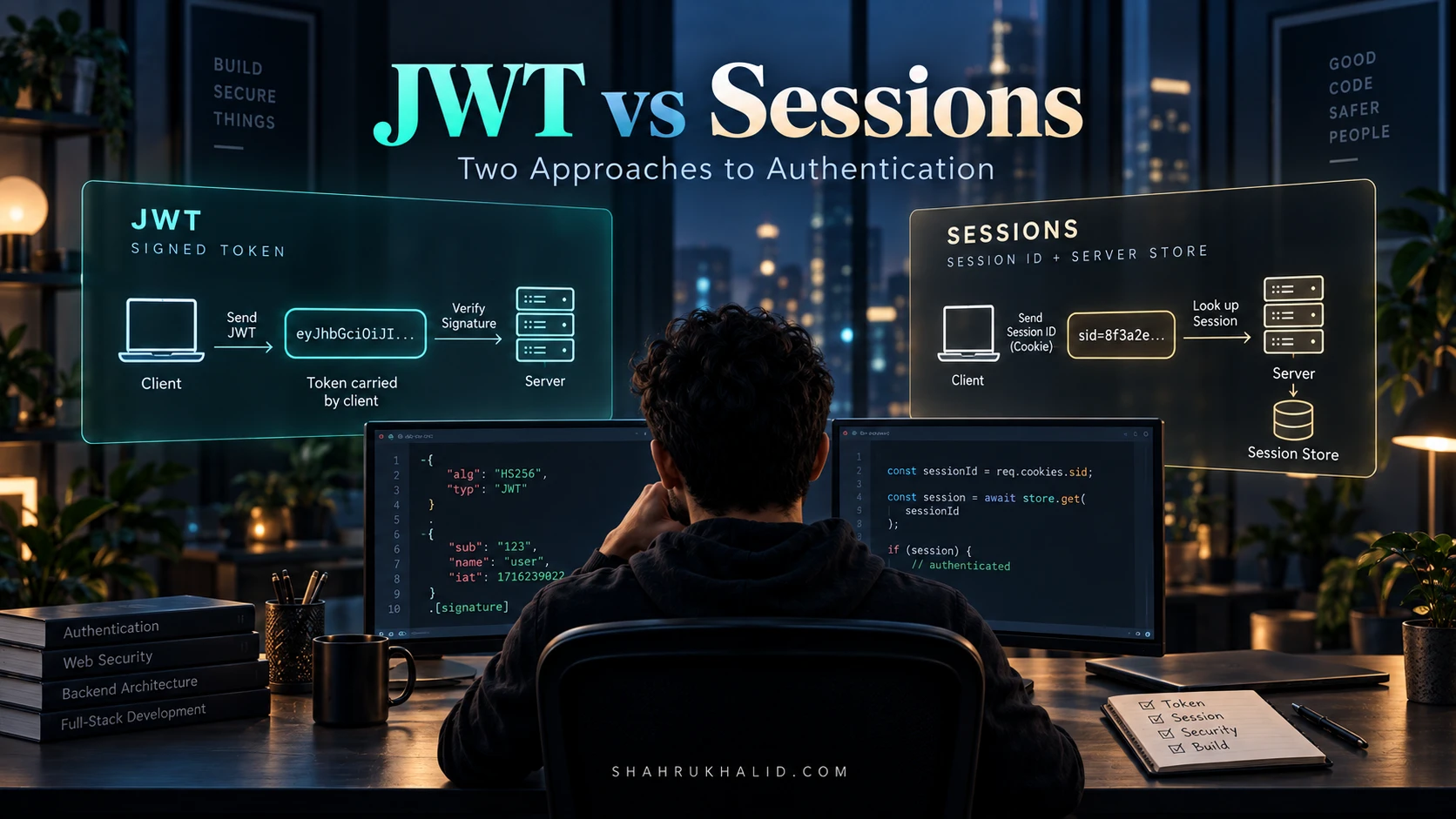
A JWT typically consists of three parts, separated by dots (.), which are Base64Url-encoded:
- Header: Contains metadata about the token, such as the type of token (JWT) and the signing algorithm used (e.g., HMAC SHA256 or RSA).
- Payload: Contains the “claims” – statements about an entity (typically the user) and additional data. Common claims include
iss(issuer),exp(expiration time),sub(subject), and custom application-specific data. - Signature: Created by taking the encoded header, the encoded payload, a secret key, and the algorithm specified in the header, and signing them. This signature is crucial for verifying the token’s authenticity.
When a client authenticates, the server generates a JWT and sends it back. The client then stores this token (e.g., in local storage or a cookie) and includes it in the Authorization header of subsequent requests. The server can then validate the token’s signature without needing to query a database, making it a stateless authentication mechanism.
What is Sessions?
Traditional server-side sessions represent a stateful approach to managing user authentication.
When a user successfully logs in, the server generates a unique session identifier (Session ID) and stores user-specific data (e.g., user ID, roles, permissions) associated with this ID on its own memory, file system, database, or a dedicated session store like Redis.
This Session ID is then sent back to the client, typically embedded in an HTTP cookie.
For every subsequent request, the client’s browser automatically sends this Session ID cookie back to the server.
The server then uses this ID to look up the corresponding session data from its storage.
If the session data is found and is valid, the user is considered authenticated, and their associated data is retrieved for processing the request.
If the session ID is not found or has expired, the user is typically redirected to the login page.
This method means the server maintains a “memory” of the user’s state, making it a stateful system.
The session data itself is never sent to the client, only the ID.
JWT — Pros and Cons
Pros of JWT
- Statelessness: This is the primary advantage. The server does not need to store any session information. All necessary user data is contained within the token itself. This simplifies server architecture and allows for easy horizontal scaling.
- Scalability: Without server-side session storage, any server can process any request, making it ideal for distributed systems, microservices architectures, and load-balanced environments.
- Mobile and Cross-Domain Friendly: JWTs are well-suited for authenticating mobile applications and enabling cross-origin resource sharing (CORS) scenarios, as they are not tied to browser cookies and can be sent in any HTTP header.
- Performance: Once a JWT is issued, subsequent requests can be authenticated by merely validating the token’s signature. This avoids database lookups for every request, potentially reducing latency.
- Information Embedding: Relevant user information (e.g., user ID, roles, permissions) can be embedded directly into the token’s payload, reducing the need for additional database queries for authorization checks.
- Decoupling: Allows for a clear separation between the authentication server and resource servers, which only need to know the shared secret to validate tokens.
Cons of JWT
- No Easy Revocation: Revoking a JWT before its natural expiration is challenging. Since tokens are stateless, the server doesn’t “know” about them once issued. Immediate revocation typically requires implementing a blacklist (or whitelist) mechanism, which reintroduces state and negates some of the stateless benefits.
- Token Size: As more claims are added to the payload, the token size increases. Since the token is sent with every request, larger tokens can lead to increased network overhead.
-
Security Concerns (if mishandled):
- XSS Vulnerability: If JWTs are stored in browser Local Storage, they are susceptible to Cross-Site Scripting (XSS) attacks, where malicious JavaScript can steal the token. HTTP-only cookies are generally preferred for storing JWTs to mitigate this.
- Sensitive Data: The payload is only Base64Url encoded, not encrypted. Sensitive information should never be stored directly in the payload, as it can be easily decoded.
- Secret Management: The secret key used to sign JWTs must be kept extremely secure. If compromised, an attacker can forge valid tokens.
- Expiration Management: Managing short-lived access tokens and long-lived refresh tokens adds complexity, especially around securely storing and rotating refresh tokens.
- Initial Learning Curve: Implementing JWT securely, especially with refresh tokens and proper storage, can have a steeper learning curve compared to framework-provided session management.
Sessions — Pros and Cons
Pros of Sessions
- Easy Revocation: Sessions can be immediately and easily revoked by simply deleting the session data from the server-side store. This is crucial for security events like password changes or detecting suspicious activity.
- Smaller Client-Side Footprint: Only a small session ID (typically a string) is stored on the client (usually in an HTTP-only cookie), reducing network overhead compared to potentially larger JWTs.
- Simpler Initial Implementation: Many web frameworks (e.g., Express.js, Ruby on Rails, Django, ASP.NET) provide built-in session management, making initial setup straightforward.
- Better for Sensitive Data: All sensitive user data is kept securely on the server. The client only holds an opaque identifier, mitigating risks associated with client-side data exposure.
- CSRF Protection: Frameworks often provide built-in CSRF (Cross-Site Request Forgery) protection mechanisms that integrate well with session management.
Cons of Sessions
-
Scalability Challenges (Stateful): Maintaining session state on the server can become a bottleneck in highly scalable or distributed environments.
- Sticky Sessions: Requires load balancers to direct a user’s requests to the same server where their session data resides, which can be inefficient and reduce fault tolerance.
- Shared Session Store: To overcome sticky sessions, a centralized session store (e.g., Redis, database) is needed, which adds infrastructure complexity and a potential single point of failure or performance bottleneck.
- Server-Side Memory/Database Load: Storing and retrieving session data for potentially millions of users can consume significant server resources (memory, CPU, I/O).
- Not Ideal for Mobile/Cross-Domain: Cookies are inherently tied to a domain, making cross-domain authentication complex. Native mobile applications don’t naturally handle browser cookies, requiring custom solutions.
-
CORS Issues: Using session cookies across different domains (e.g., API on
api.example.comand frontend onapp.example.com) requires careful configuration of CORS headers and cookie settings. - Monolithic Tendencies: Tends to encourage a more monolithic application architecture where the backend manages all user state, which can be less flexible for microservices.
When to Choose JWT
JWTs shine in scenarios where statelessness, scalability, and flexibility are paramount. Consider opting for JWTs in the following situations:
- RESTful APIs and Microservices: When building a backend API that serves various client applications (web, mobile, third-party services) or a microservices architecture, JWTs provide a clean, stateless way for services to authenticate and authorize requests without needing to share session state.
- Single Page Applications (SPAs): For frontend frameworks like React, Angular, or Vue.js, JWTs offer a straightforward mechanism for authentication, allowing the frontend to send the token with each API request.
- Mobile Applications: Native mobile apps do not inherently handle browser cookies well. JWTs, being transmitted in HTTP headers, are a natural fit for mobile authentication.
- Single Sign-On (SSO): JWTs are an excellent choice for implementing SSO across multiple applications or services, as a single token can be issued by an identity provider and validated by various resource servers.
- High Scalability Requirements: If your application needs to handle a large number of concurrent users and scale horizontally without complex session management, JWTs are advantageous due to their stateless nature.
- Cross-Domain Authentication: When authentication needs to work seamlessly across different subdomains or entirely separate domains, JWTs are more flexible than cookie-based sessions.
When to Choose Sessions
Traditional server-side sessions remain a robust and often simpler choice for specific types of applications, particularly those with a more traditional architecture. Choose sessions when:
- Traditional Web Applications (Server-Rendered): For applications where the server renders HTML pages and maintains user state throughout their journey (e.g., a typical PHP, Ruby on Rails, or Django application), sessions are often the default and most straightforward solution.
- Strong Need for Immediate Revocation: If your application requires the ability to instantly log out a user or revoke their access (e.g., for security reasons like a password reset or suspicious activity), sessions offer this capability natively without additional complexity.
- Simpler Setups: For smaller projects or applications where horizontal scalability is not an immediate or critical concern, the built-in session management provided by most web frameworks can significantly reduce development time and complexity.
- Sensitive Data Handling: When you need to store highly sensitive user data that should never leave the server, sessions are preferable as only an opaque ID is sent to the client.
- Built-in Framework Support: If your chosen web framework provides robust and secure session management out-of-the-box, leveraging it can be more efficient than implementing a custom JWT solution from scratch.
Real-World Use Cases for Each
JWT Real-World Examples
- Google’s OAuth 2.0 and OpenID Connect: Google uses JWTs extensively for its authentication and authorization flows, allowing users to grant third-party applications access to their data without sharing their credentials.
- Stripe API: Many payment gateway APIs, including Stripe, use token-based authentication (often JWT-like structures) for securing API calls.
- Netflix Microservices: As a prime example of a microservices architecture, Netflix likely leverages token-based authentication to manage user sessions across its vast array of independent services.
- Auth0 and Okta: These identity management platforms heavily rely on JWTs for issuing and verifying user identities across various applications.
Sessions Real-World Examples
- E-commerce Websites (Shopping Carts): Many traditional e-commerce platforms use sessions to maintain a user’s shopping cart state, login status, and preferences as they navigate the site.
- Content Management Systems (CMS): Platforms like WordPress, Drupal, or Joomla often use server-side sessions to manage administrative logins and user-specific dashboard states.
- Traditional Enterprise Applications: Many legacy or internal enterprise applications, especially those built with frameworks like ASP.NET Web Forms or older Java EE applications, extensively use server-side sessions.
- Social Media Platforms (for direct website usage): While they may use JWTs for API access, direct website interactions on platforms like Facebook or Twitter often rely on server-side sessions for managing the user’s logged-in state.
Verdict
The choice between JWT and Sessions is not about one being inherently “better” than the other, but rather about selecting the most appropriate tool for your specific architectural needs and project constraints.
Both “JWT vs Sessions” are powerful authentication mechanisms, each with its own strengths and weaknesses.
For modern, distributed systems, microservices, mobile applications, and Single Page Applications that prioritize scalability and statelessness, JWTs are often the superior choice. They offer flexibility, reduce server load by offloading state management to the client, and are well-suited for cross-domain and multi-platform scenarios. However, their secure implementation requires careful attention to token storage, expiration, and potential revocation challenges.
Conversely, for traditional server-rendered web applications, simpler monoliths, or systems where immediate session revocation is a critical security requirement, server-side sessions remain a robust and often simpler solution. They leverage mature framework support, keep sensitive data strictly on the server, and offer straightforward revocation capabilities. The main trade-off here is the potential for scalability challenges in highly distributed environments.
Ultimately, the decision should be driven by a thorough analysis of your application’s architecture, anticipated scale, security requirements, and the development team’s familiarity with each approach. Sometimes, a hybrid approach might even be considered, using JWT for API authentication and sessions for traditional web parts. The key is to understand the implications of each choice on your system’s design and long-term maintainability.