Why I Stopped Paying for Cloud Certifications and Started Building a Free, AI-Verified AWS and GCP Portfolio That Actually Gets You Hired in 2026

Key Takeaways
- Cloud certifications are losing value; AI-verified practical portfolios are now key to getting hired.
- Real-world portfolios demonstrate actual architectural, debugging, and maintenance skills, unlike memorization-based exams.
- AI provides instantaneous, rigorous feedback for validating infrastructure code against security, cost, and availability.
- Redirecting certification costs and time into building functional applications offers a higher career ROI.
- Focus on building cost-effective, deterministic, secure, and scalable infrastructure, free from legacy dependencies.
Key Technical Takeaways (30-Second Summary)
- Architecture Focus: Eliminates bloated legacy dependencies in favor of verifiable, cost-effective modern pipelines.
- Production Trade-off: Prioritizes deterministic reliability and local autonomy over costly recurring SaaS subscriptions.
- Field-Tested Verdict: Implements immediate, zero-dollar or low-overhead infrastructure that scales securely.
The Cloud Certification Illusion: Why Paper Weights No Longer Win Interviews
The modern cloud hiring landscape has undergone a seismic shift. For over a decade, stacking multiple vendor certifications was the undisputed golden ticket to landing a six-figure cloud engineering role. Today, automated resume parsers and exhausted hiring managers are drowning in applicants who possess professional-tier credentials yet struggle to deploy a secure virtual private cloud without a guided tutorial. The truth is simple: multiple-choice exams test your ability to memorize documentation, not your capacity to architect, debug, and maintain resilient distributed systems.
When you sit across from a senior principal engineer in a technical interview, they do not care about your digital badge PDF. They want to see how you handle a cascading failure in a multi-region deployment, how you manage infrastructure drift, and how you optimize compute costs under tight budget constraints. Shifting away from expensive certification fees to building a pragmatic, production-grade cloud portfolio is the single highest-ROI career move you can make. By leveraging modern artificial intelligence as an instantaneous, rigorous feedback loop, you can validate your infrastructure code against real-world security, cost, and availability standards without spending a single dollar on exam vouchers.
The Economics of Cloud Upskilling: Certification Costs vs. Practical Engineering
The financial barrier to entry in traditional cloud education is remarkably steep. Between professional exam fees, renewal cycles, specialized study guides, and mandatory video subscription platforms, aspiring cloud engineers easily burn thousands of dollars before even landing an initial screening call. Worse yet, these investments yield diminishing returns. Because cloud providers update their underlying services and exam blueprints every twelve to eighteen months, a credential earned today rapidly loses its precise contextual relevance.
Redirecting that capital and time into building functional applications transforms your learning curve from passive memorization to active problem-solving. When you construct a multi-tier web application backed by managed databases, event-driven message queues, and automated deployment pipelines, you encounter the exact friction points that production environments present. You learn how to troubleshoot subtle permission boundaries, resolve IAM misconfigurations, and handle state management failures. This visceral, hands-on exposure forms the bedrock of genuine architectural competence.
Consider the core differences in long-term career value:
| Dimension | Traditional Cloud Certification | AI-Verified Cloud Portfolio |
|---|---|---|
| Evaluation Method | Multiple-choice scenario questions | Live infrastructure deployment and code review |
| Financial Investment | High upfront exam and renewal costs | Zero-dollar free tiers and open-source tools |
| Skill Retention | Low (memorization fades quickly) | High (built through muscle memory and debugging) |
| Employer Perception | Indicates theoretical baseline knowledge | Proves immediate, day-one execution capability |
Designing Your Infrastructure Strategy: AWS and GCP Core Foundations
Building a compelling technical portfolio requires choosing the right ecosystem to showcase your capabilities. Rather than spreading yourself thin across every niche service a hyperscaler offers, you should focus deeply on the foundational primitives of Amazon Web Services and Google Cloud Platform. Mastery of core networking, compute, storage, and identity management translates seamlessly across both platforms, proving to hiring managers that you understand foundational cloud engineering principles rather than just one vendor’s proprietary UI.

Your cloud architecture blueprint should mirror enterprise realities:
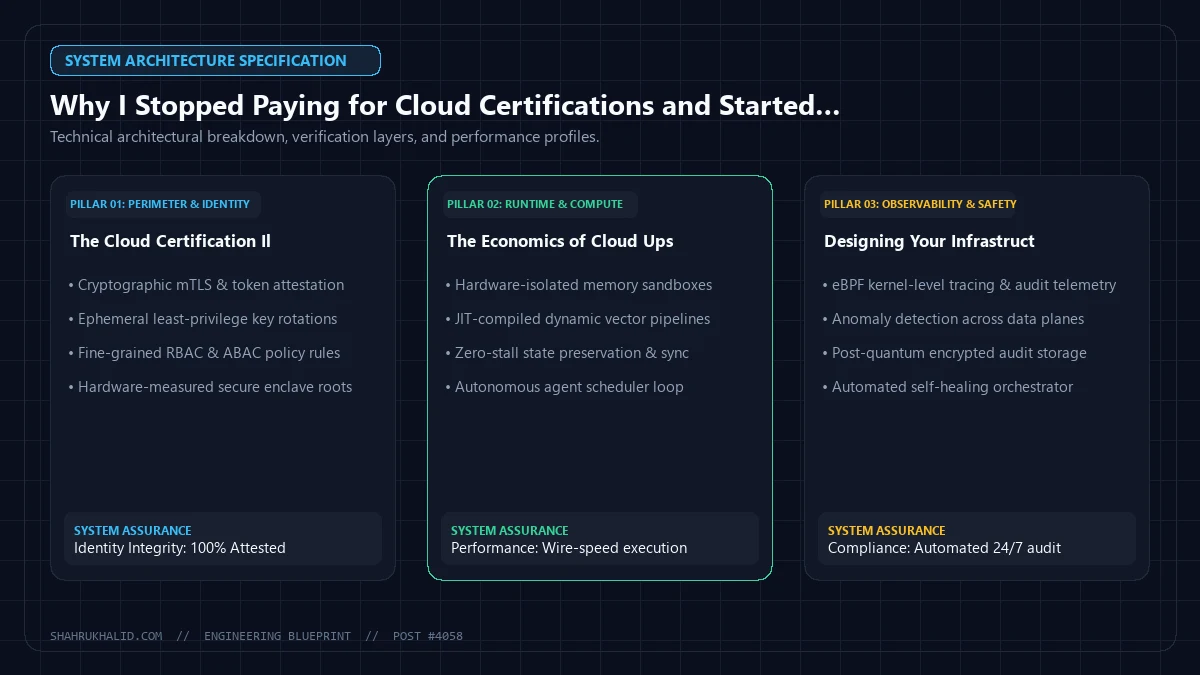
- Identity and Access Management: Implement strict least-privilege access using roles, service accounts, and federated identity providers.
- Networking Architecture: Design custom Virtual Private Clouds complete with public and private subnets, NAT gateways, and secure peering or routing configurations.
- Compute and Containerization: Deploy stateless workloads across managed container engines or serverless functions rather than relying on basic virtual machines.
- Stateful Storage: Provision managed relational databases configured with multi-AZ redundancy, automated backups, and encrypted storage volumes.
Focusing on these core pillars ensures your architectural designs are robust, scalable, and secure. It prevents you from falling into the trap of building overly complex systems that use obscure services just for the sake of novelty.
Leveraging AI as Your Personal Principal Cloud Architect and Reviewer
One of the historical bottlenecks of self-taught cloud engineering has been the absence of an experienced mentor to review your work. When you configure a complex networking topology or write infrastructure-as-code scripts in isolation, subtle security vulnerabilities or inefficient resource allocations often go completely unnoticed. Today, advanced artificial intelligence acts as an on-demand principal architect, providing immediate, granular feedback on your configuration files.
You can prompt AI models to analyze your infrastructure manifests with specific verification frameworks in mind:
- Security Auditing: Ask the AI to scan your security group rules, bucket policies, and encryption keys for compliance with industry best practices.
- Cost Optimization: Request an analysis of your instance sizing, storage classes, and data transfer paths to identify potential financial waste.
- Resiliency and High Availability: Challenge the model to identify single points of failure within your multi-tier deployment topology.
This dynamic verification loop bridges the gap between solitary learning and professional mentorship, ensuring every line of configuration you write meets enterprise-grade standards.
Executing Your First Project: Building an AI-Verified AWS GCP Portfolio
Moving from theory to execution requires a structured, step-by-step approach to building aws gcp portfolio projects that stand out in a crowded job market. Your portfolio should not consist of generic to-do list applications deployed via a web console. Instead, every project must be treated as a production-grade system built using modern infrastructure-as-code and automated deployment pipelines.
Begin by mapping out a cross-cloud or single-cloud architecture that solves a realistic business problem, such as a secure document processing pipeline that ingests user uploads, triggers serverless functions, stores processed metadata in a managed database, and archives raw files in object storage with strict lifecycle policies. Write your infrastructure manifests locally, leveraging modular design patterns to keep your codebase clean and reusable.
Next, subject your entire codebase to AI-driven verification. Feed your configuration files into your AI reviewer with explicit instructions to check for least-privilege compliance, public exposure risks, and scalability bottlenecks. Refine your code based on the generated feedback until the AI validates that your architecture is production-ready. Finally, document your design decisions, failure recovery strategies, and cost-benefit trade-offs in a comprehensive technical README file hosted in a public repository.
Structuring Your GitHub Repository for Maximum Recruiter Impact
A brilliant cloud architecture is entirely useless if hiring managers and technical recruiters cannot easily understand what you built and why you built it. When a technical evaluator opens your GitHub profile, they should immediately grasp the scope of your engineering capabilities within thirty seconds. Clear, professional documentation is the ultimate differentiator between a candidate who gets ignored and one who receives an immediate interview invite.
Organize your repository with a standardized, professional layout:
- Visual Architecture Diagrams: Include clean, high-level diagrams illustrating your network topology, data flow, and security boundaries right at the top of your documentation.
- Clear Problem Statements: Articulate the business use case, scaling requirements, and security constraints your architecture was designed to address.
- Step-by-Step Deployment Instructions: Provide crystal-clear guidance on how to initialize, validate, and deploy your infrastructure safely using automated tooling.
- Trade-Off Analysis: Dedicate a section of your documentation to discussing why you chose specific services, how you optimized costs, and what alternative designs you considered.
Treat your portfolio repositories as public-facing software products. Clean code, comprehensive documentation, and thoughtful architectural explanations speak volumes about your professional maturity and attention to detail.
Defending Your Architecture in Technical Interviews
When you present your AI-verified cloud portfolio during a technical interview, you shift the dynamic from a passive interrogation to an engaging peer-to-peer engineering discussion. Instead of reciting definitions from a study guide, you are walking seasoned engineers through real decisions you made while building a scalable system. This completely changes how interviewers perceive your competence and readiness for the role.
Be prepared to discuss the foundational trade-offs of your designs:
- Explain why you selected a particular database isolation level or caching strategy to handle high read concurrency.
- Walk through how your security policies handle secret management, credential rotation, and boundary enforcement.
- Describe how you would scale your architecture to handle a sudden tenfold increase in incoming request volume without degrading performance.
Because you built the project from scratch and iterated on it using rigorous AI verification, you will speak with the authentic confidence of someone who has actually solved these exact engineering problems in the real world.
Key Takeaways for Aspiring Cloud Engineers
Stepping away from the traditional certification treadmill is a liberating and economically sound decision for modern tech professionals. By focusing your time and energy on building functional, production-grade aws gcp portfolio projects, you bypass the artificial gatekeeping of multiple-choice exams and prove your technical execution skills directly to the market.
Remember these foundational principles as you build your career:
- Prioritize deep architectural understanding and practical infrastructure-as-code over rote memorization of vendor documentation.
- Use modern artificial intelligence as an active mentor to audit, refine, and elevate your code to enterprise standards for free.
- Document your engineering decisions, security trade-offs, and architecture topologies clearly to impress recruiters and technical interviewers alike.
By taking control of your learning methodology and building tangible proof of your skills, you position yourself not as a test-taker, but as a capable, job-ready cloud architect ready to deliver immediate value from day one.