2030 Tech Radar: Autonomous AIs Enterprise Revolution & The Strategists Guide to Unlocking Future Value
Key Takeaways
- Autonomous AI architecture eliminates legacy dependencies, prioritizing cost-effective, scalable, and secure modern pipelines.
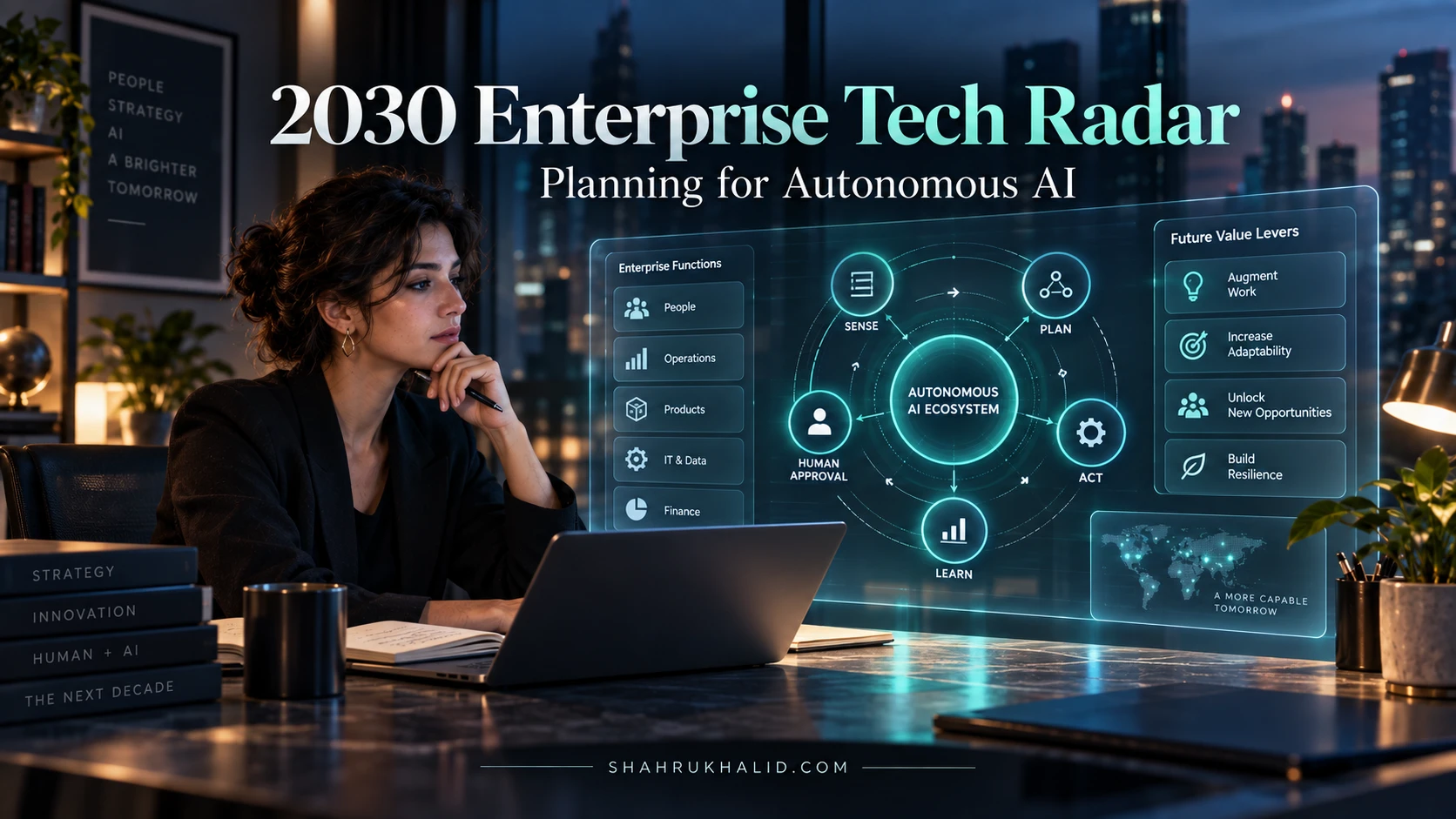
- Autonomous AI enables systems to observe, learn, decide, and act with minimal human intervention.
- Autonomous AI represents a paradigm shift from assistive tools to self-optimizing, decision-making enterprise systems.
- Prioritizes deterministic reliability and local autonomy over costly SaaS, enabling low-overhead, secure scaling.
- This evolution from assistive to autonomous AI is a critical economic reality for future enterprise strategists.
Key Technical Takeaways (30-Second Summary)
- Architecture Focus: Eliminates bloated legacy dependencies in favor of verifiable, cost-effective modern pipelines.
- Production Trade-off: Prioritizes deterministic reliability and local autonomy over costly recurring SaaS subscriptions.
- Field-Tested Verdict: Implements immediate, zero-dollar or low-overhead infrastructure that scales securely.
The year is 2026, and the digital landscape is abuzz with a transformative force that is rapidly reshaping enterprise operations: Autonomous AI. This isn’t merely about automation; it’s about intelligent systems that observe, learn, decide, and act with minimal human intervention, driving an unprecedented revolution in efficiency, innovation, and strategic advantage. For students and future strategists, understanding the trajectory and implications of the Autonomous AI Enterprise is not just beneficial—it’s essential for navigating the decade ahead.
This master article serves as your 2030 Tech Radar, offering a deep dive into how these self-governing AI systems are moving from theoretical promise to practical, economic reality, and what this means for the future of work, business models, and societal structures. We will unpack the exponential drivers propelling this shift, explore high-probability scenarios, and equip you with a strategic framework to unlock future value in this evolving technological frontier.
The Genesis of Autonomy: Tracing the Evolution of Enterprise AI
To grasp the future, we must first understand the past. The journey to the Autonomous AI Enterprise began decades ago, rooted in early expert systems and rule-based automation. These foundational technologies, while limited, laid the groundwork for today’s sophisticated AI. The mid-2010s saw the explosion of machine learning, particularly deep learning, fueled by vast datasets and computational power, enabling AI to identify complex patterns and make predictions with remarkable accuracy.

By the early 2020s, AI had permeated various enterprise functions, from predictive analytics in finance to personalized recommendations in e-commerce. However, these systems often operated in silos, requiring significant human oversight for data preparation, model training, deployment, and monitoring. The critical inflection point arrived with the maturation of reinforcement learning, generative AI, and advanced cognitive architectures, enabling AI systems to learn continuously, adapt to novel situations, and even generate new solutions or content.
This evolution from assistive AI to autonomous AI marks a paradigm shift. Where traditional automation executes predefined tasks, and earlier AIs offered intelligent recommendations, the Autonomous AI Enterprise envisions systems that can define goals, allocate resources, execute complex workflows, and even self-optimize entire business processes without constant human directives. It’s a move from tools that enhance human capability to systems that replicate and extend human-like decision-making and operational execution at scale.
Exponential Drivers Propelling the Autonomous AI Enterprise Revolution
Several interconnected forces are accelerating the development and adoption of Autonomous AI in enterprise settings. These drivers, acting in concert, create a powerful tailwind for this technological revolution.
Advanced Algorithmic Architectures: The Brains of Autonomy
The core of autonomous AI lies in its sophisticated algorithms. We’re seeing a convergence of several advanced techniques:
- Reinforcement Learning (RL) at Scale: Beyond game-playing, RL is now being applied to complex real-world control problems, such as optimizing logistics networks, managing energy grids, and fine-tuning manufacturing processes. RL agents learn through trial and error, developing optimal policies in dynamic environments.
- Generative AI for Dynamic Task Generation: Large Language Models (LLMs) and other generative models are no longer just content creators. They are evolving into powerful task planners and code generators, capable of breaking down high-level objectives into actionable steps, even designing new software modules or data pipelines on the fly. This capability is crucial for enabling AI to adapt to unforeseen challenges.
- Cognitive Architectures and Multi-Agent Systems: The development of cognitive architectures allows AI to integrate perception, reasoning, learning, and action into a cohesive framework. Furthermore, multi-agent systems, where several specialized AIs collaborate to achieve a common goal, are becoming commonplace, orchestrating complex operations across an enterprise.
- Foundation Models and Transfer Learning: Pre-trained foundation models, built on massive datasets, provide a robust base for various downstream tasks. Enterprises can fine-tune these models with their specific data, achieving high performance with less data and computational effort, accelerating deployment of specialized autonomous agents.
Pervasive Data Infrastructures: The Fuel for Learning
Autonomous AI systems are data-hungry. The proliferation of connected devices, IoT sensors, cloud platforms, and enterprise data lakes provides an unprecedented volume and variety of data. Real-time data streams from operational systems, customer interactions, and external environments feed these AIs, enabling continuous learning and adaptive behavior. Data governance, ethical data sourcing, and robust MLOps practices are becoming paramount to ensure the integrity and reliability of autonomous systems.
Ubiquitous Compute Power: The Engine Room
The relentless march of computational power, driven by advancements in GPUs, TPUs, and specialized AI accelerators, makes training and deploying complex autonomous models economically feasible. Edge computing further extends this power closer to the data source, enabling real-time decision-making in environments where latency is critical, such as autonomous vehicles or industrial robotics. Quantum computing, while still nascent, promises to unlock even more profound capabilities for optimization and simulation in the distant future.
Advanced Robotics and Physical Actuation: Bringing AI to the Real World
The integration of advanced AI with sophisticated robotics and physical actuation systems is extending autonomy beyond the digital realm. Collaborative robots (cobots), autonomous mobile robots (AMRs) in warehouses, and increasingly dexterous robotic arms in manufacturing are examples. These systems, guided by autonomous AI, can perform complex physical tasks, interact with their environment, and adapt to changing conditions, blurring the lines between the digital and physical enterprise.
The Competitive Imperative: Innovate or Be Left Behind
Beyond the technological enablers, there’s a powerful business driver: competitive pressure. Companies that successfully deploy Autonomous AI Enterprise solutions are demonstrating significant gains in efficiency, cost reduction, innovation cycles, and customer experience. This creates a strong incentive for other organizations to invest, fearing disruption from more agile, AI-driven competitors. The race for AI supremacy is not just a technological one; it’s a strategic business imperative.
Charting the 2030 Landscape: High-Probability Scenarios for Autonomous AI Enterprise
By 2030, Autonomous AI will not be a niche technology but a foundational layer across many enterprise functions. While radical disruptions are always possible, several high-probability scenarios outline how the Autonomous AI Enterprise will manifest.
Autonomous Supply Chain Optimization
Imagine a supply chain that self-optimizes from raw material sourcing to last-mile delivery. Autonomous AI will monitor global demand signals, geopolitical events, weather patterns, and supplier performance in real-time. It will dynamically re-route shipments, negotiate contracts, predict and mitigate disruptions, and even initiate orders for raw materials. This goes beyond current predictive logistics; it’s a self-healing, self-managing supply network capable of unprecedented resilience and efficiency. For example, a global logistics firm might leverage a multi-agent AI system where one agent monitors shipping routes, another manages inventory levels, and a third dynamically reprices services based on real-time market conditions, all coordinating autonomously to maximize throughput and minimize cost.
Self-Governing Financial Operations
In finance, autonomous AI will oversee complex trading strategies, fraud detection, regulatory compliance, and even internal auditing. AI agents will monitor market anomalies, execute trades within predefined risk parameters, and automatically generate compliance reports. Furthermore, autonomous systems will manage treasury functions, optimizing cash flow and investment portfolios without constant human oversight. A large bank could deploy an autonomous AI for real-time anomaly detection in financial transactions, not just flagging suspicious activity but automatically initiating investigations, freezing accounts, and generating compliance reports, significantly reducing the time and human effort involved in combating financial crime.
Intelligent Customer Experience Orchestration
Customer service will evolve from rule-based chatbots to highly sophisticated, empathetic AI agents capable of resolving complex issues, predicting customer needs, and proactively offering personalized solutions. These autonomous CX systems will learn from every interaction, adapt their communication style, and even anticipate potential churn, initiating retention strategies without human intervention. Think of an AI that not only answers your query but also anticipates your next need based on your historical behavior, proactively offers a solution, and seamlessly integrates with backend systems to execute it, all while maintaining a consistent brand voice.
Autonomous Product Development and Innovation
Autonomous AI will play a pivotal role in the entire product lifecycle. Generative AI will assist in ideation, designing new product features, and even generating initial prototypes or code. AI-driven simulation platforms will autonomously test product designs for durability, performance, and user experience. Feedback loops from market data will autonomously inform iterative improvements, leading to faster innovation cycles and products perfectly tailored to market demands. A software company might use autonomous AI to analyze user feedback, identify common pain points, and then generate potential code solutions or feature designs, which are then autonomously tested and refined before human developers ever see them.
Adaptive Manufacturing and Industrial Operations
Factories will become “lights-out” operations, with autonomous robots and AI systems managing production lines, quality control, predictive maintenance, and energy optimization. These systems will detect anomalies, self-diagnose equipment failures, and even reconfigure production processes to adapt to changing product specifications or supply chain disruptions. The entire manufacturing process will be a dynamic, self-regulating ecosystem. Consider an automotive plant where AI monitors every robotic arm, every sensor, predicting potential failures before they occur and automatically scheduling maintenance or re-routing production to avoid downtime, all while optimizing energy consumption.
Economic and Societal Ripple Effects: Navigating the New Frontier
The widespread adoption of the Autonomous AI Enterprise will bring profound economic and societal changes, requiring careful consideration and strategic planning.
Economic Restructuring and Productivity Gains
The most immediate economic effect will be a significant boost in productivity. Autonomous systems operate 24/7, with greater precision and speed than humans, leading to substantial cost reductions and increased output. This will drive down the cost of goods and services, potentially stimulating economic growth. However, it also implies a restructuring of labor markets, with a shift away from routine, repetitive tasks and a greater demand for skills in AI development, oversight, ethics, and creative problem-solving.
New Job Categories and Skill Demands
- AI Ethicists and Governance Specialists: Ensuring autonomous systems operate fairly, transparently, and in alignment with human values.
- AI System Architects and Engineers: Designing, building, and maintaining complex autonomous AI infrastructures.
- Human-AI Collaboration Facilitators: Training and integrating human teams to work effectively alongside autonomous agents.
- Creative and Strategic Roles: Roles emphasizing human creativity, critical thinking, empathy, and strategic foresight will become even more valuable.
Ethical and Governance Imperatives
As AI systems become more autonomous, the ethical implications become more pronounced. Questions of accountability, bias, transparency, and control will move to the forefront. Who is responsible when an autonomous system makes an error? How do we ensure fairness in AI-driven decisions that impact individuals or groups? Robust regulatory frameworks, ethical AI design principles, and transparent auditing mechanisms will be crucial to build public trust and prevent adverse outcomes.
Key Ethical Considerations
- Accountability: Defining liability for decisions made by autonomous systems.
- Bias Mitigation: Ensuring AI models are trained on diverse, representative data and do not perpetuate or amplify societal biases.
- Transparency and Explainability (XAI): Developing methods to understand how autonomous AIs arrive at their decisions, especially in critical applications.
- Control and Override: Designing clear human-in-the-loop mechanisms for intervention when necessary.
Cybersecurity and Resilience Challenges
The interconnected nature of autonomous AI systems presents new cybersecurity challenges. A successful breach of an autonomous system could have cascading effects across an entire enterprise or critical infrastructure. Ensuring the resilience, robustness, and security of these systems against sophisticated cyber threats will be paramount. This includes adversarial AI research to make systems more robust to manipulation.
Societal Transformation and Human-AI Symbiosis
Beyond the workplace, autonomous AI will reshape daily life. Smart cities will leverage autonomous systems for traffic management, public safety, and resource allocation. Healthcare will see autonomous diagnostics and personalized treatment plans. The key will be to foster a symbiotic relationship between humans and AI, where AI augments human capabilities and frees up human potential for more creative, complex, and empathetic endeavors, rather than simply replacing human roles.
The Strategist’s Guide: Unlocking Future Value in the Autonomous AI Enterprise
For students aspiring to be future leaders and strategists, understanding how to harness the power of Autonomous AI is vital. This guide provides a foundational framework for strategic preparation.

1. Cultivate an AI-First Mindset
The first step is a fundamental shift in perspective. Instead of asking “How can AI help our existing processes?”, ask “How would we design this process if AI could handle any complex, repetitive, or data-intensive task autonomously?” This mind shift encourages rethinking business models from the ground up, identifying opportunities for radical optimization and innovation.
Practical Exercise: Reimagining a Process
Choose a common enterprise process (e.g., customer onboarding, expense reporting, product defect analysis). First, map the current human-driven steps. Then, identify every decision point, data input, and action. Now, imagine an autonomous AI system capable of performing these tasks. How would the process change? What human roles would evolve? What new data would be needed?
2. Master the Fundamentals of AI and Data Science
While you may not become a deep learning engineer, a foundational understanding of AI concepts, methodologies, and limitations is crucial. This includes:
- Core AI Concepts: Differentiating between machine learning, deep learning, reinforcement learning, and generative AI.
- Data Literacy: Understanding data types, data quality, data governance, and the importance of ethical data sourcing.
- AI Project Lifecycle: Familiarity with problem framing, data collection, model training, evaluation, deployment (MLOps), and monitoring.
- AI Ethics and Governance: Awareness of bias, fairness, transparency, and accountability in AI systems.
Study Tip: Hands-on Exploration
Engage with online courses (Coursera, edX, Google AI), participate in Kaggle competitions, and experiment with open-source AI frameworks (e.g., TensorFlow, PyTorch). Even simple projects, like building a sentiment analyzer or a basic image classifier, provide invaluable practical experience.
3. Develop Strong Systems Thinking and Interdisciplinary Skills
Autonomous AI systems are not isolated components; they are interconnected parts of a larger enterprise ecosystem. Strategists must develop strong systems thinking to understand how changes in one part of the system affect others. Furthermore, the future demands interdisciplinary leaders who can bridge the gap between technology, business, ethics, and human psychology.
Example: Interdisciplinary Challenge
Consider the deployment of an autonomous AI for HR recruitment. A strategist needs to understand the technical capabilities of the AI, the business goals (e.g., reducing time-to-hire), the ethical implications (e.g., algorithmic bias in candidate selection), and the human impact (e.g., how to communicate with candidates rejected by AI).
4. Prioritize Data Infrastructure and MLOps Maturity
The success of any Autonomous AI Enterprise hinges on robust data infrastructure and mature MLOps (Machine Learning Operations) practices. This involves:
- Data Pipelines: Building efficient and reliable pipelines for collecting, cleaning, transforming, and storing data.
- Model Governance: Implementing version control, lineage tracking, and auditing for AI models.
- Continuous Integration/Continuous Deployment (CI/CD) for AI: Automating the testing, deployment, and monitoring of AI models.
- Monitoring and Observability: Establishing systems to continuously track model performance, detect drift, and ensure ethical operation.
Architectural Breakdown Example: MLOps for Autonomous AI
An MLOps pipeline for an autonomous AI might look like this:
- Data Ingestion: Real-time data streams from various sources (IoT, transactional systems, external APIs).
- Data Preparation & Feature Engineering: Automated cleaning, transformation, and creation of features for AI models.
- Model Training & Validation: Automated training of multiple AI models (e.g., RL agents, generative models) and rigorous validation against performance and ethical benchmarks.
- Model Registry: Versioning and storing trained models with metadata.
- Automated Deployment: Deploying validated models to production environments (cloud, edge).
- Continuous Monitoring: Real-time tracking of model performance, data drift, concept drift, and adherence to ethical guidelines. Automated alerts and re-training triggers.
- Feedback Loop: Learning from production outcomes to retrain and improve models continuously, ensuring autonomous adaptation.
5. Focus on Human-AI Teaming and Change Management
Autonomous AI will not eliminate humans from the loop entirely, but it will redefine human roles. Strategists must focus on designing effective human-AI collaboration models and managing the organizational change associated with AI adoption. This includes training employees, redesigning workflows, and fostering a culture of continuous learning and adaptation.
Key Elements of Human-AI Teaming
- Clear Interface Design: Creating intuitive dashboards and communication channels for humans to monitor and interact with autonomous systems.
- Defined Intervention Points: Establishing clear protocols for human override or intervention in autonomous decision-making.
- Upskilling and Reskilling Programs: Investing in training programs to equip the workforce with the skills needed to work alongside AI.
- Psychological Preparedness: Addressing concerns about job displacement and fostering a positive attitude towards AI as an augmentative force.
6. Champion Ethical AI and Responsible Innovation
As future leaders, you will be responsible for ensuring that autonomous AI is developed and deployed responsibly. This means advocating for ethical AI principles, building diverse and inclusive AI teams, and proactively addressing potential societal harms. Responsible innovation is not just a moral imperative; it’s a strategic advantage, building trust with customers, employees, and regulators.
Study Tip: Engage with Policy and Philosophy
Explore resources from organizations like the AI Now Institute, OpenAI, and governmental AI ethics committees. Read philosophical works on technology and society. Understanding the broader implications beyond purely technical aspects is crucial for responsible leadership.
7. Embrace Continuous Learning and Adaptability
The field of AI is evolving at an unprecedented pace. What is cutting-edge today may be foundational tomorrow. Strategists must cultivate a mindset of continuous learning, staying abreast of new research, technologies, and best practices. Adaptability will be the ultimate competitive advantage.
Recommended Learning Resources (2026 Perspective)
- MIT Technology Review: For deep dives into emerging technologies and their societal impact.
- Google AI Blog & DeepMind Blog: For research breakthroughs and practical applications.
- Harvard Business Review: For strategic implications of AI on business models and leadership.
- Wired Magazine: For accessible insights into technological trends and their cultural resonance.
- NIST AI Risk Management Framework: For understanding practical approaches to AI governance and risk.
Conclusion: The Dawn of the Autonomous AI Enterprise and Your Role in Shaping It
The Autonomous AI Enterprise is not a distant fantasy; it is the inevitable evolution of business in the digital age, rapidly solidifying its presence by 2030. This revolution promises unprecedented levels of efficiency, innovation, and resilience, fundamentally reshaping industries from finance to manufacturing, and from logistics to customer experience. The strategic imperative for every organization is clear: adapt, evolve, and integrate, or risk obsolescence.
For you, the aspiring strategist and future leader, this era presents both immense challenges and unparalleled opportunities. Your ability to understand, design, implement, and ethically govern autonomous AI systems will define your impact. By cultivating an AI-first mindset, mastering foundational AI and data science concepts, developing strong systems thinking, prioritizing robust MLOps, championing human-AI collaboration, and committing to responsible innovation, you will not only navigate this complex landscape but actively shape it. The future of the Autonomous AI Enterprise is not merely happening to us; it is being built by us, and your informed, strategic contributions will be critical to unlocking its true, beneficial value for all.