Your 2026 Breakthrough: The Beginners Simple Recipe for Viral Lists That Hit Page One

Key Takeaways
- Apply an engineering mindset to content creation for predictable viral listicle success.
- Viral lists achieve sustainable, compounding organic reach and ranking, not just social shares.
- Leverage cognitive ease: listicles promise finite effort, making complex topics less intimidating.
- Create a curiosity gap with numbered headlines to psychologically hook readers.
- Design listicles for scannability, catering to how readers consume information online.

Forget the myths about “going viral” being a lightning strike of pure luck. It’s not. It’s a science, an art, and an engineering problem all rolled into one. And by the end of this masterclass, you’ll have the complete blueprint. We’re going to build your first high-ranking list post from the ground up, piece by piece, just like a developer builds an application. Let’s get started.
Comprehensive Foundations & The Viral List SEO Primer
Welcome to the bedrock of our entire journey. Before we write a single word or look at a single tool, we need to understand the ‘why’ behind it all. Why do listicles, or “list posts,” have such an incredible power to capture attention and climb the search rankings? And what exactly is this “Viral List SEO” concept we’re going to master? Think of this module as learning the physics of our universe before we try to build a rocket ship.
The Irresistible Psychology of Lists: Why Our Brains Are Hardwired for “Top 10s”
Have you ever found yourself mindlessly scrolling and suddenly stopping at an article titled “7 Unexpected Habits of Highly Productive People”? Of course you have. We all have. This isn’t a weakness; it’s a feature of the human brain. Lists appeal to our fundamental desire for order and easy consumption of information.
Here’s the simple breakdown:
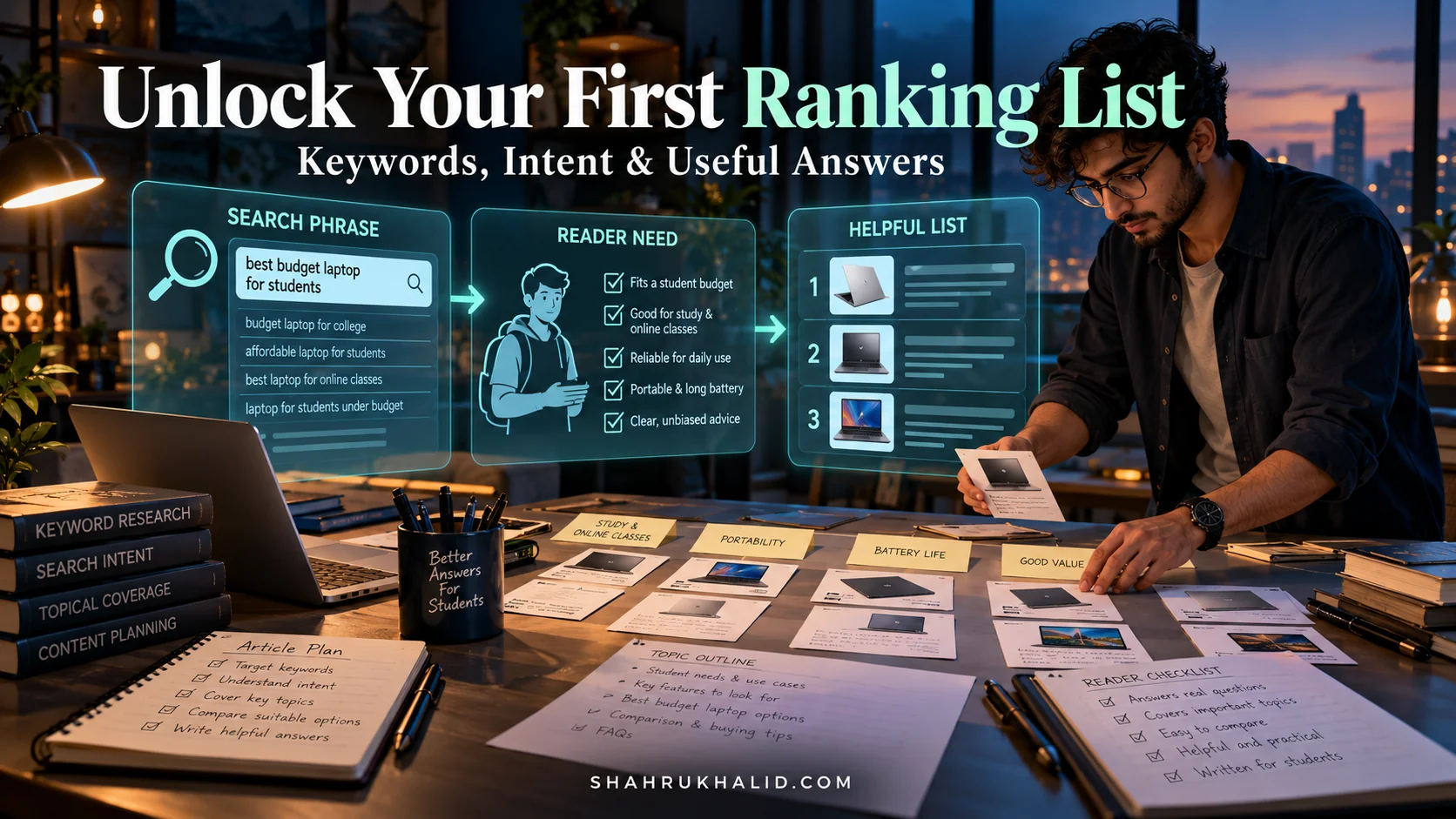
- They Promise a Finite Effort: A title like “The Ultimate Guide to JavaScript” is intimidating. It sounds like a textbook. But “5 Common JavaScript Mistakes to Avoid” is a promise. It tells your brain, “This won’t take forever. There’s a clear beginning and a clear end. You can handle this.” This is called cognitive ease.
- They Create a Curiosity Gap: A number in the headline creates an immediate question in your mind. “12 Secret VS Code Shortcuts”? My brain instantly goes, “I know some… but do I know all 12? What am I missing out on?” This gap between what we know and what the article promises to tell us is a powerful psychological hook that’s almost impossible to ignore.
- They’re Scannable: In our fast-paced world, we don’t read online; we scan. Numbered headings and clear sections make it incredibly easy for a reader to jump to the points that interest them most, getting the value they want with minimal effort.
Understanding this is your first superpower. We’re not just writing an article; we’re crafting a piece of content that works with human psychology, not against it.
Demystifying “Viral List SEO”: It’s Not Magic, It’s Engineering
Let’s clear the air. “Viral” doesn’t just mean getting a million shares on social media overnight. In our context, a “viral” list is one that achieves sustainable, compounding organic traffic because it perfectly answers a user’s question, is structured for maximum engagement, and earns the trust of search engines like Google.
Viral List SEO is the discipline of engineering a list post to excel in three key areas simultaneously:
- Human Virality (The Share): The content is so useful, surprising, or emotionally resonant that people are compelled to share it with their friends, colleagues, or social networks. This answers the question, “How do you make a listicle go viral?”
- Search Engine Virality (The Rank): The content is so well-structured, authoritative, and relevant to a search query that Google places it on page one, creating a self-sustaining loop of traffic. This answers, “What makes a list post rank on Google?”
- Value Virality (The Stickiness): The content is so genuinely helpful that readers bookmark it, return to it, and see the author or brand as a trusted resource. This is the long-term win.
Think of it like a three-legged stool. If you only focus on social shares, your traffic will die when the buzz fades. If you only focus on rigid SEO rules, your content might be boring and unshareable. If you only provide value without thinking about discovery, no one will ever find it. Our recipe is about building all three legs to be strong and balanced. This is the core of our beginner content marketing strategy.
The 2026 Landscape: Why This Skill is More Critical Than Ever
The digital world is getting noisier. AI can generate mountains of generic, soulless content in seconds. In this new reality, the winners won’t be the ones who produce the most content, but the ones who produce the most valuable, human-centric, and well-structured content.
Google’s own documentation on creating helpful, reliable, people-first content emphasizes this. They are actively rewarding content that demonstrates experience, expertise, authoritativeness, and trustworthiness (E-E-A-T). A well-engineered listicle is the perfect format to showcase this. You can demonstrate expertise by curating the best items, show experience through personal anecdotes in each point, and build trust by providing genuinely helpful advice.
The simple, structured format of a listicle is your secret weapon against the noise. It’s a format that both humans and search engine algorithms inherently understand and appreciate. Mastering this “simple recipe for viral list content for beginners” isn’t just about getting a few more clicks in 2024; it’s about building a foundational skill that will keep you relevant and successful well into 2026 and beyond.
Prerequisites & Complete Environment Setup
Every great project, whether it’s coding an application or baking a cake, starts with preparing your workspace and gathering your ingredients. In the world of content creation, our “environment setup” isn’t about installing complex software, but about equipping ourselves with the right tools and organizing our workflow for efficiency and success. This module is your step-by-step guide to setting up your “developer environment” for writing.
Your Core Toolkit: The Four Essential “Software” Packages
You don’t need expensive, complicated software to start. In fact, for your first viral list, we’re going to stick to a suite of simple, mostly free tools. Think of these as your code editor, your compiler, and your debugger.
- The Text Editor (Your IDE): This is where the magic happens. You need a clean, distraction-free space to write.
- Beginner’s Choice: Google Docs. It’s free, cloud-based (no lost work!), has great collaboration features, and includes a decent spell checker and grammar suggestions.
- Developer’s Choice: Visual Studio Code (VS Code) with the Markdown All in One extension. If you’re from a dev background, this will feel like home. Writing in Markdown (
.mdfiles) is a fantastic way to focus on structure (headings, lists, bolding) without getting bogged down by complex formatting menus. - The Keyword Compass (Your Linter): This tool helps us understand what people are actually searching for. It ensures our content is aligned with real user intent.
- The Simple Start: Google itself! Start typing your topic idea into the search bar and look at the autocomplete suggestions. Scroll to the bottom of the results page and analyze the “Related searches.” These are pure gold. They are literally Google telling you, “Here are other things people are searching for related to your topic.”
- The Next Step (Free): Google Keyword Planner. If you have a Google account, you can access this tool for free. It gives you concrete data on search volume (how many people are searching for a term per month) and competition.
- The Grammar & Style Guardian (Your Debugger): Typos and grammatical errors are like bugs in your code. They destroy credibility and make your content look unprofessional.
- The Standard: Grammarly (Free Version). The browser extension and desktop app are fantastic. The free version catches most critical spelling and grammar mistakes. It’s a non-negotiable safety net.
- The Visual Asset Library (Your Graphics Engine): A listicle without images is like a user interface without icons—dull and hard to navigate.
- The Go-To: Unsplash or Pexels. Both offer massive libraries of high-quality, royalty-free images that you can use without attribution (though it’s always a nice gesture).
Step-by-Step Environment Configuration: Building Your Project Directory
Just like a software project, we need an organized folder structure. This prevents chaos and makes it easy to find everything. On your computer, create a main folder for your content projects. Inside that, create a new folder for the listicle you’re about to write.
Let’s say we’re writing an article called “7 Essential Python Libraries for Data Science Beginners.”
Step 1: Create the Project Root Folder.
Create a folder named python-libraries-listicle.
Step 2: Create Your Sub-directories.
Inside python-libraries-listicle, create the following structure:
|
|– 01_research/
| |– keywords.txt
| |– competitor_analysis.txt
| |– brain_dump.md
|
|– 02_drafts/
| |– v1_first_draft.md (or a Google Doc link)
| |– v2_edited_draft.md
|
|– 03_assets/
| |– header_image.jpg
| |– pandas_logo.png
| |– numpy_diagram.jpg
|
|– 04_final/
| |– final_published_text.md
Why this structure?
01_research: Keeps all your messy brainstorming, keyword lists, and notes on competitor articles in one place.02_drafts: Separates your work-in-progress from your final version. You can always go back to an older version if you need to.03_assets: Stores all your images and graphics. This is crucial for keeping track of them and for easy uploading later.04_final: This holds the polished, ready-to-publish version of your article.
This might seem overly formal for a blog post, but I promise you, this discipline is what separates amateurs from pros. It’s a system that scales. When you’re working on your tenth listicle, you’ll be so glad you have this organized workflow.
CLI Verification: Your Pre-Flight Checklist
In development, we run npm install or pip freeze to verify our environment. For our content project, our “verification” is a simple checklist. Before you move to the next module, confirm the following:
- [ ] Chosen Text Editor: Is it installed or open in your browser?
- [ ] Keyword Research: Have you spent at least 15 minutes typing your core topic into Google and noting down autocomplete/related searches in your
keywords.txtfile? - [ ] Grammar Tool: Is the Grammarly extension installed in your browser?
- [ ] Project Directory: Have you created the folder structure as outlined above?
Once you can check all these boxes, your environment is officially configured. You’re ready to start building the architecture of your viral list.
Core Implementation Architecture
Now that our environment is set up, it’s time to become architects. In software, architecture is the blueprint that defines the structure, components, and interactions of the system. In our Viral List SEO recipe, the “architecture” is the fundamental structure of the listicle itself. A post that goes viral and ranks on page one is not an accident; it’s meticulously designed.
We will break down a high-performance listicle into its core components, just like a developer would break down an application into microservices. We’ll use a “visual card” model to think about each list item as a self-contained, value-packed unit.
The Anatomy of a Page-One Listicle: A Diagrammatic Grid
Imagine your entire article as a container. Inside this container are several distinct, interlocking components. Each one has a specific job to do.
Getting this structure right is more than half the battle. It makes your content predictable and easy to consume for humans, and perfectly legible for Google’s crawlers, which are looking for clear, hierarchical information. This is the foundational answer to “How can beginners create high-ranking listicles?”—by focusing on a superior structure.
The Title (H1): Your First and Most Important API Call
Your title has two jobs, and they are equally important:
- For Humans: It must create an irresistible curiosity gap.
- For Google: It must contain your primary keyword.
Let’s workshop a title. Imagine our topic is “ways to learn coding.”
- Boring: “Ways to Learn Coding”
- Better (adds a number): “10 Ways to Learn Coding”
- Great (adds a benefit/adjective): “10 Proven Ways to Learn Coding Faster”
- Excellent (adds a target audience and timeframe): “10 Proven Ways for Beginners to Learn Coding in 2026”
A great title formula is: [Number] + [Adjective/Promise] + [Primary Keyword] + [Benefit/Audience]
Example: 7 Surprising git Commands That Will Save You Hours
This is your most critical piece of metadata. It’s what shows up in the Google search results and on social media shares. Spend real time on it. Write 5-10 different versions in your brain_dump.md file before you pick the winner.
The Introduction: The 10-Second Trust-Building Exercise
You have about 10 seconds to convince a reader they’ve come to the right place. A high-performing introduction follows a simple three-step formula I call “Problem, Promise, Proof.”
- The Problem (Relate): Start by stating a problem or feeling your target reader experiences. This shows empathy and hooks them immediately.
- Example: “Staring at a blank screen, wondering where to even begin your coding journey? The sheer number of languages, courses, and tutorials can feel overwhelming, leading to paralysis before you even write your first line of
hello world.” - The Promise (Agitate & Solve): Briefly agitate the problem and then promise a clear, simple solution. This is where you introduce your list.
- Example: “But what if there was a simple roadmap? In this guide, we’ve boiled it all down to the 10 most effective, proven strategies that will take you from absolute beginner to confident coder. No fluff, just actionable steps.”
- The Proof (Authority): Briefly mention why you are qualified to give this advice. This can be subtle.
- Example: “As someone who has mentored dozens of junior developers, I’ve seen exactly which methods work and which ones are a waste of time. These are the 10 I recommend every single time.”
This intro builds instant rapport and sets the stage for the value you’re about to deliver.
The “Visual Card” Structure for Each List Item
Now for the core of your article. Do NOT just write a wall of text. Think of each list item as a self-contained, beautifully designed “card.” Each card must have, at a minimum, these four elements:
- The Numbered Heading (H2 or H3):
<h2>1. Master the Command Line</h2>This is the anchor. It makes the content scannable and signals a new section to Google. Use<h2>if your list items are the main sections of your article, or<h3>if they are subsections within a larger topic. For most listicles,<h2>is the right choice. - The Supporting Visual: Immediately after the heading, place a relevant image, a simple diagram, or even a code snippet screenshot. Visuals break up the text and can often explain a concept faster than words can.
- The Core Explanation (The “P-E-A” Method): This is the meat of the card. Don’t just state the item; explain it using the Point, Evidence, Action formula.
- Point: Clearly state the main idea of this list item. (“The command line is the single most important tool for a developer.”)
- Evidence: Explain why it’s important. Give a short anecdote, a statistic, or a logical reason. (“It’s the universal language for interacting with servers, version control, and build tools. GUIs change, but the command line is forever.”)
- Action: Give the reader a concrete, simple next step. (“Your task this week: learn just three basic commands:
ls,cd, andmkdir. That’s it.”) - The Internal Link: Somewhere in the text, find an opportunity to link to another relevant article on your site or a trusted external resource. This is great for SEO and provides more value to the reader. For example, in a section about Git, you could link to the official Git documentation.
By architecting every single list item this way, you create a rhythm. The reader knows what to expect, and each “card” delivers a satisfying, complete piece of value. This meticulous structure is a key element of viral list content.
Hands-on Code & Practical Implementation
Theory and architecture are essential, but the real learning happens when you get your hands dirty. In this module, we’re going to translate our architectural blueprint into a tangible, production-ready piece of content. I’m going to provide you with a “heavily commented” Markdown template.
Think of this Markdown not as code that a computer compiles, but as a structured script that the human brain and Google’s crawlers “execute.” The “comments” are my notes to you, the developer-writer, explaining the purpose of each line and section. This is your simple steps for viral list post SEO, laid out in a format you can copy, paste, and adapt for your own topic.
The “Production-Ready” Listicle Template (Commented Markdown)
Copy this entire block of code into your v1_first_draft.md file (or a new Google Doc). The content is a placeholder for our example topic: “7 Simple SEO Tips for Developers Who Hate Marketing.” Your job will be to replace the placeholder content with your own, following the structural guidance in the comments.
The 7 Actionable Rules of Viral Technical List Design
- Front-Load High-Intent Keywords: Structure your titles to match exact searcher vocabulary while emphasizing practical timeliness.
- Establish Clear Visual Hierarchy: Break lengthy prose into consumable cards featuring distinct headings, bullet summaries, and code snippets.
- Implement Verified Code Examples: Every code snippet must run without syntax errors and reflect current library syntax.
- Eliminate Vague Marketing Fluff: Focus strictly on architectural trade-offs, setup requirements, and benchmarks.
- Add Semantic JSON-LD Schema: Help search engines recognize item sequences with structured data markup.
- Integrate Contextual Cross-Links: Direct readers to related foundational tutorials across your platform.
- Provide Next-Step Implementation Calls: Wrap every guide with a tangible starter project or checklist.
Summary & Developer Takeaways
Transforming complex technical concepts into viral, search-dominating resources requires intentionality rather than luck. By applying systematic formatting, verified code blocks, and human-first clarity, your engineering content stands out in an era of automated noise.