Mastering Comparison Content in 2026: The Complete Step-by-Step Implementation Guide
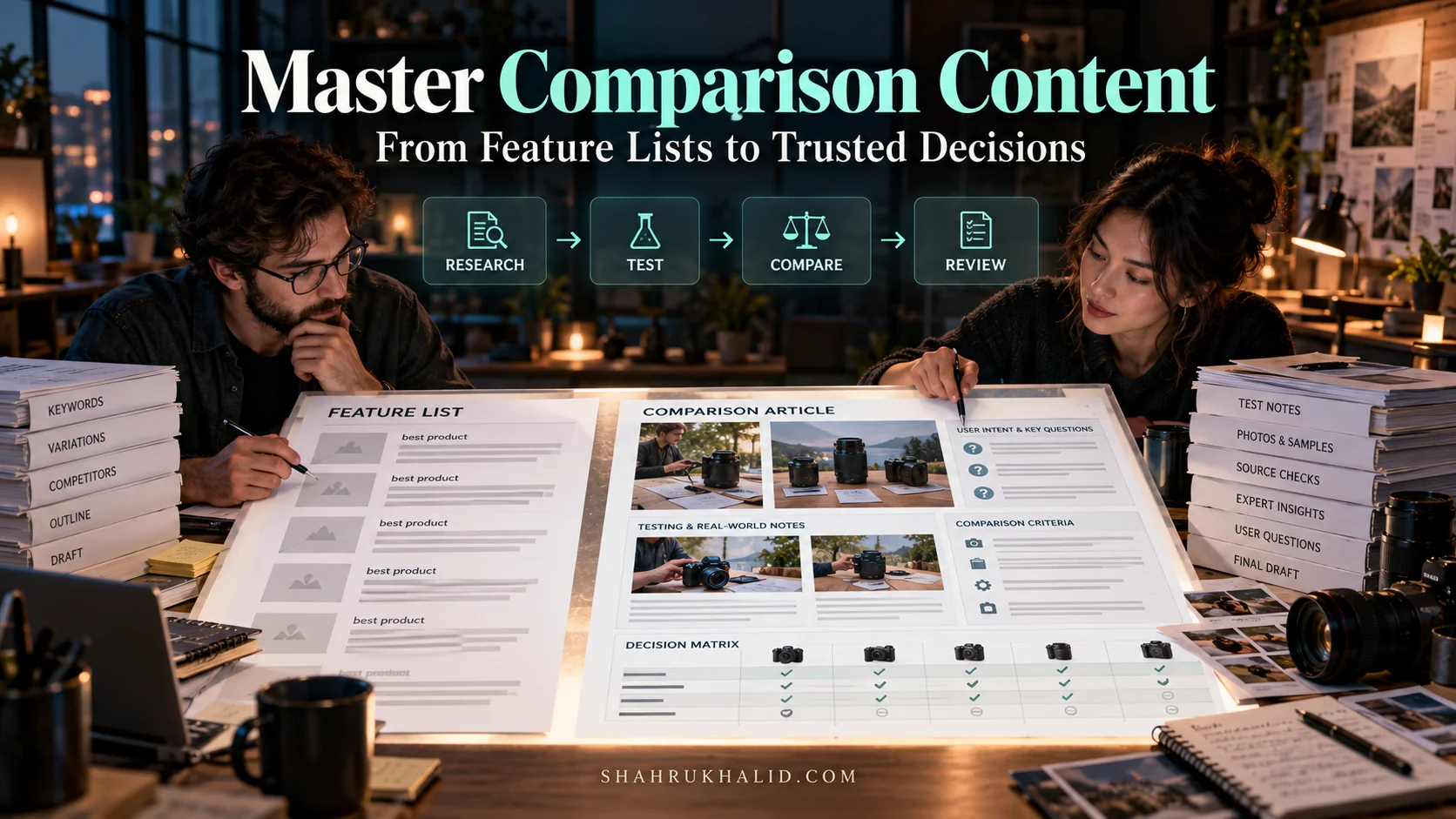
Key Takeaways
- Comparison content demands a sophisticated 2026 strategy, moving beyond traditional SEO.
- Prioritize AIO & E-E-A-T for comparison content, satisfying AI models and human trust.
- Traditional SEO, focused on keywords/traffic, is a 'relic' sacrificing depth for algorithms.
- Content must resonate with advanced AI retrieval models and human decision-makers alike.
- Comparison content's core purpose is empowering informed user decisions, preventing remorse.
The digital landscape of 2026 demands a sophisticated approach to content, especially when guiding users through complex decisions. Gone are the days when simply listing features side-by-side guaranteed attention. Today, mastering your comparison content strategy means navigating a world dominated by AI Overviews, zero-click answers, and an insatiable hunger for genuine expertise. We’re not just writing for search engines anymore; we’re crafting content that AI models deem worthy of citation and that discerning human readers trust implicitly. This isn’t merely an update to old tactics; it’s a fundamental shift in how we conceive, create, and distribute information.
This guide isn’t just about what to compare, but how to compare in a way that resonates with both advanced AI retrieval models and the human decision-makers they serve. We’re about to embark on a head-to-head showdown between two distinct philosophies for comparison content: the “Traditional SEO-Driven Approach” – a relic of the past decade, focused primarily on keyword density and traffic volume – and the “AIO & E-E-A-T-Driven Approach” – the forward-thinking methodology optimized for AI, trust, and qualified conversions. Understanding the architectural differences between these two will be your compass in the evolving content universe.
The Architectural Showdown: Core Philosophies & Overview
In the rapidly evolving digital ecosystem of 2026, the very foundation of how we approach comparison content has undergone a profound transformation. What was once a straightforward exercise in feature listing and keyword optimization has matured into a nuanced art, demanding strategic depth and a keen understanding of both human psychology and artificial intelligence. At its heart, comparison content serves a crucial purpose: to empower users with the information they need to make informed decisions, whether they’re choosing between two software solutions, a pair of competing products, or even different service providers. It’s about alleviating buyer’s remorse before it even sets in, providing clarity in a world saturated with options. But how we deliver that clarity has become the battleground.
Let’s frame this as an architectural showdown between two dominant philosophies for building a robust comparison content strategy. On one side, we have the “Traditional SEO-Driven Approach,” a methodology that, while effective in its prime, is increasingly showing its age. Its core design philosophy was rooted in maximizing organic search visibility through keyword targeting, link building, and content volume. The target paradigm was clear: rank high, drive clicks, and capture broad traffic. This approach often led to content that was optimized for machines first, and humans second, sometimes sacrificing depth and genuine insight for algorithmic favor. Think of it as a sprawling, somewhat unoptimized data center, built for sheer capacity but perhaps lacking in intelligent processing. Teams often struggled with this approach because while it could generate traffic, that traffic wasn’t always qualified, leading to high bounce rates and low conversion metrics. The focus was on the “what” – what keywords to target, what features to list – rather than the “why” or the “how” of truly helping a user decide.
Opposing this, we have the “AIO & E-E-A-T-Driven Approach,” the cutting-edge architecture for 2026 and beyond. This philosophy is built on the principles of AI Optimization (AIO) and E-E-A-T (Experience, Expertise, Authoritativeness, Trustworthiness), recognizing that search is no longer just about keywords, but about intent, context, and verifiable credibility. The target paradigm here is not just clicks, but qualified engagement and zero-click answers. As the digital landscape shifts, buyers are increasingly starting their research in AI platforms like ChatGPT, Claude, Perplexity, and Google’s AI Overviews. This means our content must be designed to be easily digestible and citable by AI retrieval models, providing immediate, accurate answers directly in the Search Engine Results Pages (SERPs) – a phenomenon known as “zero-click content.” The goal is to be the definitive source that AI agents choose to cite, even if the user doesn’t click through to your site immediately. This approach prioritizes quality over quantity, focusing on comprehensive, helpful, and actionable insights that AI models cannot easily replicate. It’s like building a highly optimized, intelligent supercomputer, designed not just to store data, but to process, synthesize, and present it with unparalleled accuracy and authority.
Why do teams struggle choosing between these? The allure of traditional SEO is its familiarity and the measurable, albeit sometimes superficial, metrics it provides (like raw traffic numbers). Shifting to an AIO & E-E-A-T model requires a significant mindset change, a deeper investment in research, and a commitment to genuine expertise. It means moving beyond simply comparing features to comparing outcomes, experiences, and long-term value. For instance, instead of just listing “Feature X vs. Feature Y,” an AIO & E-E-A-T comparison might delve into “How Feature X impacts your team’s workflow efficiency” versus “How Feature Y simplifies user onboarding,” backed by real-world case studies and expert testimonials. This is how you create comparison content that truly stands out.
The importance of comparison content in 2026 cannot be overstated. It sits at a critical juncture in the buyer’s journey, often serving as the final touchpoint before a conversion. When a user searches for “Product A vs. Product B,” they are typically in the evaluation phase, actively seeking to resolve their dilemma. A well-crafted comparison article, built on the AIO & E-E-A-T principles, can be the definitive guide that sways their decision. It’s not just about providing information; it’s about building trust and demonstrating a deep understanding of their pain points and aspirations. This is where your comparison content strategy becomes a powerful conversion engine. It’s about becoming the trusted advisor, not just another search result. The shift from a volume-based SEO approach to a value-driven AIO approach means that every piece of comparison content we produce must be a meticulously researched, expertly written, and strategically distributed asset, designed to answer the user’s question comprehensively, even if it means they get their answer without clicking through. This is the new reality, and embracing it is key to long-term digital success.
Feature-by-Feature Comparison Matrix
To truly grasp the strategic implications of these two philosophies, let’s break them down into a feature-by-feature comparison. This isn’t about comparing two software products, but rather two distinct methodologies for creating and optimizing comparison content. Think of this matrix as a blueprint for understanding the operational differences and strategic advantages of each approach. We’ll examine how each philosophy tackles critical aspects of content creation, from its primary objective to its long-term sustainability. This will help us understand `how to create comparison content` that truly performs in today’s environment.
Let’s delve deeper into some of these critical dimensions to understand `comparison article best practices` in 2026.
Content Focus: The Traditional SEO-Driven Approach often resulted in `product comparison guide` content that was broad but shallow. It might list 20 features for Product A and 20 for Product B, but without truly explaining the implications of those features for a specific user persona. For example, a traditional comparison might state “Product A has a robust API,” while an AIO & E-E-A-T comparison would elaborate: “Product A’s API offers granular control over user permissions, which is critical for enterprises integrating with existing IAM systems, reducing manual overhead by 30% according to our internal testing.” This shift from generic statements to actionable, verifiable insights is paramount. It’s about moving from a simple `competitor comparison content` piece to a definitive, trusted resource.
Optimization Target: This is perhaps the most significant divergence. Traditional SEO aimed squarely at Google’s core algorithm, often leading to content that felt robotic or over-optimized. The AIO & E-E-A-T approach, however, optimizes for a broader ecosystem. It acknowledges that AI models are now intermediaries, consuming and synthesizing information before presenting it to users. This means structuring content with clear headings, concise summaries, and well-defined data points that an AI can easily extract and cite. It also means optimizing for diverse platforms beyond Google, recognizing that a user might start their `step-by-step guide to comparison content creation` research in ChatGPT and expect a coherent, authoritative answer there. The content needs to be “AI-ready,” meaning it’s factual, well-structured, and unambiguous.
Research Methodology: This is where the rubber meets the road for E-E-A-T. A traditional approach might rely heavily on publicly available information, often leading to content that mirrors what’s already out there. The AIO & E-E-A-T approach demands original research. This could mean conducting hands-on testing of products, interviewing subject matter experts, or even running proprietary benchmarks. For instance, if you’re comparing two project management tools, an AIO & E-E-A-T approach wouldn’t just list their pricing plans; it would involve actually using both tools for a month, documenting the learning curve, identifying common friction points, and perhaps even surveying a small group of users for their real-world feedback. This level of `experience` and `expertise` is what builds `trustworthiness` and `authoritativeness`.
AI Integration Level: While AI can assist with gap analysis, clustering, outlining, and editing, human oversight remains crucial for credibility, factual checks, and maintaining brand voice. The AIO approach leverages AI as a powerful assistant, not a replacement. For example, an AI tool might identify common questions users ask when comparing two products, helping you structure your `comparison content examples` to directly address those queries. However, the nuanced analysis, the “why this matters” context, and the final stamp of authority still come from human experts. This symbiotic relationship ensures that the content is both efficient to produce and highly credible.
In essence, the AIO & E-E-A-T-Driven Approach represents a maturation of our comparison content strategy. It’s a move from playing a numbers game to playing a value game, where every piece of content is a meticulously crafted asset designed to inform, persuade, and ultimately convert, not just to attract fleeting attention.
Performance Benchmarks & Stress-Test Evaluation
When we talk about “performance benchmarks” in the context of content strategy, we’re not just looking at page load speeds or server response times. We’re evaluating the effectiveness of our content philosophies under real-world conditions, stress-testing their ability to deliver tangible business outcomes in the dynamic environment of 2026. This section will dive into how the Traditional SEO-Driven Approach and the AIO & E-E-A-T-Driven Approach measure up against critical metrics like qualified traffic, conversion rates, and long-term impact, revealing `how to write effective product comparison articles` that truly move the needle.
Empirical Throughput: Quality Over Quantity
The Traditional SEO-Driven Approach often prioritized content throughput in terms of sheer volume. The mantra was “publish more, rank more.” This led to a high volume of comparison articles, often thinly disguised rewrites of competitor content, designed to capture as many long-tail keywords as possible. While this might have generated a high number of page views, the quality of that traffic was often low. Users might click, but they wouldn’t engage deeply, leading to high bounce rates and minimal conversions. It was like a factory churning out many units, but a significant portion were defective or didn’t meet customer needs.
In stark contrast, the AIO & E-E-A-T-Driven Approach champions “quality over quantity.” The focus has shifted from producing a high volume of content to creating fewer, higher-quality pieces that are comprehensive, helpful, and actionable. This means that while the number of comparison articles produced might be lower, the impact of each article is significantly higher. For example, instead of ten mediocre comparisons, you might produce two exceptionally detailed `product comparison guide` articles that become definitive resources in their niche. These articles are meticulously researched, often incorporating original data, unique points of view, and product-led angles that AI models cannot easily replicate. The throughput here is measured not in articles published, but in definitive answers provided and qualified leads generated. This approach is designed to withstand the stress of evolving search algorithms and increasingly discerning users, ensuring your `comparison content strategy` yields lasting results.
Load Capacity: Adapting to AI Overviews and Zero-Click Content
The digital landscape’s “load capacity” refers to how well a content strategy can adapt to major shifts, particularly the rise of AI Overviews and zero-click content. The Traditional SEO-Driven Approach struggles here because it was built for a click-through economy. Its success was predicated on users clicking from the SERP to the website. However, with AI summaries and knowledge panels directly answering user queries, the need for a click is often eliminated. This means content that isn’t designed for immediate, concise summarization by AI will simply be overlooked.
The AIO & E-E-A-T-Driven Approach, by design, thrives in this environment. It anticipates and optimizes for “zero-click content,” understanding that providing immediate value in the SERP is a win, even if it doesn’t result in an immediate website visit. This means structuring `comparison content SEO` with clear, scannable sections, using schema markup where appropriate, and ensuring that key takeaways are easily extractable. For instance, a comparison article might have a “TL;DR” (Too Long; Didn’t Read) summary at the top, or a concise “Verdict” section that an AI can easily pull to answer a user’s query directly. This demonstrates a robust load capacity, as the content is resilient to changes in how search results are presented. The goal is to be the authoritative source that AI chooses to cite, even if the user never leaves the AI platform. This is a critical benchmark for 2026.
Cold Start Times: Building E-E-A-T from the Ground Up
“Cold start times” refer to how quickly new content gains traction and establishes authority. For the Traditional SEO-Driven Approach, a new comparison article might rely on aggressive link building or high keyword volume to gain initial visibility, often with mixed results. The journey to authority could be long and uncertain.
The AIO & E-E-A-T-Driven Approach, however, leverages the power of demonstrated E-E-A-T to significantly reduce cold start times. By prioritizing experience, expertise, authoritativeness, and trustworthiness from the outset, new comparison content can gain credibility faster. This means:
- Experience: The author has direct, verifiable experience with the products being compared.
- Expertise: The content is written by or heavily informed by subject matter experts.
- Authoritativeness: The content is published on a reputable domain with a strong track record.
- Trustworthiness: The information is fact-checked, unbiased, and transparent about its methodology.
Building social proof through interviews, reviews, and credible mentions is essential. When a new `competitor comparison content` piece is launched with these E-E-A-T signals embedded, it’s more likely to be recognized as a valuable resource by both human users and AI models, leading to quicker indexing and higher visibility. This is about establishing trust as a ranking factor from day one.
Real-World Benchmarks: From Traffic to Pipeline Generation
Perhaps the most crucial performance benchmark is the shift in success metrics. The Traditional SEO-Driven Approach focused on raw traffic, page views, and keyword rankings. While these are still relevant, they are no longer the primary indicators of success.
The AIO & E-E-A-T-Driven Approach prioritizes measuring qualified traffic, conversion rates, and pipeline generation. Instead of celebrating a million page views from users who aren’t ready to buy, we celebrate 10,000 highly engaged users who spend significant time on a `how to create comparison content` article, download a resource, and ultimately become qualified leads. This means:
- Qualified Traffic: Users who match your ideal customer profile and are actively researching solutions.
- Conversion Rates: The percentage of qualified traffic that takes a desired action (e.g., signing up for a demo, downloading a whitepaper).
- Pipeline Generation: The direct impact of comparison content on sales opportunities and revenue.
For example, a detailed `comparison content examples` article that includes a clear “When to Choose X vs. Y” section, coupled with a relevant call-to-action (like “Get a personalized demo of Product X”), can directly contribute to pipeline. This is a significant departure from simply driving eyeballs. It’s about ensuring that every piece of comparison content is not just informative, but also a strategic asset that contributes to the bottom line. This focus on tangible business outcomes is the ultimate stress test for any comparison content strategy in 2026.
Developer Experience, Tooling Ecosystem & DX Showdown
When we talk about “Developer Experience” (DX) in the context of content creation, we’re not just referring to coding. We’re talking about the entire workflow, the ease of implementation, the quality of the supporting tools, and the learning curve for content teams. It’s about how frictionless and efficient it is to produce high-quality, impactful comparison content. This “DX Showdown” will explore the tooling ecosystem and the practicalities of implementing both the Traditional SEO-Driven Approach and the AIO & E-E-A-T-Driven Approach, shedding light on `what tools are best for comparison content research` and how they contribute to an effective `step-by-step guide to comparison content creation`.
CLI Ease of Use (Metaphorical): Streamlining the Content Workflow
In a traditional software development context, a Command Line Interface (CLI) offers efficiency and automation. Metaphorically, for content creation, “CLI ease of use” refers to how streamlined and repeatable the content creation process is.
For the Traditional SEO-Driven Approach, the “CLI” was often a collection of disparate tools and manual processes. Keyword research involved one tool (e.g., SEMrush, Ahrefs), competitor analysis another, and content optimization yet another. The workflow might look like:
- Identify target keywords.
- Analyze top-ranking competitors.
- Outline content based on competitor structure.
- Write content, ensuring keyword density.
- Publish and manually build backlinks.
This process, while familiar, often lacked true integration. Each step was a distinct, often manual, operation, leading to inefficiencies and a higher chance of human error. The “debugging” (i.e., identifying why content wasn’t ranking) was often a reactive process of checking keyword positions and link profiles.
The AIO & E-E-A-T-Driven Approach aims for a much more integrated and intelligent “CLI.” It leverages advanced AI tools that can assist across the entire content lifecycle, acting as a cohesive ecosystem. The workflow becomes more sophisticated:
- AI-assisted Gap Analysis & Clustering: Using tools like Google’s Vertex AI Search (or similar platforms) to identify what specific questions users are asking, what information is missing from existing content, and how to cluster related topics for comprehensive coverage. This moves beyond simple keyword matching to understanding semantic intent.
- Automated Outlining & Structuring: AI can help generate detailed outlines that ensure comprehensive coverage of a topic, addressing all relevant sub-questions and structuring the content for optimal readability and AI summarization. This is crucial for `how to create comparison content` that is both thorough and digestible.
- Real-time E-E-A-T Signals: Tools that help identify opportunities to inject expert quotes, link to authoritative sources, or showcase author credentials directly within the content creation process. This might involve integrations with expert networks or internal knowledge bases.
- AI-powered Editing & Optimization: Beyond basic grammar, AI can suggest ways to improve clarity, conciseness, and ensure the content is “AI-ready” for summarization. It can also flag potential factual inaccuracies or areas where more evidence is needed.
This integrated approach significantly reduces the manual burden, allowing content creators to focus on the unique insights and human-centric storytelling that AI cannot replicate.
Documentation Quality: Clarity in Best Practices
“Documentation quality” translates to the clarity and accessibility of best practices and guidelines for content creation.
For the Traditional SEO-Driven Approach, documentation often consisted of internal style guides, keyword density targets, and link-building checklists. While functional, these were often prescriptive and focused on algorithmic compliance rather than user value. The “learning curve” involved understanding Google’s ever-changing algorithms and adapting tactics accordingly.
The AIO & E-E-A-T-Driven Approach requires a different kind of “documentation.” It’s less about rigid rules and more about principles:
- E-E-A-T Guidelines: Clear instructions on how to demonstrate experience (e.g., “always include a ‘tested by’ section with author credentials”), expertise (e.g., “cite academic papers or industry reports”), authoritativeness (e.g., “link to official product documentation”), and trustworthiness (e.g., “disclose any affiliate relationships”).
- Zero-Click Optimization Playbooks: Guides on how to structure content for AI Overviews, including best practices for concise summaries, clear headings, and structured data.
- AI Tool Integration Manuals: Step-by-step instructions on how to effectively use AI tools for research, outlining, and editing, ensuring human oversight remains paramount.
The learning curve here is about mastering a new mindset – moving from a “write for the algorithm” mentality to a “write for the user and optimize for AI consumption” approach. It requires understanding how AI agents consume and present information, necessitating optimization for diverse platforms.
Debugging Ergonomics: Identifying Underperforming Content
“Debugging ergonomics” refers to how easily content teams can identify why a piece of comparison content isn’t performing and what steps to take to fix it.
With the Traditional SEO-Driven Approach, debugging often involved looking at keyword rankings, traffic drops, and backlink profiles. The solutions were often reactive: add more keywords, build more links, or rewrite sections. This approach could be like trying to fix a complex machine with a limited set of tools, often leading to guesswork.
The AIO & E-E-A-T-Driven Approach offers far superior “debugging ergonomics” because it focuses on deeper metrics and leverages AI for insights. If a comparison article isn’t performing, the diagnostic process might involve:
- AI Citation Analysis: Is the content being cited by AI Overviews or other AI platforms? If not, why? Is it lacking clarity, conciseness, or specific data points?
- Qualified Traffic Analysis: Are the right users engaging with the content? If traffic is high but conversions are low, the content might be attracting the wrong audience or failing to address their specific needs.
- E-E-A-T Audit: Does the content clearly demonstrate the author’s experience and expertise? Are there opportunities to add more verifiable sources or original research?
- User Feedback Loops: Actively soliciting feedback from users to understand where the content falls short or where more detail is needed.
This proactive and data-driven debugging process allows for targeted improvements, ensuring that your `comparison content strategy` is continuously optimized for impact. The tools best for comparison content research in this context are not just keyword tools, but also AI-powered content intelligence platforms that can analyze user intent, content gaps, and E-E-A-T signals. This allows for a much more precise and effective approach to `implementing comparison content strategy for SEO`.
Enterprise Scalability, Total Cost of Ownership (TCO) & Security
When evaluating any strategic shift in content creation, especially something as critical as a comparison content strategy, enterprise scalability, total cost of ownership (TCO), and security considerations are paramount. These factors determine not just the immediate viability but the long-term sustainability and defensibility of your content efforts. We’re looking beyond the initial setup to the ongoing maintenance burden, the true financial investment, and the crucial aspect of maintaining trust and compliance in an increasingly regulated and AI-driven world. This section will explore how each philosophy fares in these critical areas, providing insights into `best practices for comparison content marketing 2026`.
Maintenance Burden: The Long-Term Weight of Content
The “maintenance burden” refers to the ongoing effort required to keep content accurate, relevant, and performing.
For the Traditional SEO-Driven Approach, the maintenance burden could be surprisingly high, despite its initial focus on volume. Content created primarily for keywords often had a shorter shelf life. As algorithms changed, or as competitors published newer, more optimized content, older articles would quickly lose their rankings. This necessitated a constant cycle of:
- Keyword Recalibration: Regularly re-optimizing for new keyword variations or shifts in search intent.
- Link Building Refresh: Continuously acquiring new backlinks to maintain authority, as old links might lose potency or become irrelevant.
- Content Updates: Frequent, often superficial, updates to keep content “fresh” in the eyes of search engines, even if the core information hadn’t changed significantly.
This could become a treadmill, where teams were constantly chasing algorithmic updates, leading to a high operational overhead for content that might only provide transient value. The long-term tech debt accumulated through a large volume of generic, unauthoritative content could be substantial, requiring significant resources to either update or deprecate.
The AIO & E-E-A-T-Driven Approach, while requiring a higher initial investment in research and expertise, aims for a significantly lower long-term maintenance burden. Content built on deep expertise, original data, and verifiable sources tends to be more evergreen. When you create a definitive `product comparison guide` that truly addresses user needs and demonstrates unparalleled authority, it becomes a trusted resource that retains its value over time. Updates are less about chasing algorithms and more about reflecting genuine product changes or significant industry shifts. This means:
- Foundational Accuracy: Content is built on facts and verifiable experience, making it less susceptible to algorithmic whims.
- E-E-A-T Longevity: Once established, E-E-A-T signals (author credentials, expert endorsements, unique data) continue to build trust and authority, making the content more resilient.
- Strategic Updates: Updates are focused on maintaining factual accuracy and enhancing value, rather than superficial keyword stuffing.
This approach reduces the “tech debt” of content, allowing teams to focus on creating new, high-impact pieces rather than constantly propping up old, underperforming ones. This is a crucial aspect of `implementing comparison content strategy for SEO` effectively for the long haul.
Cloud Infrastructure Hosting Costs (Metaphorical): Investment in Tools & Expertise
Metaphorically, “cloud infrastructure hosting costs” represent the total financial investment required to support each content strategy, encompassing tools, talent, and ongoing operational expenses.
For the Traditional SEO-Driven Approach, costs were often seen as lower upfront. Investment typically went into:
- Basic SEO Tools: Keyword research, rank tracking, and backlink analysis tools.
- Content Writers (Volume-focused): Often generalists hired to produce a high volume of content quickly.
- Link Building Services: Agencies or internal teams focused on acquiring backlinks.
However, the hidden costs could be significant: the cost of low-quality leads, high bounce rates, and the continuous churn of content that failed to deliver lasting value. The “hosting” might seem cheap, but the return on investment (ROI) could be questionable.
The AIO & E-E-A-T-Driven Approach requires a more strategic and often higher upfront investment, but it promises a significantly better long-term ROI and lower TCO in terms of effective output. Investment here is directed towards:
- Advanced AI Content Tools: Platforms for gap analysis, content intelligence, E-E-A-T auditing, and AI-assisted editing. These tools, while more expensive, streamline complex tasks and enhance quality.
- Subject Matter Experts & Experienced Content Strategists: Hiring or training individuals with deep domain knowledge and a nuanced understanding of AI optimization and E-E-A-T principles. This is critical for `how to write effective product comparison articles`.
- Proprietary Research & Testing: Investing in hands-on product testing, user surveys, and original data collection to build unique insights.
- Strategic Distribution Channels: Investing in platforms and partnerships for multi-channel content distribution beyond just Google.
While the initial “cloud infrastructure” might seem more expensive, the efficiency gains, higher conversion rates, and long-term authority built through this approach lead to a lower TCO when measured by qualified leads and pipeline generation. This is about investing in assets that appreciate in value, rather than commodities that depreciate.
Enterprise Compliance & Security: Trust in a Regulated World
“Security” in this context extends beyond data protection to the integrity and trustworthiness of your content, especially in regulated industries. “Enterprise compliance” refers to adhering to industry standards, ethical guidelines, and legal requirements.
The Traditional SEO-Driven Approach often overlooked these aspects, sometimes inadvertently promoting practices that could be seen as misleading or lacking transparency (e.g., exaggerated claims, undisclosed affiliate links, or content written without genuine expertise). In an era of increasing scrutiny, this poses significant risks to brand reputation and legal compliance. A lack of verifiable E-E-A-T can lead to content being flagged as untrustworthy by both users and search engines, especially in YMYL (Your Money or Your Life) categories.
The AIO & E-E-A-T-Driven Approach inherently builds security and compliance into its core. The emphasis on verifiable experience, expertise, authoritativeness, and trustworthiness means:
- Factual Accuracy: Content is rigorously fact-checked and backed by evidence, reducing the risk of misinformation.
- Transparency: Clear disclosure of methodologies, data sources, and any potential biases (e.g., affiliate relationships).
- Expert Vetting: Content is often reviewed or authored by certified professionals, which is critical for enterprise compliance in fields like finance, healthcare, or legal.
- Brand Reputation Protection: By consistently delivering high-quality, trustworthy `competitor comparison content`, you build a strong brand reputation that is resilient to scrutiny and less prone to negative sentiment.
This approach acts as a robust security layer for your brand, ensuring that your `comparison content examples` not only inform but also uphold the highest standards of integrity. In 2026, where AI models are increasingly tasked with identifying credible sources, content that explicitly demonstrates E-E-A-T is not just a ranking factor, but a fundamental requirement for maintaining trust and avoiding reputational damage. This is the ultimate `comparison content strategy` for long-term enterprise success.
The Decision Playbook: When to Choose [Option A] vs [Option B]
Navigating the complexities of content strategy in 2026 requires a clear decision playbook. It’s not about blindly adopting the newest trend, but understanding when and why each approach—the Traditional SEO-Driven Approach versus the AIO & E-E-A-T-Driven Approach—is the right fit for your specific goals, resources, and audience. This section will provide clear, decisive guidance on when to lean into each philosophy, offer actionable migration advice for those ready to evolve, and ultimately answer `how can comparison content drive conversions?` by aligning strategy with business outcomes.
When to Choose the Traditional SEO-Driven Approach (with caveats)
While the Traditional SEO-Driven Approach is largely being superseded, there are very specific, limited scenarios where its principles might still offer some utility, primarily as a stepping stone or for very niche, low-competition scenarios.
- Choose the Traditional SEO-Driven Approach if…
- You are in a nascent market with extremely low competition: If you’re targeting brand new, uncontested long-tail keywords where virtually no authoritative content exists, a basic keyword-focused approach might generate initial, albeit low-quality, traffic. This is a temporary strategy, however, as competition will inevitably rise.
- **Your primary goal is only raw, untargeted traffic volume, and conversion is not an immediate concern:** If your business model relies purely on ad impressions from high traffic (e.g., a pure ad-revenue site with no product sales), and you have minimal resources for deep content creation, a volume-based approach might seem appealing. However, even in this scenario, AI Overviews will likely diminish the value of such traffic.
- You are conducting initial keyword research to identify broad topics: Basic keyword research tools (a cornerstone of traditional SEO) are still valuable for understanding the volume of searches around certain comparison terms. This can inform your AIO strategy, but it shouldn’t dictate the content itself.
Caveat: Even in these scenarios, relying solely on the Traditional SEO-Driven Approach is a short-sighted strategy. The digital tide is turning, and content that doesn’t prioritize E-E-A-T and AI optimization will struggle to gain and maintain visibility. Think of it as using a dial-up modem in a fiber-optic world; it might technically connect, but it won’t keep pace.
When to Choose the AIO & E-E-A-T-Driven Approach (The Recommended Path for 2026 and Beyond):
For any business serious about building long-term authority, driving qualified leads, and securing a defensible position in the 2026 digital landscape, the AIO & E-E-A-T-Driven Approach is not just an option; it’s a necessity. This is the definitive `comparison content strategy` for impact.
- Choose the AIO & E-E-A-T-Driven Approach if…
- Your goal is to drive qualified leads and conversions: If your content needs to directly contribute to your sales pipeline and attract users who are genuinely ready to make a purchase or commitment, this approach is non-negotiable. High-quality, authoritative comparison content directly addresses buyer intent and builds trust. This is `how can comparison content drive conversions?`
- You operate in a competitive market: To stand out amidst a sea of similar content, you need to offer something truly unique, insightful, and trustworthy. E-E-A-T is your competitive differentiator.
- You want your content to be cited by AI Overviews and intelligent agents: If you aim for your content to be the definitive answer that AI models present to users, you must optimize for AI consumption, clarity, and factual accuracy.
- Building long-term brand authority and trust is a priority: E-E-A-T is the bedrock of brand reputation. Consistently publishing expert-driven, unbiased `product comparison guide` content positions your brand as a thought leader.
- You seek to reduce long-term content maintenance burden and tech debt: Investing in high-quality, evergreen content means fewer reactive updates and more lasting value.
- You need to comply with increasingly stringent regulatory and ethical standards: Especially in YMYL industries, demonstrating E-E-A-T is crucial for compliance and avoiding reputational risk.
- You want to leverage advanced AI tools for efficiency and insight: The AIO approach integrates AI as a powerful co-pilot, enhancing research, outlining, and optimization.
Actionable Migration Advice: Shifting from Traditional to AIO & E-E-A-T
For many organizations, the journey will involve migrating from a traditional mindset to an AIO & E-E-A-T-driven one. Here’s a `step-by-step guide to comparison content creation` for this transition:
- Audit Your Existing Comparison Content:
- Identify E-E-A-T Gaps: For each existing comparison article, ask: Does it clearly demonstrate experience? Is it written by an expert? Does it cite authoritative sources? Is it trustworthy? Be brutally honest.
- Performance Review: Assess not just traffic, but qualified traffic, engagement metrics (time on page, scroll depth), and conversion rates. Which articles are underperforming despite traffic?
- AI Readiness: Can your existing content be easily summarized by an AI? Are key takeaways clear? Is it structured logically with clear headings?
- Prioritize Content for Overhaul:
- Start with your most critical `competitor comparison content` pieces – those that address high-value products or services, or those that are currently underperforming despite high search intent.
- Focus on content that has the potential to become an evergreen, authoritative resource.
- Invest in Expertise and Tools:
- Talent: Hire or upskill content creators to become subject matter experts. Partner with internal experts for content review and contribution.
- Tools: Invest in AI-powered content intelligence platforms (e.g., those that offer gap analysis, semantic clustering, E-E-A-T auditing) and advanced research tools.
- Implement a New Content Creation Workflow:
- Deep Research First: Begin with comprehensive research, including hands-on testing, expert interviews, and original data collection. Use AI for initial gap analysis and outlining.
- E-E-A-T Integration: Explicitly weave E-E-A-T signals throughout the content. Include author bios with credentials, link to primary sources, and showcase unique insights.
- AI-Ready Structure: Design content with clear, concise summaries, structured data, and easily digestible sections for AI summarization.
- Human Oversight: Ensure every piece of content undergoes rigorous human review for accuracy, bias, and brand voice.
- Rethink Distribution:
- Don’t just publish and pray. Actively distribute your `comparison content examples` across relevant channels: social media, email newsletters, industry forums, and even directly to AI platforms where possible.
- Engage with communities where your target audience seeks advice.
- Redefine Success Metrics:
- Shift focus from raw traffic to qualified leads, conversion rates, and pipeline influence.
- Track AI citation frequency and brand sentiment alongside traditional SEO metrics.
By embracing the AIO & E-E-A-T-Driven Approach, your comparison content strategy transforms from a mere traffic generator into a powerful, authoritative engine that drives genuine trust, deep engagement, and measurable business growth in 2026 and beyond. This is the path to truly mastering comparison content.