Subscription Fatigue vs. Mindful Ownership: Your 2026 Practical Guide to What You *Really* Need
Key Takeaways
- 2026 marks a critical shift from subscription fatigue to mindful ownership due to consumer overwhelm.
- US households spend $219-$273 monthly on subscriptions, driving widespread financial burden and cancellations.
- Subscription fatigue causes consumer exhaustion, frustration, cognitive overload, and decision paralysis by 2026.
- Subscription's architectural strengths became weaknesses, draining budget and mental bandwidth like microservices.
- This guide offers a practical roadmap to discern actual needs, combating subscription fatigue.
The year 2026 marks a critical juncture in the ongoing battle between subscription fatigue and the resurgence of mindful ownership. Consumers are increasingly overwhelmed by the sheer volume and cost of subscription services, leading to a significant shift in purchasing behavior. This guide examines the latest technical facts, architectural considerations, benchmarks, and emerging trends that define the `Subscription vs Ownership` landscape in 2026, offering a practical roadmap to discerning what you really need.
The Architectural Showdown: Core Philosophies & Overview
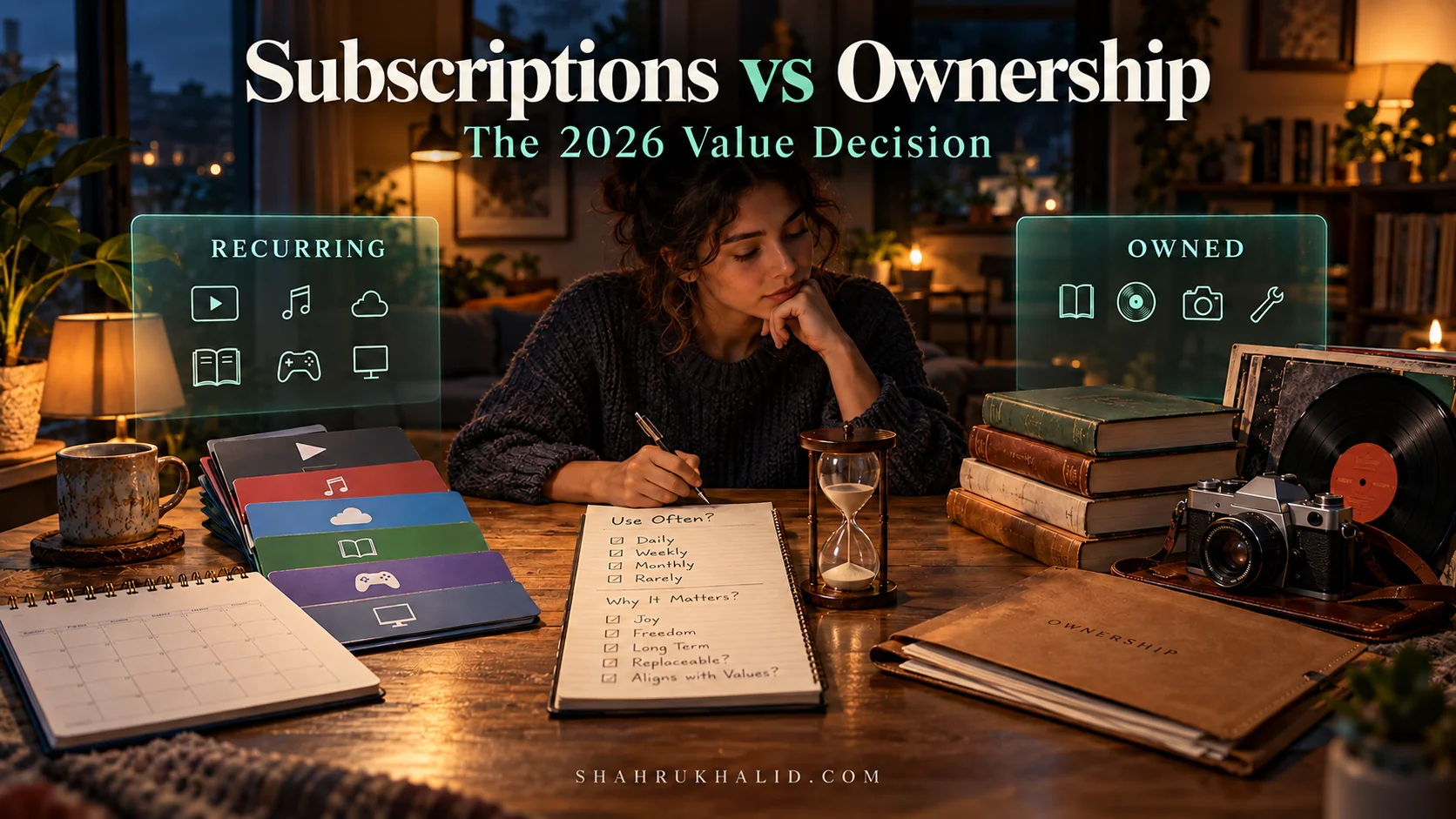
In the grand architecture of our modern consumer lives, we find ourselves at a crossroads, navigating two fundamentally different paradigms for accessing goods and services: the fluid, on-demand world of subscriptions versus the solid, enduring realm of ownership. Both have their inherent design philosophies, target paradigms, and distinct implications for our financial well-being and cognitive load. The challenge for many isn’t just picking one over the other, but understanding the underlying “architectural patterns” each represents and how they shape our daily interactions and long-term financial health.
The subscription model, at its core, is an architecture built on access, flexibility, and recurring revenue. It’s designed for continuous engagement, offering a gateway to a service or product for a periodic fee. Think of it as leasing a powerful server in the cloud: you get immediate access to immense computational power without the upfront capital expenditure of buying and maintaining the hardware. This model thrives on convenience, constant updates, and the promise of always having the latest version or an ever-expanding library of content. For software, this means automatic patches, new features delivered seamlessly, and often, cloud-based synchronization across devices. For entertainment, it’s an endless stream of movies, music, and games. This `subscription economy future` was once heralded as the ultimate consumer-friendly innovation, democratizing access to high-cost goods and services.
However, the very strengths of the subscription model have, by 2026, morphed into its most significant weaknesses, leading to widespread “subscription fatigue.” This phenomenon, characterized by consumer exhaustion and frustration from managing numerous recurring charges, has reached new heights. The average U.S. household now spends approximately $219 to $273 per month on subscriptions, significantly more than their estimated spending. This financial burden is a primary driver of cancellations. It’s akin to having dozens of microservices running in the background, each consuming a small but cumulative amount of your budget and mental bandwidth. Consumers are overwhelmed by the multitude of available services, leading to difficulty in choosing what to keep and what to cancel. This `cognitive overload and decision paralysis` means that while individual subscriptions might seem cheap, their aggregate cost and management complexity become a significant drain. The promise of flexibility turns into the burden of constant evaluation: “Do I still need this? Am I getting value?” The perceived decline in value for money is a significant factor in this fatigue, leading to feelings of guilt and dissatisfaction when paying for services rarely used.
On the other side of this architectural divide lies mindful ownership. This philosophy champions permanence, control, and the long-term accumulation of assets. It’s about investing in a product or service once, and then having full, unfettered access and control over it indefinitely. In the digital realm, this translates to buying a software license outright, purchasing digital movies or music, or owning physical books and media. For physical goods, it’s the classic model of buying a car, a piece of furniture, or a tool. The core design principle here is self-sufficiency and independence from ongoing external dependencies. You are the sole proprietor, responsible for maintenance, upgrades (if desired), and storage, but also free from recurring payments and the whims of a service provider. This approach aligns perfectly with `mindful consumption benefits`, encouraging a more deliberate and intentional approach to acquiring goods and services. It asks us to consider: “Do I truly value this enough to own it?”
The resurgence of mindful ownership is a direct response to the overwhelming reality of subscription fatigue. Founders and consumers are increasingly seeking services that produce assets rather than ongoing obligations. This includes a preference for ownership-based infrastructure models that offer stability and predictability. When you own a software license, you’re not subject to price hikes or content removal from a streaming library. When you own digital content, it’s yours to keep, even if the platform that sold it to you eventually shuts down. This desire for permanence offers a sense of security and a clear understanding of the `cost of subscription services` versus a one-time purchase. It also fosters a deeper connection with the items we possess, moving away from a transient, disposable culture.
However, mindful ownership isn’t without its own architectural considerations. The upfront `cost of ownership` can be significantly higher, acting as a barrier to entry for some. There’s also the responsibility of maintenance, storage, and managing upgrades. For software, an owned license might mean missing out on the latest features unless you pay for a new version. For digital content, ensuring long-term access might require personal backup strategies, which can be a technical hurdle for some. The “architectural showdown” isn’t about declaring a single victor, but rather understanding the optimal use cases for each model. It’s about designing a personal consumption architecture that balances immediate access with long-term value, and convenience with control. The goal is to move beyond the binary choice and embrace hybrid models that offer the best of both worlds, allowing consumers to regain control and make informed decisions about what truly serves their needs in 2026 and beyond.
Feature-by-Feature Comparison Matrix
To truly understand the implications of `Subscription vs Ownership` in 2026, we need to break down their core attributes and compare them side-by-side. This isn’t just about price; it’s about control, flexibility, long-term value, and the overall user experience. Think of this as evaluating two competing software architectures for a critical business function: each has its strengths and weaknesses across various dimensions.
Here’s a detailed feature matrix, designed to illuminate the practical differences and help you make informed decisions for your personal and professional needs.
This matrix highlights that the choice between `Subscription vs Ownership` is rarely simple. For instance, while subscriptions offer a low upfront barrier, the cumulative `cost of subscription services` can quickly spiral out of control, directly contributing to `subscription fatigue`. Imagine a small business subscribing to a dozen SaaS tools: CRM, project management, accounting, email marketing, cloud storage, design software, and more. Each might be $20-$50/month, but collectively, they represent a significant recurring outflow. A mindful approach would involve evaluating each tool against its owned counterpart, considering the total cost over several years.
For digital content, the `benefits of owning digital content` become clear when considering long-term access and control. If you’ve ever had a streaming service remove a favorite movie or TV show, you understand the frustration of rented access. Owning a digital copy, even if it’s tied to a platform like Apple TV or Amazon Prime Video, often grants more permanent access, though true independence comes from DRM-free files. This is a core tenet of `essentialism personal finance`: investing in what truly matters and provides lasting value, rather than constantly paying for ephemeral access. The decision playbook isn’t about eliminating one model entirely, but about strategically deploying each where it makes the most sense, optimizing for both financial prudence and personal satisfaction.
Performance Benchmarks & Stress-Test Evaluation
When we talk about “performance” in the context of `Subscription vs Ownership`, we’re not just measuring CPU cycles or network latency. We’re evaluating the efficiency, reliability, and resilience of each consumption model from a human perspective – how well it serves our needs, how much cognitive load it imposes, and its long-term financial “throughput.” This section delves into empirical findings and real-world stress tests that reveal the true operational costs and benefits beyond the sticker price.
Let’s first consider the “performance” of the subscription model under stress, particularly in the face of `subscription fatigue`. The data from 2026 paints a clear picture: the system is overloaded. The average U.S. household managing 11+ active subscriptions experiences significant `cognitive overload and decision paralysis`. This isn’t just an inconvenience; it’s a measurable drain on mental resources. Imagine a system administrator trying to manage 11 disparate microservices, each with its own billing cycle, login credentials, and usage patterns. The “cold start time” for deciding which streaming service has a particular movie, or which productivity app is best for a specific task, becomes a daily friction point. This constant mental overhead is a performance bottleneck for personal productivity and peace of mind.
The “throughput” of value from subscriptions is also diminishing. A significant factor in subscription fatigue is the perceived decline in value for money. Consumers often pay for services they rarely use, leading to feelings of guilt and dissatisfaction. This is like a server running at 10% utilization but still incurring 100% of the cost. The financial strain is palpable: with households spending $219 to $273 per month on subscriptions, this burden is a primary driver of cancellations. Active cancellation rates have climbed, with 47% of consumers canceling at least one subscription in 2026, up from 31% in 2024. This increased churn is a direct indicator of the subscription model failing its “stress test” for many users. Behavioral factors, rather than just price, drive most churn, highlighting the emotional and cognitive toll. Streaming services and AI subscriptions are the biggest contributors to this fatigue, driven by cost increases and rapid proliferation.
Now, let’s benchmark the “performance” of mindful ownership. Here, “throughput” is measured by the consistent, uninterrupted utility derived from an asset over its lifespan. When you own a piece of software, a digital movie, or a physical book, its “cold start time” is minimal – you access it directly, without authentication delays or content availability issues. The “latency” of access is effectively zero, as it resides on your device or in your personal library. The “load capacity” is also higher; you can use it as much as you want, whenever you want, without worrying about usage limits or throttling (unless it’s a physical item with wear and tear).
The financial “performance” of ownership, while requiring a higher upfront investment, often demonstrates superior long-term efficiency. Consider a software suite that costs $50/month as a subscription versus a one-time purchase of $600. After one year, the costs are equal. After two years, the subscription has cost $1200, while the owned version remains at $600. Over five years, the subscription costs $3000, while the owned version is still $600 (assuming no major upgrades are needed). This stark difference highlights how `mindful ownership saves money` over time, making it a powerful `consumer debt reduction strategy`. This is especially true for tools or content you use frequently and consistently. The `benefits of owning digital content` include not just cost savings but also immunity to content removal, platform changes, or price hikes.
However, ownership also has its own “stress points.” For physical goods, maintenance and potential repair costs can add to the TCO. For digital assets, the “performance” relies on your personal backup strategy and hardware longevity. If your hard drive fails and you haven’t backed up your owned software licenses or digital movies, your “asset” is effectively lost. This introduces a different kind of “maintenance burden” – the responsibility of self-management. The “upgrade path” for owned software can also be a point of friction; you might miss out on the latest features or compatibility updates unless you purchase new versions, which can feel like a mini-subscription in itself.
In a real-world stress test, the subscription model tends to buckle under the weight of too many commitments, leading to financial strain and cognitive overload. The constant need to evaluate value and manage multiple billing cycles creates a “performance hit” on personal finances and mental well-being. The ownership model, while requiring a higher initial “resource allocation,” offers more stable and predictable “performance” over the long run, with lower ongoing “operational costs” and greater resilience against external changes. The key for 2026 is to identify which “workloads” (i.e., types of services or content) are best suited for each model, optimizing for overall system efficiency and personal satisfaction. This strategic allocation is central to `essentialism personal finance`, ensuring every dollar spent delivers maximum, sustained value.
Developer Experience, Tooling Ecosystem & DX Showdown
When we evaluate `Subscription vs Ownership` from the lens of “Developer Experience” (DX), we’re essentially asking: how easy, intuitive, and friction-free is it for you, the consumer, to interact with, manage, and derive value from these models? This isn’t about writing code, but about the “user experience” of being a consumer in these two distinct ecosystems. It encompasses everything from onboarding and daily usage to troubleshooting and offboarding (cancellation or disposal).
Let’s start with the “DX” of the subscription model. The initial experience is often designed to be incredibly smooth, almost frictionless. Signing up for a new streaming service, a SaaS tool, or an AI subscription is typically a matter of a few clicks, an email, and credit card details. The “CLI ease of use” (metaphorically speaking, the user interface) is often polished, intuitive, and designed for immediate gratification. You get instant access to a vast library of content or a powerful suite of tools. The “tooling ecosystem” provided by subscription services often includes sleek apps, web dashboards, and integrated billing management, all aimed at making your life easier. This is the allure of the `subscription economy future`: convenience at your fingertips.
However, the “DX” quickly degrades as `subscription fatigue` sets in. The “documentation quality” for managing multiple subscriptions is non-existent because each service operates in its own silo. There’s no central dashboard to view all your recurring charges, usage patterns, or cancellation policies across different providers. This leads to significant “debugging ergonomics” challenges. When you see an unfamiliar charge on your bank statement, trying to trace it back to a specific subscription, remember your login, navigate a labyrinthine cancellation process, or even just pause a service, becomes a frustrating ordeal. Many services intentionally make cancellation difficult, a dark pattern that further exacerbates `cognitive overload and decision paralysis`. The “learning curve” for managing a portfolio of subscriptions becomes steep and irritating, a far cry from the initial ease of signing up. This is where the `cost of subscription services` extends beyond monetary value to include the hidden cost of mental effort and frustration.
Consider the real-world scenario: you’ve signed up for a free trial, forgotten about it, and now you’re being charged. Or you’re paying for three streaming services but only actively using one. The “tooling” to identify these redundancies and manage them efficiently is conspicuously absent from the consumer side. Services like LowerMySubs.com or CancelSubscriptionsApp.com have emerged precisely to address this gap, acting as third-party “developer tools” to help consumers “debug” their subscription sprawl. They highlight how broken the native DX is for managing the aggregate subscription experience. The lack of `flexibility` in rigid subscription plans, where pausing or temporarily downgrading isn’t an option, further contributes to a poor DX, often forcing outright cancellation rather than retention.
Now, let’s pivot to the “DX” of mindful ownership. The initial “CLI ease of use” might be perceived as higher. Purchasing a perpetual software license, for example, often involves a more deliberate process than a quick subscription signup. You might need to download an installer, manage a license key, or understand system requirements. The “learning curve” for initial setup can be steeper. However, once owned, the “DX” shifts dramatically. You have full control. There’s no recurring billing to manage, no fear of content disappearing, and no complex cancellation process because there’s nothing to cancel. The “tooling ecosystem” for owned assets is often your operating system’s file manager, your backup software, and potentially community forums for support.
The “debugging ergonomics” for owned assets are different. If a piece of owned software stops working, you troubleshoot it locally, or seek support for that specific version. If a digital movie file is corrupted, you rely on your backup. While this requires more personal responsibility, it also offers greater transparency and direct control over the solution. The `benefits of owning digital content` are deeply tied to this sense of autonomy. You’re not at the mercy of a service provider’s changing terms or disappearing content libraries. The “documentation quality” for owned software is often robust, focusing on installation, configuration, and troubleshooting specific versions.
For physical goods, the “DX” of ownership is even more tangible. You buy a book, you own it. You can lend it, resell it, or keep it forever. There’s no “subscription” to the book’s content. The “tooling” is simply your bookshelf. The “learning curve” is minimal. The “debugging” might involve repairing a torn page or dusting it off. This direct, tangible interaction fosters `mindful consumption benefits` and aligns with `essentialism personal finance`, where each acquisition is a deliberate, valued addition to your personal “asset library.”
In summary, while subscriptions offer a superior initial onboarding “DX” and effortless updates, their long-term management “DX” is plagued by fragmentation, cognitive load, and often user-hostile cancellation processes. Ownership, conversely, might have a slightly higher initial “learning curve” or setup “latency,” but it delivers a far more stable, predictable, and empowering “DX” over the long haul, free from recurring financial and mental burdens. The showdown reveals that the true “developer experience” for consumers isn’t just about ease of access, but about sustained control, clarity, and peace of mind.
Enterprise Scalability, Total Cost of Ownership (TCO) & Security
When we elevate our perspective from individual consumer choices to the considerations of an “enterprise” – whether that’s a small business, a large corporation, or even a well-managed household budget – the concepts of scalability, Total Cost of Ownership (TCO), and security become paramount. These factors often dictate long-term viability and financial prudence, moving beyond immediate convenience to strategic planning.
Let’s first examine the `Subscription vs Ownership` models through the lens of Enterprise Scalability.
For subscriptions, scalability is often touted as a major advantage. Need more users for your CRM? Add licenses. Need more storage for your cloud service? Upgrade your plan. This “elasticity” allows businesses to scale up or down quickly, theoretically paying only for what they use. This is akin to cloud computing’s promise of infinite resources on demand. In the context of the `subscription economy future`, this agility is powerful. However, this scalability comes with a significant caveat: each additional “unit” (user, GB, feature) directly translates to an increased recurring cost. While individual subscriptions might seem like a low-friction way to scale, the aggregate effect can lead to “subscription sprawl” – a chaotic collection of services that are difficult to track and optimize. This contributes directly to `subscription fatigue` at an organizational level, where finance departments struggle to reconcile invoices and IT departments grapple with managing multiple vendor relationships and access controls. The ease of adding subscriptions can mask the true, rapidly escalating `cost of subscription services`.
Mindful ownership, on the other hand, approaches scalability differently. For software, buying perpetual licenses means you own the right to use that software indefinitely for a fixed number of users or installations. Scaling up often means buying more licenses, which is a predictable, one-time capital expenditure rather than an ongoing operational expense. For physical assets, scalability might involve purchasing additional equipment as needed. While this requires more upfront planning and capital, it provides cost predictability and avoids the compounding effect of recurring fees. The “scalability” here is about controlled growth with fixed assets, rather than elastic, variable expenses. This aligns with `essentialism personal finance` by encouraging deliberate, asset-building investments.
Next, let’s dive into Total Cost of Ownership (TCO), a critical metric for any “enterprise.”
For subscriptions, calculating TCO is deceptively complex. The initial low monthly fee often obscures the long-term financial burden. TCO for subscriptions must include:
- Direct Recurring Fees: The obvious monthly/annual charges.
- Price Hikes: Providers frequently increase prices, often annually.
- Hidden Costs: Transaction fees, overage charges, premium feature unlocks.
- Management Overhead: Time spent by employees managing accounts, billing, and cancellations (a direct consequence of `cognitive overload and decision paralysis`).
- Exit Costs: The difficulty and potential cost of migrating data if you decide to cancel and switch providers (vendor lock-in).
The average U.S. household now spends approximately $219 to $273 per month on subscriptions, significantly more than their estimated spending. For an enterprise, these figures multiply rapidly. Over a 3-5 year period, the cumulative `cost of subscription services` can far exceed the one-time purchase price of an owned alternative, even when factoring in potential upgrade costs for owned software. This financial burden is a primary driver of cancellations and a key component of `subscription fatigue`.
For mindful ownership, TCO is generally more transparent and predictable:
- Upfront Purchase Price: The initial capital outlay.
- Maintenance Costs: Repairs, physical upkeep, or annual support contracts (if applicable).
- Upgrade Costs: The cost of purchasing new versions of software or replacing physical assets.
- Depreciation/Resale Value: The asset’s value over time, which can offset some TCO.
- Self-Management Overhead: Time spent on backups, security, and local troubleshooting.
While the initial investment is higher, the absence of recurring fees often results in a lower TCO over the asset’s useful life. This is where `mindful ownership saves money` and contributes significantly to `consumer debt reduction strategies` by converting ongoing expenses into one-time investments. The `benefits of owning digital content` are particularly evident here, as digital assets often have zero ongoing maintenance costs once acquired, beyond personal backup.
Finally, let’s address Security.
In the subscription model, security is largely delegated to the service provider. Your data resides on their servers, and you rely on their infrastructure, encryption, and compliance certifications. While reputable providers invest heavily in security, this also represents a single point of failure and a loss of direct control. Data breaches at major subscription services are a recurring concern, impacting millions of users. Furthermore, managing multiple logins and passwords for numerous subscriptions increases the attack surface for phishing and credential stuffing attacks, exacerbating `cognitive overload and decision paralysis` for users trying to maintain strong security hygiene.
For mindful ownership, especially concerning `digital ownership vs subscription`, security responsibility shifts to you. For software, this means ensuring your local machine is secure, keeping your operating system patched, and implementing robust backup strategies. For physical assets, it’s about physical security and insurance. While this requires more proactive effort, it also grants you ultimate control over your data and assets. You decide where your data resides, how it’s encrypted, and who has access. This can be a significant advantage for sensitive data or for individuals and organizations with strict privacy requirements. The trade-off is the burden of expertise and implementation.
In essence, the enterprise perspective reveals that while subscriptions offer immediate agility and offload some operational burdens, they introduce significant long-term TCO risks and security dependencies. Mindful ownership, conversely, demands higher upfront investment and self-management but delivers greater cost predictability, long-term financial efficiency, and direct control over security and data. The strategic choice hinges on balancing agility with control, and recurring operational costs with capital investments, always with an eye on the true, long-term value proposition.
The Decision Playbook: When to Choose Subscription vs. Ownership
Navigating the complex terrain of `Subscription vs Ownership` in 2026 requires more than just understanding the differences; it demands a practical decision playbook. This isn’t about declaring a universal winner, but about making informed, intentional choices that align with your specific needs, usage patterns, and financial goals. The goal is to overcome `subscription fatigue` and embrace `mindful consumption benefits` by strategically deploying each model.
Let’s break down the scenarios where each model shines, providing clear guidance on when to choose one over the other, and offering actionable advice for a more `essentialism personal finance` approach.
Choose Subscription If:
- You need temporary or infrequent access: For services or content you’ll only use for a short period, or very occasionally, a subscription is often more cost-effective. Think about a specific software tool for a one-off project, a streaming service for a single popular show, or a gym membership you’ll only use for a few months. The low upfront `cost of subscription services` makes it ideal for transient needs.
- Example: You need Adobe Photoshop for a single client project that lasts three months. Subscribing for three months is far cheaper than buying a perpetual license (if one were even available for the latest version).
- You require constant updates and cutting-edge features: Many software tools, especially in rapidly evolving fields like AI, design, or cybersecurity, benefit from continuous updates, patches, and new features. Subscriptions guarantee you always have the latest version without additional purchases.
- Example: AI subscriptions are proliferating rapidly. If your work depends on the latest large language models or generative AI features, a subscription ensures you’re always on the cutting edge.
- You value convenience and managed services: If you prefer to offload maintenance, upgrades, and technical support to a third party, subscriptions are often the way to go. Cloud storage, managed hosting, or comprehensive security suites fall into this category.
- Example: For cloud storage, the convenience of automatic syncing, backups, and cross-device access often outweighs the desire for local ownership of all data, especially for non-critical files.
- The upfront cost of ownership is prohibitive: For very expensive software suites or specialized equipment, a subscription can democratize access, allowing you to use tools you otherwise couldn’t afford.
- Example: High-end 3D modeling software or professional video editing suites can cost thousands for a perpetual license. A monthly subscription makes them accessible to freelancers and small studios.
- You want to “try before you buy” (or commit): Many subscriptions offer free trials or short-term commitments, allowing you to evaluate a service thoroughly before making a larger investment or committing to a longer-term plan.
- Actionable Advice: Always set a calendar reminder to review or cancel trials before they convert to paid subscriptions. This helps `avoid subscription fatigue`.
Choose Mindful Ownership If:
- You need permanent, uninterrupted access: For essential tools, foundational content, or critical data, ownership provides unparalleled control and guarantees long-term access, free from provider changes or content removal. This directly addresses the `benefits of owning digital content`.
- Example: Your personal photo library, important documents, or classic movies/music you re-watch/listen to frequently. Owning these ensures they’re always available, regardless of streaming service changes.
- The long-term TCO is lower: For products or services you use consistently over many years, the cumulative `cost of subscription services` often far exceeds a one-time purchase. Calculate the TCO over 3-5 years.
- Example: A productivity suite like Microsoft Office (if you can find a perpetual license for your needs) or a niche software tool you use daily for a decade. The initial investment pays off significantly. This is a core `consumer debt reduction strategy`.
- You prioritize autonomy and control: If vendor lock-in, data portability, or reliance on external providers are concerns, ownership gives you ultimate control over your assets, data, and usage terms. This is the essence of `digital ownership vs subscription`.
- Example: Using open-source software that you can self-host and modify, or buying DRM-free digital books. You control the environment and the content.
- Resale value or transferability is important: For physical goods or transferable digital licenses, ownership allows you to recoup some of your initial investment or pass the asset on, extending its lifecycle and value.
- Example: Selling a used video game, a camera lens, or even a software license (if permitted) when you no longer need it. This is a tangible `mindful consumption benefit`.
- You prefer a fixed, predictable budget: Ownership converts variable, recurring expenses into predictable capital expenditures, simplifying budgeting and financial planning.
- Actionable Advice: For software, consider older, stable versions of tools. Do you truly need the absolute latest features, or will a version from a couple of years ago suffice perfectly for your core tasks? Often, the answer is the latter, saving you significant money.
Actionable Migration Advice & Overcoming Subscription Fatigue in 2026:
- Audit Everything: The first step to `overcoming subscription fatigue in 2026` is to know what you’re paying for. Use financial tracking apps or manually review bank statements for recurring charges. Identify services you rarely use or have forgotten about. This addresses the `cognitive overload and decision paralysis`.
- Prioritize & Prune: Categorize your subscriptions into “Essential,” “Valuable but Optional,” and “Rarely Used.” Ruthlessly cancel the “Rarely Used” ones. For “Valuable but Optional,” consider pausing if the service allows, or rotating them (e.g., subscribe to Netflix for a month, then cancel and subscribe to Disney+ the next).
- Calculate True TCO: For every “Essential” or “Valuable” service, compare its cumulative subscription cost over 3-5 years against the cost of an owned alternative. This will reveal where `mindful ownership saves money`.
- Embrace Hybrid Models: The most effective approach in 2026 is often a hybrid. Subscribe to services that genuinely offer dynamic, frequently updated content (e.g., news, certain AI tools) or for short-term needs. Own the foundational tools, critical content, and physical assets that provide long-term, stable value.
- Seek Alternatives: For software, explore open-source alternatives (e.g., GIMP instead of Photoshop, LibreOffice instead of Microsoft Office) that offer perpetual ownership and often robust communities. For media, consider libraries (physical and digital) or purchasing used physical copies.
- Budget for Ownership: If you decide to own, factor the upfront cost into your financial planning. This might mean saving up for a larger purchase, but it’s an investment that reduces future recurring expenses, aligning with `consumer debt reduction strategies`.
- Review Annually: Just as you’d review a project’s architecture, make an annual review of your `Subscription vs Ownership` portfolio. Needs change, and so should your consumption strategy.
By adopting this decision playbook, you can move beyond the reactive cycle of `subscription fatigue` and cultivate a more intentional, financially sound, and personally empowering approach to consuming goods and services in 2026. It’s about designing a personal economy that serves you, not the other way around.