AI-Curated Life vs. Your Own Intuition in 2026: The Practical Guide to Living *Your* Best Story
Key Takeaways
- The core challenge in 2026 is integrating AI-curated guidance with personal intuition for life decisions.
- AI-curated life champions efficiency, measurable outcomes, and external optimization via data and algorithms.
- Intuition offers internal alignment, authentic self-expression, and deep meaning from lived experience.
- AI's appeal lies in offloading cognitive load, promising streamlined efficiency and infallible, data-driven logic.
- Intuition processes information emotionally, experientially, and connects to core values beyond quantifiable metrics.
Navigating the complexities of modern existence feels increasingly like architecting a personal operating system. In 2026, two dominant paradigms vie for control over our life’s most critical decisions: the meticulously calculated guidance of AI-curated systems and the deeply personal, often enigmatic, wisdom of our own intuition. This isn’t merely a philosophical debate; it’s a practical showdown influencing everything from our career paths and financial strategies to our relationships and daily well-being. Understanding which approach to prioritize, or more importantly, how to integrate them, is paramount to crafting a life that truly resonates as *your* best story.
The Architectural Showdown: Core Philosophies & Overview
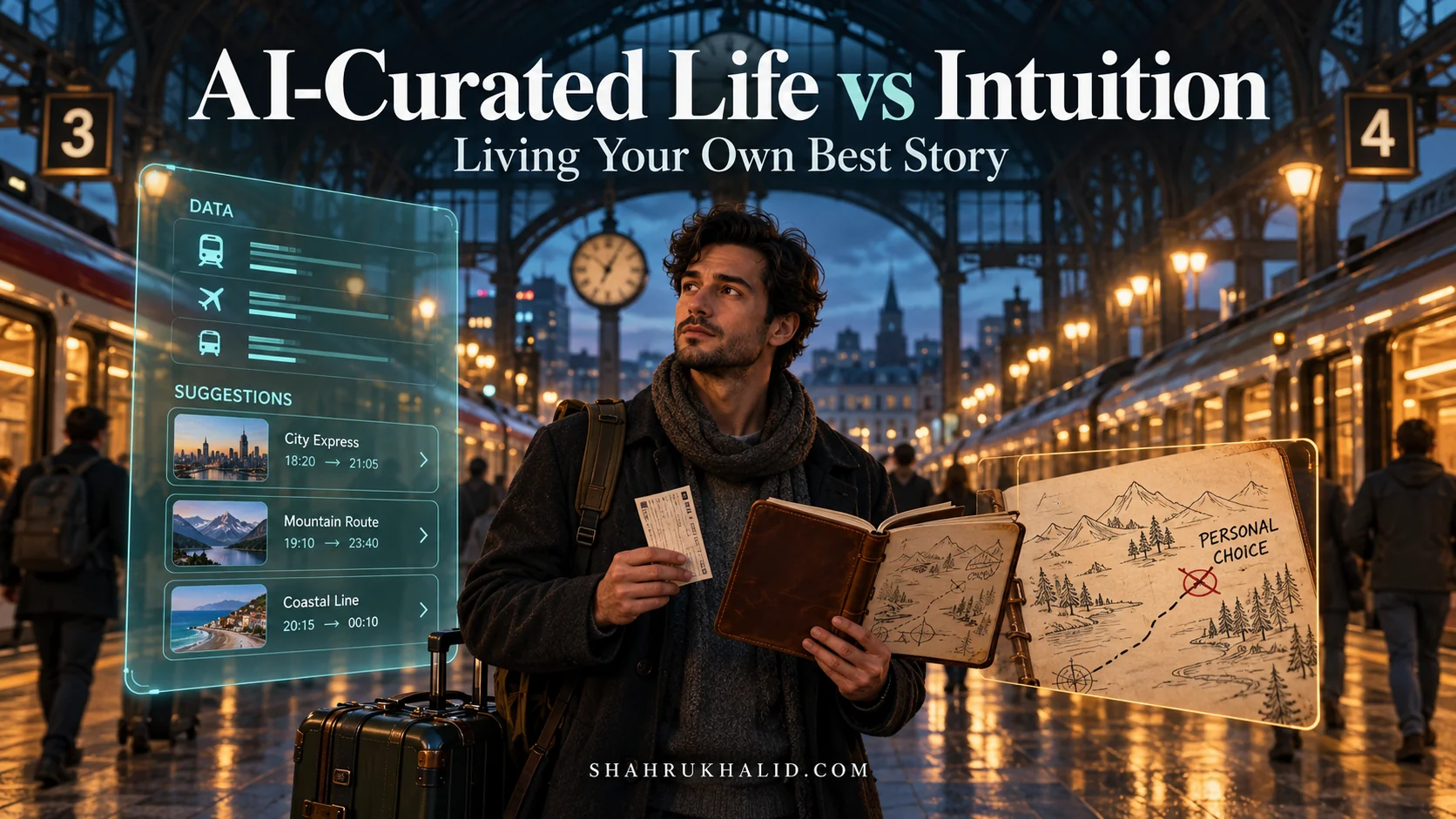
In the grand architecture of personal fulfillment, we stand at a crossroads, evaluating two profoundly different design philosophies for living. On one side, we have the AI-Curated Life, a system built on the bedrock of data, algorithms, and predictive analytics. Imagine a hyper-efficient, constantly optimizing personal assistant, meticulously observing your patterns, preferences, and external data points to recommend the “optimal” path forward. This approach champions efficiency, measurable outcomes, and the eradication of uncertainty. Its core design principle is external optimization: by processing vast datasets – from your digital footprint to global trends – it aims to identify and present the most logical, statistically probable, or financially beneficial choices. Proponents argue that in an increasingly complex world, offloading decision-making to a superior intelligence frees up cognitive load, leading to demonstrably better results in areas like financial planning, health management, or even career trajectory. The target paradigm here is a life of streamlined efficiency, where friction is minimized, and progress is quantifiable. Teams (or individuals) often struggle with this choice because the allure of data-driven certainty is powerful, promising to eliminate regret and maximize potential by sidestepping human error. It offers a seductive vision of a life devoid of missteps, guided by infallible logic.
On the opposing side, we encounter the philosophy of Your Own Intuition. This is an internal, organic system, developed over a lifetime of experiences, observations, and subconscious processing. It’s less about external data points and more about internal resonance – that “gut feeling,” that sudden flash of insight, or the quiet knowing that emerges without a clear logical chain. The core design principle of intuition is internal alignment and holistic understanding. It processes information not just logically, but emotionally, experientially, and often with a profound connection to our core values and long-term aspirations that might not be easily quantifiable by an algorithm. The target paradigm here is a life of authentic self-expression, deep meaning, and personal agency, where decisions are rooted in a sense of inner truth rather than external validation or statistical probability. While AI promises to optimize for *what works*, intuition often guides us towards *what feels right*, even if the immediate logical benefits aren’t apparent. The challenge for individuals considering this path is that intuition can be elusive, sometimes contradictory, and often requires a leap of faith. In a world that increasingly values data and proof, trusting an unquantifiable inner voice can feel risky.
The tension between these two “architectural approaches” is palpable. The AI-curated life offers a compelling promise of objective optimization. It leverages vast computational power to identify patterns and predict outcomes with a precision that human cognition simply cannot match. For instance, an AI might analyze your spending habits, market trends, and personal goals to recommend an investment strategy that maximizes returns while minimizing risk, far beyond what a human financial advisor or your own back-of-the-envelope calculations could achieve. Or it might suggest a career pivot based on skill adjacencies, industry growth, and your personality profile, identifying opportunities you might never have considered. This approach often integrates seamlessly with existing digital platforms, drawing data from your calendar, fitness trackers, and communication apps to paint a comprehensive picture. For those developing an AI system, the objective is often to create a model that predicts human behavior or preferences with high accuracy, often measured by metrics like precision, recall, or F1 score in machine learning contexts, as detailed in resources like Google’s AI development documentation, which emphasizes robust model evaluation.
Conversely, intuition, while less “measurable” in a traditional sense, offers a depth of understanding rooted in personal context and emotional intelligence. It’s the feeling that a particular job, despite appearing perfect on paper (AI-approved!), just isn’t “right” for you, or the spontaneous decision to take a different route home that leads to an unexpected, meaningful encounter. Intuition often arises from the subconscious processing of countless micro-observations and experiences, synthesizing them into a holistic “hunch” or “insight.” It taps into our embodied knowledge, our values, and our unique individual narratives, which are inherently difficult for an external system to fully comprehend or quantify. The struggle for many is that while AI offers a clear, actionable output, intuition often provides a subtle nudge, a feeling to explore, or a direction to consider, requiring personal interpretation and courage. The allure of certainty from AI can overshadow the subtle wisdom of intuition, leading many to default to the algorithm, even when an inner voice whispers otherwise. The true challenge lies not in choosing one over the other, but in understanding their unique strengths and weaknesses, and then designing a personal operating system that intelligently integrates both, allowing them to complement rather than contradict each other, ultimately empowering you to live *your* best story, not just the most efficient one. This foundational understanding is crucial before diving into the specifics of their operational differences.
Feature-by-Feature Comparison Matrix
When we approach the question of an AI-curated life versus one driven by intuition as a technical architect evaluating competing solutions, a feature matrix becomes indispensable. It allows us to systematically break down their capabilities, limitations, and operational characteristics. This isn’t about declaring a definitive “winner,” but rather understanding where each excels and where they might fall short, much like comparing different database systems for a specific application.
Here’s a detailed comparison matrix outlining key dimensions for both the AI-Curated Life (ACL) and the Intuition-Driven Life (IDL) in 2026:
This matrix reveals a fundamental divergence. The AI-Curated Life, with its ultra-low decision latency and high scalability, is a marvel of modern engineering for optimizing definable metrics. Think of it as a finely tuned machine learning model that can instantly process millions of data points to suggest the optimal route, the best stock to buy, or the most efficient study plan. It excels where objectivity, speed, and sheer data processing power are paramount. However, its heavy data dependency means it’s only as good as the information it consumes, and its “black box” nature can lead to recommendations whose underlying logic is opaque to the user. This raises significant concerns about personal agency AI and the future of human choice if we blindly follow these opaque recommendations.
On the other hand, the Intuition-Driven Life, while potentially slower and less externally scalable, offers unparalleled depth in areas of personal relevance, ethical alignment, and adaptability to novel situations. Its “memory footprint” is entirely internal, requiring continuous self-reflection and development. It’s universally accessible, costing only the investment in self-awareness. When faced with a truly unique personal dilemma – say, whether to pursue a passion project that has no clear financial return, or to forgive someone who has wronged you – intuition often provides a more nuanced, deeply resonant answer than any algorithm could. This is where the digital life balance truly comes into play; relying solely on AI might lead to an objectively “optimized” life that feels subjectively hollow. The “licensing” for intuition isn’t a subscription fee, but rather the continuous practice of mindfulness and self-trust, building a robust internal framework for decision-making, which is a core aspect of developing intuition in an AI world. The ethical implications of AI decision making also highlight the importance of intuition, as algorithms can inadvertently embed and perpetuate societal biases, making personal ethical judgment a vital counter-balance. The challenge then is not to reject one in favor of the other, but to understand when each “feature set” is most appropriate, creating a powerful hybrid approach for navigating life’s complex terrain.
Performance Benchmarks & Stress-Test Evaluation
When evaluating systems in a production environment, raw performance metrics and stress-test evaluations are critical. For the ‘AI vs Intuition’ showdown, these benchmarks translate into how effectively each approach delivers desired life outcomes under various pressures and conditions. We’re looking at empirical throughput (how many decisions can be processed and acted upon), load capacity (how well it handles complex, multi-faceted problems), cold start times (how quickly it can adapt to new, unforeseen situations), and real-world benchmark findings in terms of personal fulfillment and objective success.
Let’s begin with the AI-Curated Life. Its throughput is undeniably high. An AI system can process millions of data points, analyze trends, and generate recommendations across multiple life domains (finance, health, career, social scheduling) in milliseconds. Imagine an AI financial advisor automatically rebalancing your portfolio based on real-time market fluctuations, or a health AI adjusting your diet and exercise plan daily based on your biometric data and sleep quality. The “load capacity” is immense; it thrives on complexity, synthesizing disparate information sources that would overwhelm human cognition. Want to optimize your commute, manage multiple project deadlines, and find the perfect gift for a distant relative, all while learning a new language? An AI can juggle these tasks with ease, offering immediate, data-backed solutions. Cold start times, however, reveal a vulnerability. While AI can quickly generate a recommendation for a known problem, truly novel situations—those entirely outside its training data—can cause it to falter. If you suddenly decide to move to a remote village with no digital footprint, or pursue an entirely new, unconventional passion for which no historical data exists, the AI might struggle to provide meaningful guidance, potentially defaulting to generic advice or even “hallucinating” plausible but irrelevant solutions. This is where the ethical considerations of AI decision making become stark; relying solely on an AI that lacks context for novel human experiences can lead to a sense of disconnect from one’s authentic path. Real-world benchmarks for AI often show impressive gains in efficiency and objective metrics: individuals using AI for financial planning often report higher savings rates, health app users might show improved fitness metrics, and AI-driven learning platforms can demonstrably accelerate skill acquisition. These are powerful, quantifiable results that speak to the system’s performance in specific, measurable domains.
Now, consider Your Own Intuition. Its throughput is highly variable. Sometimes, a gut feeling can lead to an instantaneous, correct decision, like knowing not to take a particular flight or trusting a stranger. Other times, intuition requires incubation – a period of reflection, sleep, or even distraction, allowing the subconscious to process information and surface an insight. This is a slower, less predictable throughput compared to AI’s algorithmic speed. Its load capacity also differs fundamentally. While an AI crunches numbers, intuition synthesizes experiences, emotions, and values. It excels at complex, *human-centric* problems where objective data is scarce or irrelevant, such as choosing a life partner, deciding on a creative project, or navigating a moral dilemma. It can handle the “load” of ambiguity and emotional nuance far better than any current AI. However, it can be overloaded by sheer informational complexity if the individual hasn’t developed strong self-awareness practices. Cold start times for intuition are surprisingly robust in certain respects. Because it draws on deep, often subconscious pattern recognition and an understanding of one’s core values, intuition can offer surprisingly accurate guidance in entirely novel situations, provided those situations resonate with underlying human experiences or personal values. It’s the “aha!” moment that transcends data. For example, in a crisis, a person’s intuition might guide them to an unconventional solution that an AI, limited by its training data on past crises, would never suggest. Real-world benchmarks for intuition are harder to quantify but manifest as deep personal satisfaction, a sense of alignment, and resilience. People who trust their intuition often report greater job satisfaction, more authentic relationships, and a stronger sense of purpose, even if their objective metrics (like income or social media followers) aren’t always “maximized” by an algorithm. This speaks directly to the question: Is an AI-curated life truly fulfilling? The benchmarks suggest that while AI optimizes for external success, intuition often optimizes for internal fulfillment.
A critical stress test for both systems is the “black swan” event – an unpredictable, high-impact occurrence. An AI, designed to operate within statistical probabilities, can struggle profoundly when faced with something truly outside its probabilistic models. Its recommendations might become irrelevant or even harmful. For instance, during a global pandemic, an AI trained on pre-pandemic data might give flawed travel or investment advice. Intuition, while not immune to stress, can leverage adaptive human intelligence and emotional resilience. It allows for creative problem-solving and a flexible response to the unknown, drawing on a deeper well of human experience and the ability to connect seemingly disparate pieces of information. This highlights a crucial aspect of personal agency AI: the ability to override or contextualize AI recommendations with human judgment. The future of human choice hinges on our ability to discern when the swift, data-driven insights of AI are most valuable, and when the slower, deeper wisdom of our intuition is indispensable. Integrating both, where AI provides the objective data analysis and intuition offers the subjective, values-aligned interpretation, creates a far more resilient and fulfilling “personal operating system.” This balance is essential for living *your* best story in an increasingly unpredictable world.
Developer Experience, Tooling Ecosystem & DX Showdown
In the realm of personal development and decision-making, the “Developer Experience” (DX) translates to how easy, intuitive, and supportive the process is for an individual to implement and maintain either an AI-curated life or one guided by intuition. It encompasses everything from the ease of initial setup and ongoing interaction to the quality of feedback and the availability of support resources.
For the AI-Curated Life, the DX is characterized by a sleek, often automated, and seemingly effortless onboarding process. Think of signing up for a new financial planning app, a personalized learning platform, or a smart health tracker. The “CLI ease of use” (Command Line Interface, or in this analogy, the user interface and interaction model) is typically high. Modern AI tools strive for intuitive graphical interfaces, natural language processing for queries, and seamless integrations with existing digital ecosystems. You might simply connect your bank accounts, calendar, and fitness apps, and the AI immediately begins to generate insights and recommendations. The “documentation quality” for these systems often comes in the form of in-app tutorials, help sections, and responsive customer support, guiding users through features and troubleshooting common issues. For instance, platforms that leverage advanced AI, such as those discussed in Shahrukh Khalid’s insights on user-centric platform design, often prioritize ease of integration and clear feedback loops to enhance user experience.
Debugging ergonomics for an AI-curated life involves understanding *why* an AI made a particular recommendation. This can range from straightforward explanations (“You’re over budget because of these transactions”) to complex “black box” scenarios where the underlying algorithm is opaque. Some advanced AI systems are developing explainable AI (XAI) features to provide more transparent reasoning, but often, users are asked to simply trust the algorithm. The “learning curve” for adopting an AI-curated life is generally low for basic usage; the AI often adapts to *you*. However, mastering the nuances of AI interaction, understanding its limitations, and critically evaluating its suggestions—rather than blindly following them—requires a higher level of digital literacy and critical thinking. The “tooling ecosystem” is vast, encompassing everything from specialized apps for niche areas (e.g., meal prep, meditation, habit tracking) to comprehensive personal AI assistants that attempt to orchestrate multiple aspects of your life. The promise is that these tools will simplify your life, providing a smooth, optimized ride.
Now, let’s look at the DX for Your Own Intuition. This is a fundamentally different experience. The “CLI ease of use” is not about a digital interface, but about internal practices. It involves developing self-awareness through journaling, mindfulness meditation, self-reflection exercises, and even spending time in nature. There’s no single “onboarding” button; it’s a continuous, iterative process. The “documentation quality” is personal and experiential. It comes from observing your own reactions, understanding your values, and learning from past successes and failures. It’s about building an internal library of wisdom. Debugging ergonomics for intuition involves introspective work: asking *why* you feel a certain way, tracing the origins of a gut feeling, and challenging internal biases. This can be a challenging, sometimes uncomfortable process, requiring emotional intelligence and a willingness to confront oneself. There are no instant “error messages” or “logs” to review; instead, it’s a process of deep self-inquiry and pattern recognition within your own psyche.
The “learning curve” for developing intuition is initially steep because it requires consistent effort and a shift in mindset from external validation to internal trust. It’s not about passively receiving recommendations but actively cultivating an inner compass. The “tooling ecosystem” for intuition is less about software and more about practices: mindfulness apps (used as tools to *support* intuition, not replace it), therapy, coaching, creative expression, and cultivating diverse real-world experiences. It’s about enriching the input to your internal processing system. The core difference in DX is that AI aims to *reduce* your cognitive load by providing answers, while intuition aims to *enhance* your cognitive and emotional capacities to *find* your own answers. While AI offers convenience and efficiency, developing intuition offers a profound sense of personal mastery and resilience, especially in the face of unique, emotionally charged situations where AI decision making might fall short. The beauty lies in the potential for synergy: using AI tools to manage the mundane and complex data-driven tasks, thereby freeing up mental and emotional bandwidth to cultivate and listen to your intuition for the truly important, values-aligned decisions. This balance is key to avoiding a life that is merely optimized but lacks soul, ensuring that your personal agency AI remains at the helm.
Enterprise Scalability, Total Cost of Ownership (TCO) & Security
When evaluating any system for long-term deployment, particularly one affecting something as critical as a human life, considerations of enterprise scalability, total cost of ownership (TCO), and security move to the forefront. These factors determine the sustainability, accessibility, and resilience of our chosen “personal operating system.”
For the AI-Curated Life, scalability is often its greatest strength. Modern AI systems are designed to handle vast amounts of data and complex computations for millions, even billions, of users. From a technical standpoint, the underlying infrastructure of cloud computing allows AI services to scale on demand, processing ever-increasing streams of personal data, market trends, and global information without degradation in performance. This means an AI can theoretically optimize every aspect of your life—from personalized learning paths to global career moves and intricate financial strategies—without hitting a computational bottleneck. The “maintenance burden” is largely externalized; you rely on the AI providers to update algorithms, maintain servers, and ensure data integrity. However, this externalization introduces its own complexities.
The Total Cost of Ownership (TCO) for an AI-Curated Life extends beyond simple subscription fees. It includes the implicit cost of data exchange – trading personal information for “free” or subsidized services. There’s also the potential for vendor lock-in, where switching AI providers becomes costly and disruptive due to data migration challenges or proprietary formats. Cloud infrastructure hosting costs, while not directly borne by the end-user, are baked into subscription models, making advanced, comprehensive AI curation potentially expensive over time. More critically, the TCO includes the *cognitive cost* of constantly managing and validating AI recommendations, ensuring they align with your evolving values, and guarding against algorithmic bias. Enterprise compliance, in this context, refers to the ethical and regulatory frameworks governing AI. As discussed in Google’s AI principles, ensuring fairness, transparency, and accountability is paramount. Failure to adhere to these principles can lead to algorithmic discrimination or unintended negative consequences, impacting the “compliance” of your AI-curated life with your own moral standards.
Security for an AI-Curated Life is a paramount concern. With vast amounts of personal data aggregated and analyzed, the risk of data breaches, identity theft, or manipulative targeting is ever-present. Your digital life balance hinges on robust cybersecurity measures. Furthermore, the long-term tech debt isn’t just about outdated software; it’s about the potential erosion of personal agency. Over-reliance on AI can lead to a “use it or lose it” scenario for critical thinking and intuitive decision-making skills. The more we outsource our choices, the less adept we may become at making them ourselves, creating a dependency that is difficult to reverse. This is a profound challenge to the future of human choice.
In contrast, Your Own Intuition offers a fundamentally different TCO and security profile. Scalability, while not in the traditional “enterprise” sense of processing external data, refers to its capacity to handle increasingly complex personal and emotional landscapes. As you develop your intuition, its “bandwidth” for insight and wisdom grows, allowing you to navigate more nuanced life decisions. The “maintenance burden” is entirely internal: continuous self-reflection, mindfulness practices, and experiential learning. There are no external servers to maintain, no software updates to download.
The TCO for intuition is primarily an investment of time, effort, and self-awareness. It’s “free” in monetary terms but demands significant personal commitment. There’s no vendor lock-in, as your intuition is intrinsically yours. Cloud infrastructure costs are zero, as it operates entirely within your own cognitive and emotional architecture. Enterprise compliance, in this context, means aligning with your deepest values and ethical compass. It’s about developing an internal moral framework that guides your decisions, a process that is inherently personalized and resistant to external manipulation. This directly addresses the AI ethics personal dimension, positioning intuition as a vital safeguard.
Security for intuition is intrinsic. Your inner wisdom is not susceptible to data breaches or external hacking in the same way digital systems are. While your intuition can be influenced by external factors or personal biases, it remains an internal, private resource. The long-term tech debt for intuition is minimal; in fact, it’s an asset that compounds over time. The more you use and refine your intuition, the stronger and more reliable it becomes, enhancing your personal agency AI and resilience. The crucial insight here is that while AI offers external scalability and efficiency, it comes with significant TCO and security trade-offs related to data, vendor dependency, and potential erosion of personal skills. Intuition, while requiring internal investment, offers unparalleled intrinsic security, zero monetary cost, and a compounding personal asset, making it